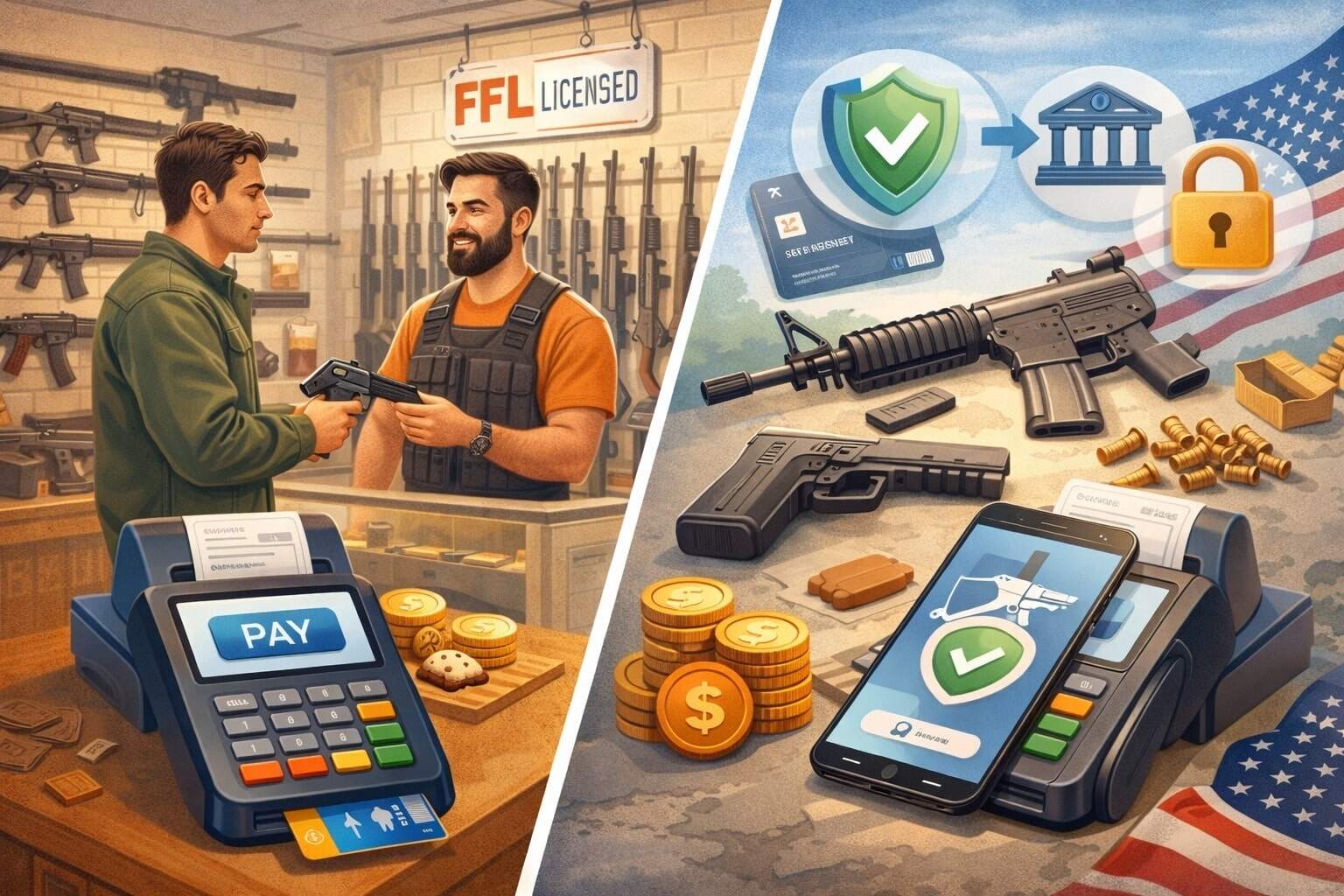
Running a firearms business means you live in two worlds at once: the everyday reality of retail (inventory, customer experience, margins) and the high-scrutiny reality of regulated commerce (compliance, audits, documentation, and risk controls).
Payment acceptance sits right at that intersection. When you choose the wrong provider, you can lose the ability to take cards overnight, face sudden “risk reviews,” or get stuck with frozen funds and chargeback pressure.
When you choose the right provider, firearm-friendly payment processing becomes a competitive advantage—helping you sell confidently in-store and online, reduce friction at checkout, and protect cash flow.
This guide is written specifically for Federal Firearms License holders (FFLs) and firearms-adjacent merchants who need firearm-friendly payment processing that stays stable as regulations, card-network monitoring, and state-level rules evolve. It’s designed to be readable, search-friendly, and practical—so you can act on it, not just skim it.
What “Firearm-Friendly Payment Processing” Really Means for an FFL

A processor calling itself “gun-friendly” doesn’t automatically mean you’ll be approved, supported, and kept live long-term.
For an FFL, firearm-friendly payment processing means the provider is prepared to underwrite and board your business as a firearms merchant—not as a generic “sporting goods” shop—and is willing to support you through ongoing compliance and risk management.
In practical terms, firearm-friendly processing includes correct merchant setup, a sponsor bank that allows firearms, and clear documentation standards.
It also means realistic expectations: underwriting may take longer than a standard retailer, you may be asked for more paperwork, and pricing may reflect perceived risk. But the right partner should explain this up front—not after you’ve integrated a gateway or printed new signage.
It also means stable policies around what you sell. Many mainstream “easy” providers restrict firearms and ammunition, which is why FFLs often need specialized merchant accounts built for regulated or “high-risk” categories.
Independent industry guides frequently note that popular aggregators commonly refuse gun-related transactions, especially online, which is exactly why specialized firearm-friendly providers exist.
Finally, firearm-friendly payment processing is about resilience. Between chargeback risk, fraud attempts, high-ticket transactions, and increased transaction monitoring, your solution needs to be engineered for fewer surprises. You’re not just shopping for a rate—you’re shopping for continuity.
Why FFLs Get Declined (Or Suddenly Terminated) by Many Processors

FFLs face unique processing friction for reasons that are both commercial and regulatory. From a bank’s perspective, firearms transactions can be high ticket, occasionally contentious (returns, disputes, buyer remorse), and often scrutinized. That scrutiny can translate into more account reviews, more documentation requests, and stricter risk limits.
One major change shaping the landscape is the increasing use of a firearms-specific merchant category code (MCC). Merchant category codes classify businesses by what they sell.
ISO’s merchant category code standard (ISO 18245:2023) defines how MCCs exist and are maintained, and recent policy shifts have pushed firearms merchants toward more explicit classification.
On top of that, several states have moved toward requiring use of a firearms-and-ammunition MCC. For example, California’s AB 1587 sets deadlines requiring card networks to make the firearms MCC available (by July 1, 2024) and for merchant acquirers to assign it to firearms merchants beginning May 1, 2025.
When your business is explicitly categorized, banks and processors may apply more aggressive risk monitoring. That doesn’t mean you can’t process—it means you need firearm-friendly payment processing built for this reality.
If a provider is vague about firearms classification, understates compliance requirements, or tries to “hide” your category to get you approved faster, that’s a red flag. Shortcuts often turn into shutdowns.
The Impact of the Firearms Merchant Category Code on Payment Acceptance

For many FFLs, the biggest strategic change isn’t a new terminal or a new checkout page—it’s how your business is identified in the payment ecosystem. In some jurisdictions, firearms merchants are assigned a specific MCC (commonly referenced as MCC 5723 for “Guns and Ammunition”).
Bank of America’s merchant help resource describes MCC 5723 as a classification for firearms, accessories, and ammunition businesses in certain states and notes it should be used where required.
Why does this matter? Because MCC influences underwriting posture, fraud models, reserve policies, and sometimes even what downstream service providers will support (gateways, shopping carts, or fraud tools).
It also affects how “normal” your transaction patterns look to automated monitoring systems. High average tickets, bursts of sales (holidays, promotions, new inventory drops), and card-not-present orders can all draw extra attention when combined with a firearms MCC.
There’s also a policy tug-of-war: some states require or encourage the firearms MCC, while other jurisdictions have pushed back. The result is a complex patchwork that can affect multi-state operators, ecommerce sellers shipping to multiple states, and businesses that operate at events.
Compliance Foundations Every FFL Should Have Before Applying
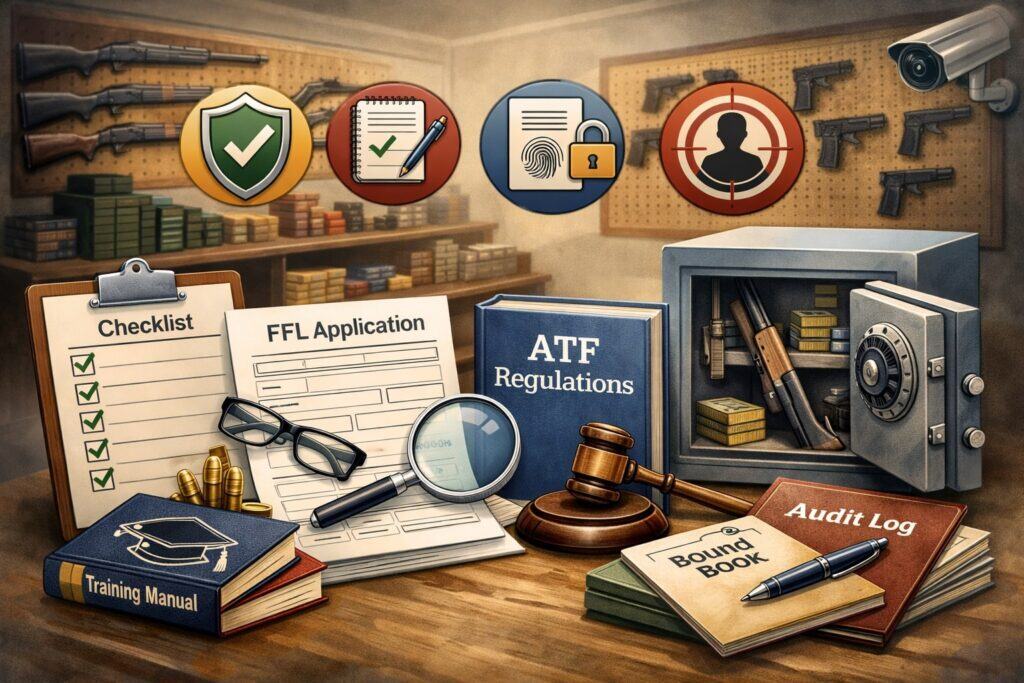
The fastest path to approval—and the best path to long-term stability—is to present a clean, compliant, well-documented business. Underwriters don’t just evaluate your products; they evaluate your operational maturity.
If you want reliable firearm-friendly payment processing, get these fundamentals in place before you submit an application.
Start with business documentation: active licensing, consistent ownership details across your filings, and clear product description.
Your website (if you sell online) should include policies that reduce disputes: shipping timelines, return policies (with any firearm-specific limitations), customer support contact information, and age/eligibility statements where applicable. Lack of clarity drives chargebacks, and chargebacks drive shutdowns.
Next, get your transaction story straight. Underwriters will ask: What’s your average ticket? What percentage is card-present vs card-not-present? Do you sell firearms, ammunition, accessories, training, or range memberships?
A provider that truly offers firearm-friendly payment processing will ask these questions because they determine the right bank fit and risk controls.
Finally, ensure your inventory and fulfillment practices are consistent. Sudden order delays, backorders, or unclear refund handling are a chargeback magnet. Firearms businesses can be perfectly legitimate and still get shut down if chargebacks spike. Your goal is to look like a low-drama operator in a high-scrutiny category.
Key Features to Demand in Firearm-Friendly Payment Processing
Not all “gun-friendly” offers are equal. If you’re serious about stable firearm-friendly payment processing, you should evaluate providers against features that matter specifically to firearms merchants.
1) True merchant account (not just an aggregator): Many FFLs do better with a dedicated merchant account underwritten for firearms. It tends to be more stable than platforms that onboard merchants in bulk and terminate accounts quickly when automated monitoring flags the business.
2) Clear high-risk controls without punitive surprises: It’s normal for firearms merchants to see rolling reserves or enhanced monitoring. What’s not acceptable is hidden reserves, sudden withheld batches, or pricing that changes after go-live. Industry content aimed at firearms merchants often emphasizes that high-risk accounts can come with reserves and higher costs—so transparency is critical.
3) Ecommerce readiness: If you sell online, you need gateway compatibility, fraud tools, and checkout flows that reduce disputes. A provider should support common platforms or have an integration plan.
4) Chargeback and fraud tooling: Look for tools like AVS/CVV rules, velocity filters, 3-D Secure for card-not-present where appropriate, and a clear representation process.
5) Multi-channel support: Many FFLs do in-store + online + events. Your provider should support countertop terminals, virtual terminal, mobile acceptance, and invoicing—under one compliant account structure.
When these pieces work together, firearm-friendly payment processing becomes less about “being allowed” and more about being operationally strong.
Best Firearm-Friendly Payment Processing Solutions for FFLs
This section focuses on providers and categories of solutions that market support for firearms merchants and FFLs. Because underwriting outcomes vary by business model, location, product mix, and history, treat these as starting points for evaluation—not guarantees.
The goal is to help you shortlist options for firearm-friendly payment processing that are built for regulated commerce.
Host Merchant Services (Firearms Merchant Accounts)

Host Merchant Services publishes a firearms merchant account offering positioned for high-risk merchants, emphasizing tailored solutions for firearms businesses and operational support for secure payment acceptance.
For an FFL, the practical value here is specialization: you want a provider that expects firearms underwriting questions and has a process for them. A firearms-friendly setup should include appropriate gateway options, card-present tools, and risk controls aligned with your ticket size and sales channels.
When evaluating this option, ask detailed questions that affect stability: Which sponsor banks will board firearms? How are reserves handled? What chargeback tools are included? Can you support both in-store and online sales under one MID (merchant ID) strategy? How do you handle firearms-specific MCC requirements when they apply?
Also ask about onboarding support: do they provide a checklist for compliance, website policy requirements, and documentation needed for underwriting? The best firearm-friendly partners reduce back-and-forth by telling you exactly what will be reviewed.
If your priority is a consultative onboarding process and a solution designed around firearms merchants, this category is often a good fit for FFLs who want firearm-friendly payment processing without “guesswork” at approval time.
Firearms Merchants / FFL-Focused Specialists
Several niche providers market directly to firearms merchants, positioning themselves as purpose-built for gun retailers, ranges, and FFL holders. Examples include Firearms Merchants and FFL Merchant Services, both of which describe firearms-tailored solutions and compliance-oriented processing.
These specialists can be attractive because they often speak your language: FFL workflows, firearms ecommerce realities, and regulated inventory constraints. They may also have templated underwriting packages and common-sense risk controls that generic providers don’t offer.
However, niche does not automatically mean better. Your due diligence should be extra rigorous: verify sponsor bank relationships, review contract terms, and understand pricing components (discount rate, transaction fees, monthly minimums, gateway fees, reserves, and chargeback fees). Ask for a clear explanation of what triggers funding holds.
For FFLs who want a partner that explicitly commits to firearm-friendly payment processing, niche specialists can be a strong shortlist option—as long as you confirm the banking and compliance backbone is real, not just marketing.
PaymentCloud (Gun-Friendly Merchant Accounts)
PaymentCloud promotes gun-friendly credit card processing for firearms dealers, ammo suppliers, and FFLs, positioning itself as a solution for merchants who are often declined elsewhere.
For many FFLs, the question isn’t “Can you process payments?”—it’s “Can you keep me processing when a risk review happens?” Providers in this category typically emphasize underwriting alignment, fraud controls, and continuity. That can matter if you sell higher-ticket firearms, do card-not-present orders, or process occasional volume spikes.
In your diligence process, ask how they handle ecommerce. What gateway options are supported? Do they work with major carts, and do they have experience with firearms-related product catalogs? Ask how they manage disputes and whether they offer alerts or assistance before a chargeback becomes a loss.
Also clarify policy boundaries. Some “gun-friendly” providers support firearms but may restrict certain adjacent categories or specific product types, or require additional controls for ammo volume. You want your firearm-friendly payment processing partner to map your exact product and channel mix to an approval plan you can live with.
Corepay (Firearms Merchant Accounts & Gateway)
Corepay advertises firearms merchant accounts and explains the core concept: a firearms merchant account ties an FFL business into acquiring relationships that allow acceptance of major card brands.
For an FFL that needs both in-store and online processing, providers that emphasize gateway + acquiring coordination can reduce integration headaches.
The important detail is whether the provider can support your full operational footprint: POS terminals, ecommerce gateway, virtual terminal, invoicing, and recurring billing if you sell memberships or training subscriptions.
Ask about technical flexibility. Can you run multiple locations? Do you need separate MIDs per channel? How are transaction descriptors handled to reduce confusion-related disputes?
FFLs should also ask how the provider addresses MCC changes and state requirements. A stable firearm-friendly payment processing setup should not break when your category is classified correctly. Instead, it should be designed with the assumption that firearms merchants are monitored and must operate cleanly.
Tactical Payments (2A-Friendly Processing Positioning)
Tactical Payments markets itself as working with “2nd Amendment friendly” processors and sponsor banks and highlights firearms-industry integrations.
For FFLs, the operational promise here is less about generic processing and more about being aligned with sponsor banks that knowingly support firearms merchants. That alignment is a major determinant of stability. If the bank is uncomfortable, your account can be fragile even if the sales agent sounds confident.
If you sell on specialized marketplaces or use firearms-specific retail software, ask about integration support and whether they have a proven flow for your exact setup. That includes how orders are captured, how payment data is transmitted, and what fraud controls you can enable without breaking the checkout experience.
In this category, also ask what “friendly” means contractually. Is there a written policy? What’s the termination clause? What triggers a review? Strong firearm-friendly payment processing is backed by process and contracts, not just branding.
Adaptiv Payments (Firearms Merchant Accounts Lists and Reviews)
Adaptiv Payments published a “Best Firearms Merchant Accounts 2025” style resource and positions itself as serving high-risk categories including firearms.
Lists can be useful for comparison, but as an FFL you should treat any “best of” claim as a prompt for deeper evaluation. The right questions are operational: underwriting speed, reserve structure, gateway support, dispute tooling, and long-term continuity.
If you want stable firearm-friendly payment processing, you want to know what happens after month three—when the initial honeymoon ends and monitoring systems evaluate real transaction behavior.
Ask about account health management. Do they monitor chargeback ratio trends with you? Do they help you adjust fraud filters? Can they support split settlements or multiple locations? Can they handle high average tickets without constant funding delays?
A good provider in this category should also help you present your business properly at underwriting time—especially if you have multiple product lines (firearms + ammo + accessories + training) or mixed channels.
Other High-Risk Firearms Processing Providers (Vector Payments, Secure Global Pay, LeisurePay)
Additional providers publish firearms processing pages describing support for regulated merchants and emphasizing secure tools and risk management, such as Vector Payments and Secure Global Pay. LeisurePay also markets guns and ammo merchant accounts.
This broad category can be useful when you have unique needs: unusually high average tickets, significant online volume, subscription billing (memberships/training), or multi-location operations.
Some high-risk providers can engineer solutions with multiple MIDs, layered fraud tooling, or alternative payment rails (where legal and appropriate) to reduce dependence on a single channel.
The key is to avoid “one-size-fits-all” promises. Firearms merchants need properly underwritten, correctly classified accounts. Any provider suggesting you miscode your business or obscure product categories is a risk—because compliance and monitoring are moving toward more accurate classification.
If a provider can show you a realistic underwriting plan and a stable bank fit, they can be a viable path to firearm-friendly payment processing, especially for complex operations.
Choosing the Right Solution: A Practical Evaluation Framework
When comparing providers, most FFLs focus too heavily on headline rate. Price matters, but stability matters more. A low rate doesn’t help if you’re shut down during your busiest season. Use a framework that prioritizes continuity and risk alignment for firearm-friendly payment processing.
Step 1: Match your business model to underwriting reality
Write down your product mix, average ticket, highest ticket, monthly volume, and channel split (in-store vs online). A provider who understands firearms should map these inputs to a bank and risk strategy.
Step 2: Validate sponsor bank comfort
Ask directly whether the bank supports firearms merchants and whether firearms are explicitly allowed. The stability of firearm-friendly processing depends heavily on this.
Step 3: Get reserve terms in writing
If there’s a rolling reserve, ask: percentage, duration, release schedule, and what triggers increases. Transparency here is the difference between manageable and catastrophic cash-flow pressure.
Step 4: Review acceptable-use policy and termination triggers
Don’t accept vague answers. Ask what causes shutdown: chargeback thresholds, fraud spikes, volume spikes, policy violations, or compliance gaps.
Step 5: Confirm gateway and platform compatibility
If you run ecommerce, make sure your gateway supports your cart and that fraud tools (AVS/CVV, velocity rules, 3DS if used) are available.
When you follow this framework, you’ll choose firearm-friendly payment processing that is built to last, not just built to approve.
Chargebacks, Fraud, and Risk Controls That Keep You Processing
Chargebacks are one of the most common reasons regulated merchants lose processing. For FFLs, disputes can arise from shipping misunderstandings, policy confusion, friendly fraud, or customer dissatisfaction with accessories or non-firearm items. Your goal is to prevent disputes and win the ones you can’t prevent.
Start with prevention: crystal-clear descriptors, fast customer support response times, and accurate fulfillment timelines. Then implement layered fraud controls: AVS/CVV checks, IP/geolocation rules, velocity limits, and manual review for unusually large orders.
Firearms merchants often benefit from “friction where it matters”—extra verification for high-risk orders, while keeping normal orders smooth.
Next, operational discipline: keep documentation, receipts, tracking, and customer communications organized. When a chargeback hits, the quality of your evidence matters.
Your provider’s role is crucial. A true firearm-friendly payment processing partner should help you tune fraud settings, interpret chargeback reason codes, and submit representments correctly. If your provider offers no guidance and only sends you notices after deadlines, that’s not a partner—it’s a pipeline.
If you sell online, consider using additional verification steps for higher-ticket orders and monitoring refund patterns. A stable firearms processing setup is one where you actively manage your risk profile, rather than waiting for the bank to manage it for you.
POS and Ecommerce Setup Tips for FFLs (So You Don’t Trigger Reviews)
FFLs often operate across multiple environments: a retail counter, a range, gun shows, and an online storefront. Each environment has different risk characteristics. A strong firearm-friendly payment processing strategy is engineered to look consistent and controlled across all of them.
For in-store POS, use EMV-capable terminals and keep batching consistent. Sudden manual entry spikes can look like fraud. If you do phone orders, use a virtual terminal with strict controls and keep signed documentation where applicable.
For ecommerce, your storefront should look legitimate and complete. Underwriters commonly review websites for policy clarity, product description accuracy, customer support accessibility, and transparency.
If you sell regulated items, your compliance and eligibility messaging should be visible. A “thin” site can cause delays or denials—even if you are a legitimate FFL.
Also consider how you categorize products. Firearms, ammo, accessories, training, and memberships can have very different dispute patterns. If you can separate certain revenue streams cleanly (without violating policy or misrepresenting the business), you can sometimes reduce risk concentration.
Finally, avoid sudden volume swings without notice. If you expect a major promotion, product drop, or seasonal spike, tell your provider. A good firearm-friendly partner would rather pre-approve expected volume than freeze funds after the fact.
Future Prediction: Where Firearm-Friendly Payment Processing Is Headed
The trend line is toward more explicit classification and more active monitoring, not less. The existence and enforcement of firearms MCC requirements in certain jurisdictions—and the broader debate around it—suggest that firearms merchants will continue to face scrutiny that general retailers do not.
Here are realistic forward-looking expectations:
1) More standardized firearms classification:ISO maintains the standard that underpins MCC structure, and more ecosystems are referencing firearms-specific classification. This makes “hiding” as another category less viable over time.
2) Increased state-by-state complexity: California’s timeline (network availability by July 1, 2024; assignment beginning May 1, 2025) is a template that other states may mirror or counter with restrictions. Multi-state operators should plan for a patchwork.
3) More fintech experimentation—but card networks remain central: Some industry commentary expects alternative payment methods to grow for regulated merchants, but mainstream card acceptance will still be crucial for customer convenience and revenue.
4) Stronger emphasis on compliance-as-a-service: The best firearm-friendly providers will differentiate by offering structured underwriting prep, ongoing monitoring support, and chargeback management—because stability will be the top KPI for FFLs.
FAQs
Q.1: What is the best firearm-friendly payment processing option for an FFL?
Answer: The “best” option depends on your sales channels (in-store vs online), average ticket, monthly volume, product mix, and history. Many FFLs do best with a dedicated merchant account underwritten for firearms rather than a mass-market aggregator.
Providers that explicitly market firearms merchant accounts can be a strong place to start, but you should evaluate sponsor bank fit, reserve terms, gateway compatibility, and chargeback support.
If you want stable firearm-friendly payment processing, prioritize continuity and transparency over the lowest advertised rate. A provider who prepares you for underwriting and supports risk management is often more valuable than one who promises “instant approval.”
Q.2: Why do mainstream payment apps reject firearms transactions?
Answer: Many mainstream providers and payment apps maintain acceptable-use policies that restrict firearms and related products, especially for online transactions. Industry guides frequently note that popular mobile and online providers have refused gun-related processing, pushing FFLs toward specialized providers.
This is why firearm-friendly payment processing solutions exist: they’re designed to underwrite and support regulated merchants instead of automatically excluding them.
Q.3: What is MCC 5723 and how can it affect my business?
Answer: MCC 5723 is commonly referenced as a firearms-and-ammunition merchant category code used for classifying relevant businesses in certain contexts. Bank of America’s merchant resource explains MCC 5723 as a “Guns and Ammunition” classification in specific states and notes it should be used where required.
California law also sets requirements related to making the firearms MCC available and assigning it to firearms merchants on set deadlines.
Because MCC can influence underwriting posture and monitoring, you should choose firearm-friendly payment processing that can operate compliantly with appropriate classification.
Q.4: Will I need a rolling reserve for firearm-friendly payment processing?
Answer: Possibly. Firearms merchants are often treated as higher risk, and some acquiring banks use rolling reserves to protect against chargebacks and fraud. Industry-focused content frequently mentions reserves as a common component of high-risk merchant accounts.
The key is to get reserve terms clearly defined in writing: reserve percentage, duration, release schedule, and the triggers for changes. A good firearm-friendly payment processing partner will explain this transparently.
Q.5: Can I accept online payments for firearms and ammunition?
Answer: Many FFLs do accept online payments for eligible products and workflows, but the setup must be compliant, properly underwritten, and supported by a firearms-friendly provider and gateway.
Your storefront should include clear policies and customer support details to reduce disputes. Your provider should also support fraud controls appropriate for card-not-present transactions.
If a provider suggests you “work around” policies by misrepresenting products or business categories, avoid that approach. Firearm-friendly payment processing should be stable and compliant, not improvised.
Q.6: How do I reduce chargebacks as an FFL?
Answer: Reduce chargebacks by tightening customer expectations and strengthening documentation. Use clear product descriptions, shipping timelines, and refund policies. Provide fast support.
Use fraud controls like AVS/CVV checks and manual review for high-ticket orders. Then, keep organized evidence for representation: receipts, tracking, communications, and policy screenshots.
A strong firearm-friendly payment processing provider should help you with chargeback workflows and risk tuning—not leave you alone after setup.
Conclusion
The best payment setup for an FFL isn’t the cheapest teaser rate—it’s the solution that keeps you live, funded, and supported through compliance changes and risk reviews. As firearms merchant classification becomes more explicit and state-level rules evolve, the value of firearm-friendly payment processing increases.
To choose well, focus on fundamentals: a provider that knowingly supports firearms merchants, a sponsor bank that is comfortable with your category, transparent reserve and termination terms, and ecommerce/POS tools built for your channel mix.
Pair that with your own operational discipline—clear policies, fraud controls, and chargeback readiness—and you’ll have a setup that protects revenue and reputation.