Running a firearm retail counter isn’t the same as running a coffee shop register. Your average ticket can be higher, your fraud exposure can be higher, your compliance expectations are usually tighter, and your payment setup has to “just work” during busy rushes—without forcing your staff to become IT support.
That’s why choosing the best EMV terminals for firearm retailers is less about picking a popular device and more about picking the right deployment style (standalone vs integrated), the right security posture (PCI PTS + encryption/P2PE), and the right connectivity and uptime plan (Ethernet + LTE backup, or at least stable Wi-Fi).
EMV (chip) acceptance matters because it helps reduce counterfeit fraud and helps protect you from liability when chip cards are present and your terminal is capable of reading them. The “liability shift” concept is widely explained as liability moving to the least compliant party when chip technology isn’t used.
In this guide, you’ll learn how to evaluate hardware options, which models tend to fit common gun shop workflows, how to avoid expensive compatibility mistakes, and what’s coming next (Tap-to-Phone, PCI PTS updates, and smarter tokenization/P2PE rollouts).
If your goal is to pick the best EMV terminals for firearm retailers that are reliable, secure, and scalable across the counter, showroom floor, and events, you’re in the right place.
What “Best EMV Terminals for Firearm Retailers” Really Means (And Why Generic Lists Fail)
When people search “best EMV terminals for firearm retailers,” they usually want a simple top 5 list. But firearm retailers need a more specific definition of “best,” because the wrong terminal choice can create real operational pain: failed integrations, longer lines, higher chargeback risk, and more PCI compliance work than you expected.
A “best” EMV terminal for your store should meet five practical requirements:
First, it must support all key card-present acceptance methods: EMV chip insert, contactless tap (NFC), and magstripe swipe for the edge cases where swipe is permitted. Modern devices like Verifone’s portable line and many Ingenico and PAX terminals support EMV + contactless for wallets, which matters because customers increasingly expect tap-and-go.
Second, it should align with your checkout style. If you run a traditional fixed counter with a PC-based POS, a customer-facing PIN pad like Ingenico Lane series often provides faster throughput and better customer experience than a standalone terminal, because your cashier doesn’t need to re-key totals. Lane/3000 and Lane/5000 are built for retail lanes and semi-integrated setups.
Third, it must meet device security standards. PCI SSC’s PTS Point of Interaction standard describes security requirements for payment devices used to protect PINs and sensitive data at the point of interaction. In plain terms: you want modern, certified hardware from reputable manufacturers, deployed correctly.
Fourth, “best” includes data protection architecture, not just the terminal. Many firearm retailers benefit from encryption approaches like P2PE, which protects account data from the point of acceptance until decryption in a secure environment, reducing the value of stolen data in a breach.
Finally, it must be compatible with how firearm retailers actually sell—counter sales, deposits for special orders, phone orders where permitted by policy, in-store events, and sometimes show-floor mobility.
That pushes many stores toward a “two-device” strategy: one lane device for the counter and one mobile smart terminal for the floor.
So as you read the rest of this guide on the best EMV terminals for firearm retailers, keep a simple principle in mind: the best terminal is the one that fits your workflow and your security posture and your connectivity realities—at the same time.
EMV, Fraud Liability, and Why Firearm Retailers Should Care More Than Most

Firearm retailers often sell high-value items and accessories. Even if your fraud rate is low, a single counterfeit transaction can be painful—especially if the transaction is later disputed and you’re left fighting a chargeback.
EMV chip transactions are designed to reduce counterfeit fraud by using dynamic transaction data rather than static stripe data. The practical takeaway is that upgrading from swipe-only to EMV-capable acceptance isn’t optional anymore if you want modern fraud defenses and to avoid being the “least compliant party.”
A widely cited concept in the payments industry is the EMV liability shift, which explains that responsibility for certain types of card-present fraud can shift to whoever hasn’t adopted the more secure technology (for example, if a chip card is present but the merchant processes by swipe when the terminal could have read the chip).
Multiple industry explainers summarize this shift and emphasize that inserting the chip (rather than swiping) is key for EMV protection in many cases.
Firearm retailers also need to care because their checkout environments can be complex: counter + showroom + gunsmith services + training/range (for stores that have it) + special orders.
Complexity increases the chance of staff using “fallback” habits (like swiping) when a chip read fails, which can create disputes later. Choosing reliable EMV terminals—and training staff on chip-first handling—reduces those failure loops.
This is also where the phrase best EMV terminals for firearm retailers becomes a security decision. If you choose older, less stable hardware or an inconsistent connectivity path, you’ll see more failed chip reads, more manual workarounds, and more “fallback” transactions. High-quality terminals, current firmware, stable network, and a clean integration all reduce those risks.
One more nuance: the terminal is just one part of your transaction security. The end-to-end payment flow (POS → terminal → processor → networks) is where tokenization and encryption may also play a role, especially if you want to reduce PCI scope and simplify compliance.
We’ll cover that next because it’s often the difference between “I bought a good device” and “I built a durable, secure payment stack.”
Security Checklist: PCI PTS, P2PE, Tokenization, and What You Should Demand From Any Terminal
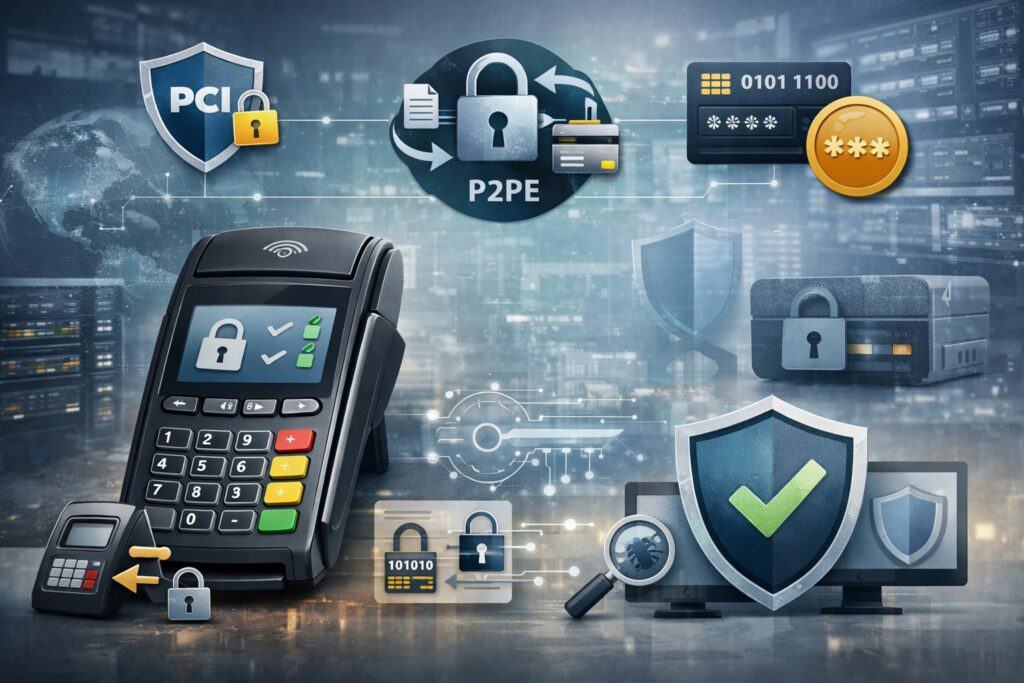
If you want the best EMV terminals for firearm retailers, you should evaluate security in layers. The first layer is the device standard itself. PCI SSC’s PTS Point of Interaction (POI) standard describes security requirements for devices used to protect PINs and sensitive payment data at the point of interaction.
In practical terms, a modern EMV terminal should be PTS-approved and sourced from a reputable channel so you avoid tampered hardware and unsupported firmware.
The second layer is how card data is protected in transit. PCI SSC describes Point-to-Point Encryption (P2PE) as cryptographic protection of account data from the point of card acceptance to a secure point of decryption.
If implemented as a validated solution, P2PE makes stolen data less useful because it remains unreadable until it reaches the secure decryption environment.
Why does this matter for firearm retailers? Because many stores don’t want to run a sprawling “payment card environment” across multiple PCs, networks, and apps.
A P2PE approach can reduce the exposure of raw card data in your environment and can simplify PCI compliance work. Some device ecosystems and solutions emphasize that P2PE can reduce PCI DSS audit scope by removing sensitive data from the merchant environment.
The third layer is operational security: device lifecycle controls. Even the best hardware can become risky if devices are left unattended, swapped, or not inspected. Build a simple routine: daily visual checks, locked-down ports, restricted access to settings menus, and a documented process for replacing devices.
Finally, consider where the industry is going. Payments security standards evolve, and the ecosystem is preparing for updated device requirements (often discussed in the context of newer PTS versions).
You don’t need to memorize versions—but you do want devices from manufacturers with a history of keeping product lines updated and supported.
If you apply this layered checklist while shopping for the best EMV terminals for firearm retailers, you’ll naturally filter out “cheap, random, online marketplace devices” and end up with terminals that are safer, more stable, and easier to support long-term.
Countertop Standalone Terminals: Best Fit for Simple Setups and Backup Lanes
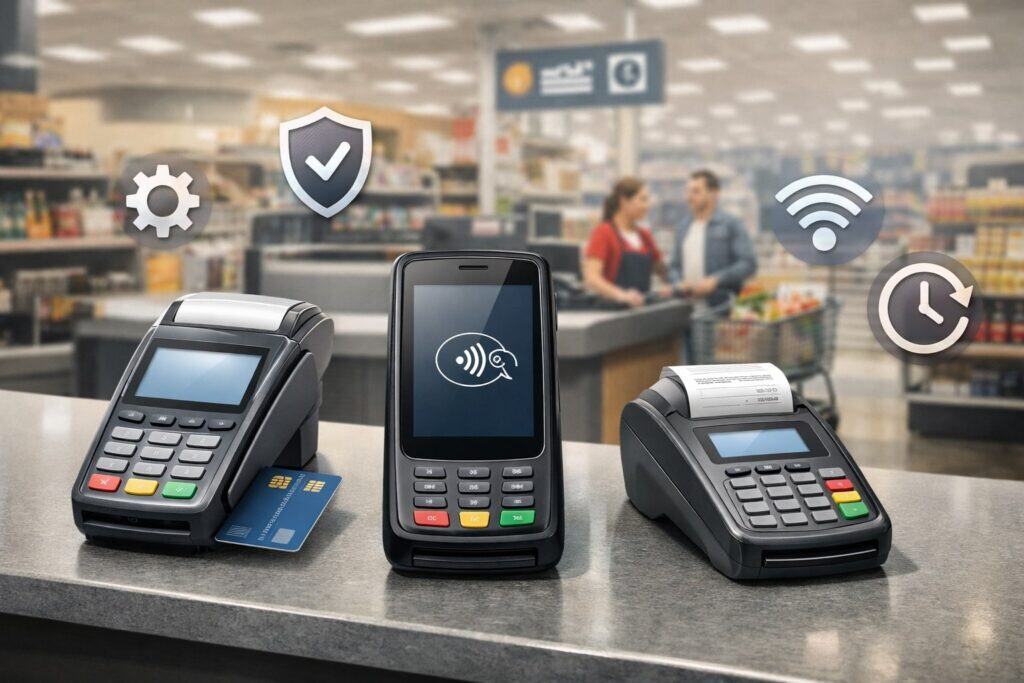
Standalone countertop terminals are popular because they’re easy: plug in, connect, run transactions. For some firearm retailers—especially smaller stores or stores that don’t need deep POS integration—this can be a good primary approach.
It can also be a smart backup lane even if you run integrated payments, because it keeps you selling when your POS PC is down.
A strong example in this category is the Ingenico Desk/5000, positioned as a robust counter device that supports multiple payment forms and can connect to other POS devices and PIN pads. Documentation and guides emphasize contactless acceptance and PCI compliance alignment in typical deployments.
Another example is the Dejavoo Z11, a compact countertop terminal that is marketed as EMV-certified, includes a touchscreen, and supports common connectivity like Ethernet and Wi-Fi. It’s often discussed as a smaller footprint terminal that still handles chip and contactless.
Standalone terminals make sense when:
- You ring sales on the terminal itself (not a separate POS).
- You want minimal integration complexity.
- You need a reliable backup device for “just take payments.”
But standalone has tradeoffs. You may lose line-item detail, tighter inventory tie-ins, and the “single source of truth” that comes from integrated checkout. That’s why many firearm retailers use standalone as a fallback device, not the main lane device, once they scale.
If your store is evaluating the best EMV terminals for firearm retailers, standalone countertop devices are best when you prioritize simplicity, redundancy, and fast deployment—especially for a second register. For a more optimized main lane, the next category (customer-facing PIN pads) often wins on speed and clean reconciliation.
Customer-Facing PIN Pads (Semi-Integrated): The Fastest Checkout for Busy Firearm Counters
If your store has a PC-based POS or a specialized retail system, semi-integrated payments with a customer-facing PIN pad can be the most efficient lane setup. The POS sends the transaction amount to the device, the customer inserts/taps, and the approval flows back into the POS—reducing keystrokes, mismatched totals, and end-of-day confusion.
The Ingenico Lane series is a widely used example for retail lanes. The Lane/5000 is described as supporting EMV, contactless, and multimedia capabilities designed for retailers, and recent datasheets emphasize all payment options and security certification.
Similarly, Lane/3000 documentation highlights multi-payment acceptance and security posture, with versions designed for intensive retail use and deployment flexibility.
Why this matters for firearm retailers: your counter staff often needs to keep their hands on the workflow—serial-number handling, accessory add-ons, deposits, and customer questions. Offloading the payment interaction to a customer-facing device makes the lane smoother and reduces staff distraction.
Semi-integrated devices also pair naturally with encryption and tokenization models used by many modern gateways and integrated payment stacks. Some integrated terminal guides describe combining EMV with encryption approaches like P2PE to help protect transactions and reduce PCI complexity.
Where semi-integrated can go wrong is certification and compatibility. Your POS, gateway, and processor must support the device model and integration method. Don’t buy first and hope it works later.
For the best EMV terminals for firearm retailers, make your provider confirm the exact model, exact connectivity type (Ethernet/USB), and exact integration path (cloud terminal service, local service, or direct) before you deploy.
If you want the shortest lines, the cleanest reconciliation, and the smoothest customer experience at a main counter, customer-facing PIN pads are often the best answer.
Mobile and Wireless Smart Terminals: The Best EMV Terminals for Firearm Retailers Who Sell on the Floor or at Events
Many gun shops don’t want customers waiting at a single counter, especially when staff are walking the showroom floor answering questions and helping compare products. A mobile smart terminal lets you take payment where the customer is—reducing abandoned purchases and improving service speed.
A standout in this category is the PAX A920 Pro, marketed as an Android SmartPOS terminal with a touchscreen, printer, and optional scanner—built for mobility and faster interactions.
Another strong option is the Verifone V400m, positioned as a portable device with Wi-Fi, Bluetooth, and 4G LTE, supporting EMV and contactless acceptance. Verifone’s T650p is also presented as a portable terminal with a larger touchscreen and flexible connectivity options (often used in high-mobility contexts).
For firearm retailers, mobile terminals shine in three scenarios:
- Showroom floor selling: staff can close sales without sending customers back to a crowded counter.
- Gun shows and events: LTE-enabled terminals reduce reliance on flaky venue Wi-Fi.
- Line-busting during rush: even one extra mobile lane can noticeably reduce wait time.
Your biggest decision is whether you need a “smart terminal” (apps, scanning, receipts on device) or just a wireless payment device. Smart terminals are great when you need receipts, simple product libraries, tips (for services), or scanning. A more basic wireless terminal might be enough if you only need to take payment and print or email receipts.
If you’re aiming for the best EMV terminals for firearm retailers and you do any meaningful volume away from the main counter, it’s hard to beat a well-supported mobile smart terminal plus a stable connectivity plan (Wi-Fi + LTE). Mobility isn’t just convenience—it’s conversion.
All-in-One Handheld POS Devices: When You Want Payments + Lightweight POS in One Device
Sometimes you don’t want a separate POS and a separate terminal. You want a handheld that can take payments, run a lightweight register, and print receipts. For certain firearm retailers—especially smaller shops, pop-up operations, training/range add-ons, or accessory-heavy counters—this can be a practical middle ground.
The Clover Flex is a common example of a handheld POS device that accepts swipe, dip, and tap payments, and the primary product page highlights portability and built-in receipt printing on the Flex model.
All-in-one devices are attractive because they simplify training: staff learns one device, one interface, one workflow. They also make it easy to add a second “register” without buying a full PC lane.
But you should be careful about two things:
First, make sure the device fits your sales complexity. Firearm retailers may need deeper inventory handling, customer records, deposits, and specialized workflows that a lightweight POS might not handle the way you need.
In many stores, all-in-one devices are ideal for accessories, range fees, or service tickets, while the main firearm sale workflow remains on a more robust POS.
Second, confirm supportability and uptime. If your all-in-one device fails, you lose both POS and payments at once. That’s why many stores pair an all-in-one with a countertop backup terminal.
If your priority is flexibility and you want a device you can carry, the all-in-one category can absolutely qualify as the best EMV terminals for firearm retailers—as long as you treat it as one piece of a resilient setup rather than your only lane.
Integration With Firearm Retail POS Workflows: What to Ask Before You Buy Any EMV Terminal
The most expensive terminal mistake isn’t buying the wrong model—it’s buying a model that doesn’t match your POS and processor certification path. Firearm retailers are more likely than average to use specialized software for inventory and compliance workflows, or to run multi-system setups (POS + eCommerce + inventory + service tickets). Your terminal must fit into that puzzle.
Start by identifying your checkout architecture:
- Standalone (terminal is the register)
- Semi-integrated (POS sends total to terminal; terminal returns approval)
- Fully integrated (POS controls the full flow; more complex certification)
Semi-integrated is usually the sweet spot for retailers because it improves speed without demanding the heaviest integration work.
Some POS ecosystems and partners explicitly discuss integrated EMV options and certified terminals with specific processors.
For example, certain retail POS providers note that EMV-compliant payments depend on supported processor partners and certified terminals, and that semi-integrated options are offered for EMV chip and contactless acceptance.
Other retail payment providers describe integrated payment models emphasizing EMV security and tokenization concepts, which can matter if you want tighter reporting and safer data handling.
Before you buy, ask these questions (and insist on written confirmation from your provider):
- Which exact terminal models are certified for my processor + gateway?
- Which connection type is required: Ethernet, USB, Wi-Fi, LTE?
- Is the setup semi-integrated or standalone?
- Does the solution support contactless (NFC) with major wallets?
- What encryption approach is used—standard encryption, tokenization, or a validated P2PE solution?
If your provider can’t answer these clearly, you’re at risk of buying hardware that “should work” but doesn’t. The best EMV terminals for firearm retailers are the ones that are proven in the same stack you plan to run—not just impressive on a spec sheet.
Recommended Shortlist: Best EMV Terminals for Firearm Retailers by Use Case (Counter, Lane, Mobile, Backup)
This section gives you a practical shortlist based on common firearm retail scenarios. These aren’t the only good devices, but they’re strong candidates because they match the patterns firearm retailers typically need: secure acceptance, durable hardware, modern connectivity, and broad industry support.
Countertop, simple primary terminal or reliable backup: Ingenico Desk/5000 and Dejavoo Z11
If you want a stable countertop terminal that’s widely deployed, Desk/5000 is positioned for counter payments and supports multiple payment forms, and typical guides emphasize contactless acceptance and PCI-aligned deployments.
If you prefer a compact touchscreen countertop model with Ethernet/Wi-Fi options, Dejavoo Z11 is frequently described as an EMV-capable unit designed for fast retail checkout with common connectivity options.
Both can work as primary devices for simpler setups, and both are excellent as redundancy devices even when you move to integrated lanes.
Best for a busy main lane with POS integration: Ingenico Lane/3000 or Lane/5000
For speed and clean reconciliation, Lane devices shine in semi-integrated setups where the POS pushes totals to the customer-facing device. Lane/5000 materials emphasize retail lane design, all payment options including contactless, and security certification.
Lane/3000 materials highlight intensive retail usage, flexible versions, and modern acceptance types including contactless and wallet support in many deployments.
For many shops, this category is the heart of “best EMV terminals for firearm retailers” because it optimizes the core counter workflow.
Best for mobility and events: Verifone V400m, Verifone T650p, PAX A920 Pro
If you want cellular-ready portability, V400m is specified with Wi-Fi, Bluetooth, and 4G LTE and supports EMV and contactless acceptance. T650p is presented as a modern portable with a larger touchscreen and flexible connectivity, built for fast-paced environments.
PAX A920 Pro is positioned as an Android smart terminal with printer and optional scanner—strong for “walk the floor” selling.
These devices are especially valuable if your shop sells at events or needs line-busting capacity.
Best all-in-one handheld POS approach: Clover Flex
If you want an all-in-one approach that combines POS + payments + receipts in a portable form factor, Clover Flex is designed for tap/dip/swipe and mobile checkout with a built-in receipt printer on the Flex model.
As always: the “best” device is the one that’s certified for your processor and fits your workflow. Use this shortlist as your starting point, not your final purchase order.
Deployment Playbook: How to Set Up EMV Terminals in a Firearm Store for Speed, Uptime, and Fewer Chargebacks
Buying the terminal is the easy part. Deploying it well is what makes it one of the best EMV terminals for firearm retailers in real life.
Start with network reliability. For fixed lanes, prefer Ethernet where possible. Wired lanes reduce drops, reduce Wi-Fi congestion problems, and often simplify troubleshooting.
For mobile devices, choose Wi-Fi with strong coverage plus LTE failover if you sell at events or have spotty local internet. Many portable devices highlight LTE support as a key capability for mobile acceptance.
Next, standardize your checkout behavior:
- “Insert chip first” as the default.
- “Tap when offered” for fast contactless.
- Define when swipe is allowed and when it isn’t.
- Train staff to avoid unnecessary fallback transactions, because those can change dispute outcomes depending on the scenario.
Then address device security hygiene:
- Inspect devices daily for tampering.
- Keep devices in staff-controlled areas.
- Restrict admin access and lock settings.
- Replace devices through trusted channels.
Finally, plan for resilience:
- Keep one backup terminal configured and tested.
- Document a two-page “payments down” checklist.
- Train staff on offline procedures (if supported) and on how to avoid taking risky transactions when connectivity is unstable.
If your store uses integrated lanes (Lane/3000, Lane/5000, similar), build the relationship between POS and terminal carefully. Integrated terminal documentation often describes the device as connected via a terminal service and highlights security approaches combining EMV and encryption models.
A good deployment turns a good device into one of the best EMV terminals for firearm retailers because it stays online, stays fast, and reduces the everyday friction that quietly costs you sales.
Future Prediction: Where EMV Terminals Are Going (Tap-to-Phone, SoftPOS, and the Next Security Wave)
The next few years will reshape what merchants think of as a “terminal.” Hardware terminals will still dominate for high-throughput retail lanes, but software-based acceptance is growing fast—especially for mobility and smaller sellers.
One major trend is Tap-to-Phone / Tap on Phone, which enables contactless acceptance on eligible NFC-enabled smartphones. Visa describes Tap to Phone as a way for sellers to accept contactless payments on smartphones or tablets they already own.
Mastercard also describes Tap on Phone as a low-cost, low-maintenance, peripheral-free contactless acceptance solution on eligible NFC devices, deployed via an app.
For firearm retailers, the most realistic near-term use case is not replacing the main counter lane—it’s adding instant extra lanes during rush, events, or remote selling in the showroom. You can think of it as “emergency line-busting” or “temporary second register” without buying hardware for every staff member.
A second trend is continuing evolution in device security standards. The payments security community regularly updates standards around point-of-interaction devices, and industry commentary around newer PTS versions suggests ongoing changes in how terminals are designed and validated.
A third trend is deeper adoption of encryption and validated P2PE solutions, because merchants want reduced breach exposure and simpler compliance work. PCI SSC’s P2PE definition highlights protecting account data from acceptance to decryption, reducing its value if stolen.
The future prediction for the best EMV terminals for firearm retailers is a blended stack:
- Lane PIN pad at the counter for speed and reliability.
- Mobile smart terminal for the floor and events.
- Tap-to-Phone as an “extra lane” tool as it becomes more common in merchant programs.
- Stronger encryption/tokenization and lifecycle controls to keep compliance overhead manageable.
FAQs
Q.1: What features should I prioritize first when choosing the best EMV terminals for firearm retailers?
Answer: Start with features that reduce operational friction and fraud risk. Prioritize EMV chip acceptance, contactless NFC support, and reliable connectivity (Ethernet for fixed lanes, LTE for mobile use).
Your goal is to minimize failed chip reads and prevent staff from using swipe fallback as a habit. The EMV liability shift concept is frequently explained as liability moving to the least compliant party when EMV isn’t used properly in relevant scenarios, which is one reason chip-first handling matters.
Next, prioritize device security posture. Look for devices aligned with PCI SSC guidance around point-of-interaction device security expectations (PCI PTS concepts), and avoid questionable sourcing.
If you can, prioritize solutions that support stronger encryption approaches, because data security is not only about the device—it’s about the path card data takes.
Finally, prioritize compatibility: the best terminal is the one certified for your processor and gateway and supported by your POS integration. A top-tier terminal that isn’t supported in your payment stack becomes an expensive paperweight.
If you follow this order—acceptance + connectivity + security + compatibility—you’ll end up with a terminal choice that performs well at a firearm counter and stays supportable over time.
Q.2: Is a customer-facing PIN pad really better than a standalone terminal for a gun shop?
Answer: In many stores, yes—especially if you ring sales on a POS system. A customer-facing PIN pad (semi-integrated) reduces manual entry by sending totals from your POS to the device, which speeds checkout and reduces reconciliation errors. That matters when staff are juggling customer service and detailed product questions.
Devices like Ingenico’s Lane/3000 and Lane/5000 are designed around multi-lane retail patterns, supporting EMV and contactless acceptance and emphasizing security certification in their product materials. If your store is busy, even small savings per transaction adds up into shorter lines and fewer staff interventions.
Standalone terminals still have a place—especially as backup. If your POS PC freezes, you can keep selling with a standalone terminal. But for your primary lane, semi-integrated is often the “best EMV terminals for firearm retailers” approach because it produces faster checkout and cleaner end-of-day reporting.
Q.3: Should I choose a mobile smart terminal or a portable wireless terminal for the showroom floor?
Answer: Choose based on what you need staff to do on the device. A mobile smart terminal is best when you need receipts on device, scanning, simple inventory lookup, or app-based workflows.
Devices like PAX A920 Pro are positioned as Android SmartPOS with integrated printer and optional scanner, designed for mobile environments where speed and portability matter.
A portable wireless terminal is best when you just need payment acceptance with minimal complexity and strong connectivity. Verifone V400m is specified with Wi-Fi, Bluetooth, and 4G LTE, supporting EMV and contactless acceptance, which makes it practical for mobility and events.
For many firearm retailers, the right answer is: one smart terminal for “sell anywhere” on the floor, plus a lane PIN pad at the main counter for speed. That combination covers most real-world situations without making your payment environment hard to support.
Q.4: Are Tap-to-Phone payments a real option for firearm retailers, or is it still “future tech”?
Answer: It’s real and growing, but you should treat it as an add-on—not a replacement for your primary counter lane. Visa describes Tap to Phone as a way for sellers to accept contactless payments on smartphones or tablets they already own.
Mastercard similarly describes Tap on Phone as a contactless acceptance solution that can run on eligible NFC-enabled devices through a dedicated app.
For firearm retailers, Tap-to-Phone can be valuable for line-busting, events, and temporary lanes. It reduces hardware dependency and can help a manager or floor associate take a quick deposit or accessory sale without walking back to the counter.
However, you still want at least one dedicated EMV terminal setup for chip insert and broader acceptance patterns, because hardware terminals remain the most proven for high-throughput, mixed-payment retail.
Over time, expect Tap-to-Phone to become a standard “extra lane” tool, while the best EMV terminals for firearm retailers remain a combination of lane devices, mobile terminals, and strong security controls.
Conclusion
The phrase best EMV terminals for firearm retailers sounds like it should have one perfect answer, but the highest-performing firearm retailers usually build a small, intentional stack:
- A customer-facing lane device (like Lane/3000 or Lane/5000) for fast, clean, integrated checkout.
- A mobile smart terminal (like PAX A920 Pro) or a portable LTE device (like Verifone V400m/T650p) for showroom and event selling.
- A standalone countertop terminal (like Desk/5000 or Dejavoo Z11) as a resilient backup lane.
Wrap that hardware strategy in a security strategy: modern device standards, controlled deployment practices, and encryption approaches like P2PE where available, which PCI SSC describes as protecting account data from acceptance to secure decryption.
And keep one eye on the future: Tap-to-Phone is expanding and will likely become a common “extra lane” tool, while dedicated terminals remain the backbone for busy counters.