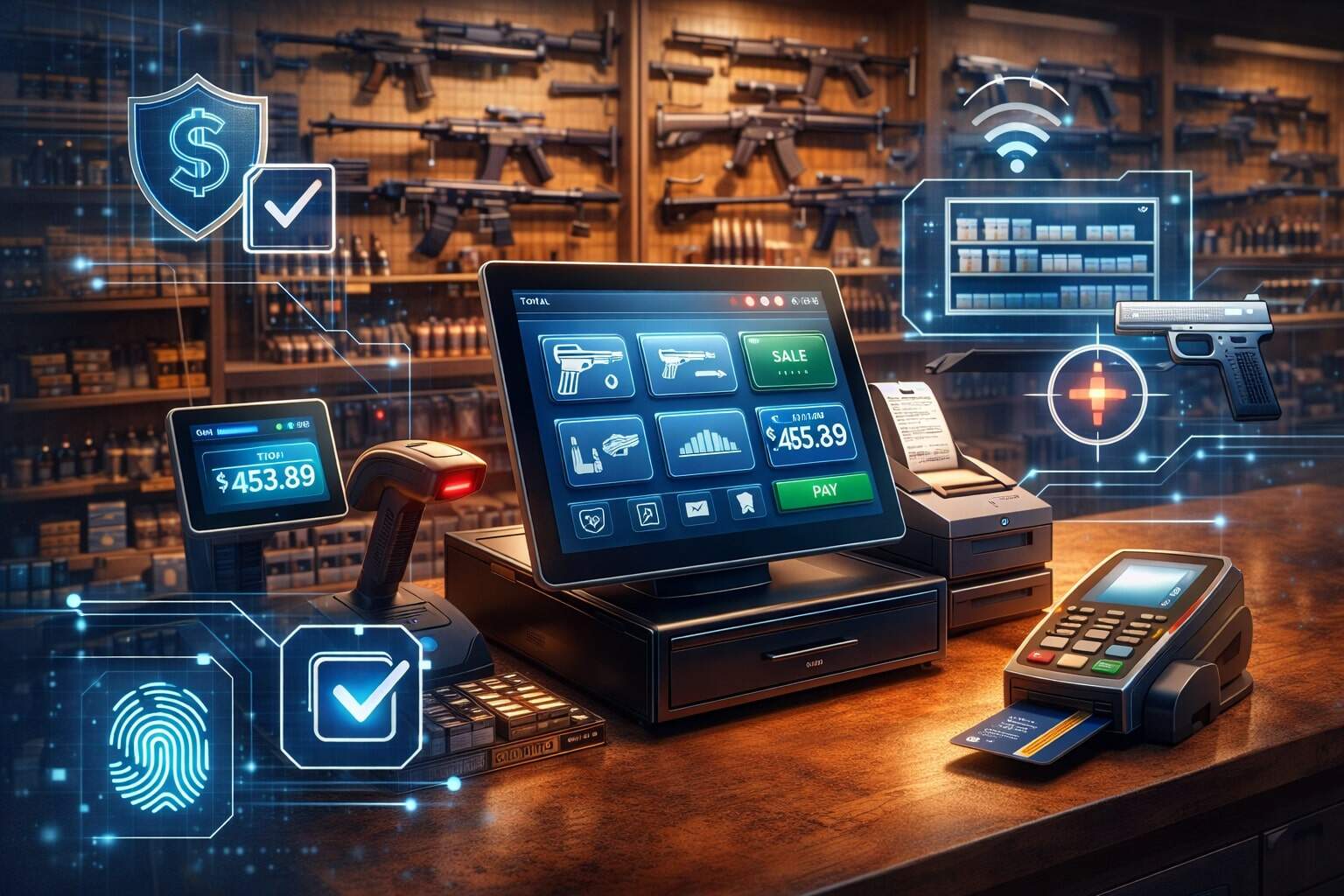
Choosing the best POS systems for firearm stores is different from choosing a general retail POS. A typical boutique POS might be great at barcode scanning and discounts, but it can fall apart the moment you need firearm-specific workflows like serial-number tracking, compliance recordkeeping, transfer handling, layaways with regulated items, and tighter audit trails.
The best POS systems for firearm stores are built around the reality that your inventory isn’t “just SKUs”—it includes serialized items, regulated transfers, and documentation workflows that must be consistent every single time, even on your busiest Saturday.
This guide breaks down what matters most, how to evaluate options, and which platforms are most commonly considered when retailers search for the best POS systems for firearm stores.
It’s written for practical decision-making: smaller single-location shops, multi-location retailers, and stores that also run a range, training, gunsmithing, or eCommerce. You’ll also see forward-looking trends so you can choose a platform that won’t feel outdated in 18 months.
Why firearm retailers need a specialized POS
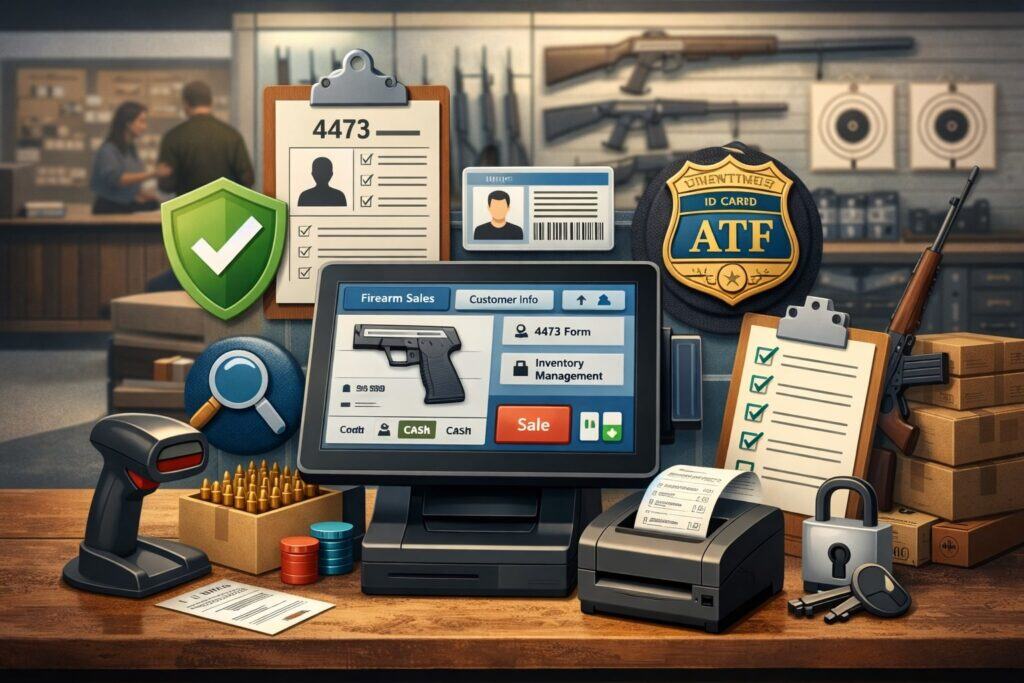
The biggest difference between a general POS and the best POS systems for firearm stores is how the system handles compliance-driven operational detail. A firearm store isn’t simply “ring item, take payment.”
It includes serialized inventory controls, consistent documentation steps, and staff permissions that reduce mistakes. Even if you already have a compliance workflow, a POS that isn’t designed for your environment forces your team to “work around the system”—and that’s where errors happen.
Another reason specialization matters is vendor policy risk. Some mainstream POS and payment ecosystems restrict or prohibit firearms businesses.
For example, Lightspeed’s Acceptable Use Policy includes language that the customer must not be a firearms store, and it may take action if it concludes the business is inconsistent with its policy.
For firearm retailers, this is not a minor detail—policy mismatches can lead to forced migrations, downtime, or sudden payment disruption. When you’re choosing the best POS systems for firearm stores, “firearm-friendly” isn’t a marketing phrase; it’s business continuity.
Finally, specialized platforms typically include firearm-industry features as first-class tools (not bolt-ons): bound book integrations, form workflows, transfer tracking, customer notes relevant to purchases, and inventory catalog structures built for firearms and accessories.
If your store has a range, training classes, rentals, or memberships, you’ll also want one system that can handle those transactions cleanly without duplicating customer profiles and reconciliation.
Compliance and recordkeeping realities that influence your POS choice
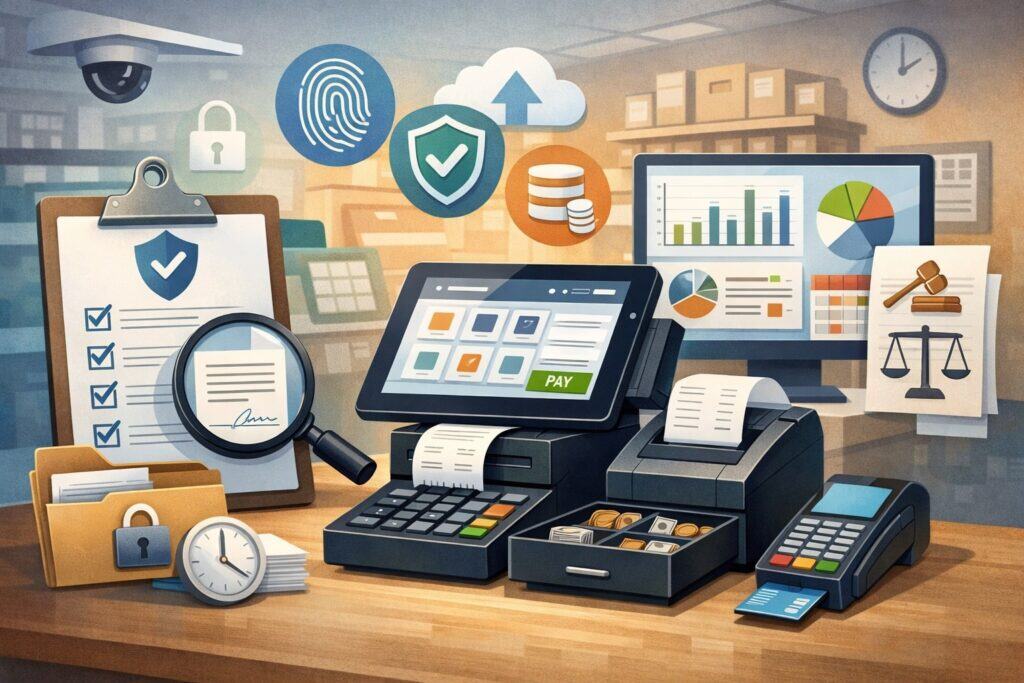
The best POS systems for firearm stores don’t replace your responsibility to follow regulations—but they can dramatically reduce human error.
In practice, compliance success is about consistency: the same steps, the same checks, the same documentation standards, every shift. A POS that supports your compliance flow helps you standardize what staff must do before a sale can be completed and what must be recorded after.
You’ll also want to pay attention to how vendors talk about updates, forms, and regulatory change. Federal rules can be amended and corrected, and agencies publish rule and ruling information as references for uniform understanding and application.
Even if you don’t rely on the POS for every compliance artifact, your system should make it easy to adapt: configurable workflows, required fields, staff prompts, and an audit trail.
A practical example: if your business handles transfers, consignments, special orders, and holds, you need a system that records the “why” behind inventory movement—who touched it, when, and under what transaction type.
That history is operational gold in normal times and incredibly valuable during audits or internal investigations. The best POS systems for firearm stores treat traceability as a feature, not an afterthought.
What “firearm-friendly” POS actually means (beyond marketing)
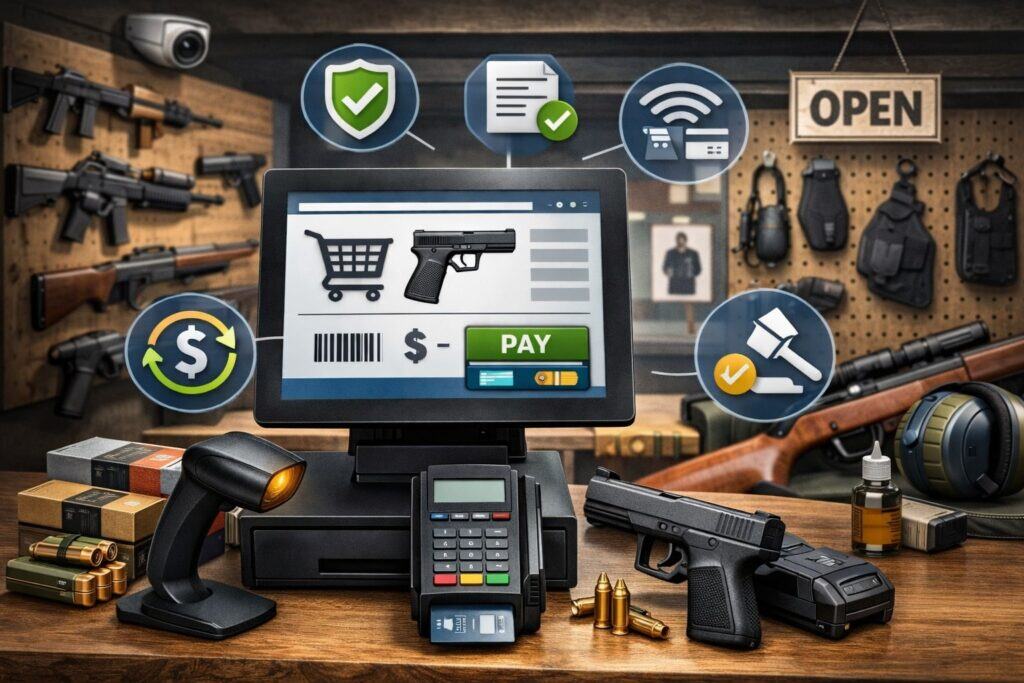
A POS can claim it’s industry-ready, but the best POS systems for firearm stores share specific characteristics you can verify during a demo:
Contract and policy alignment
Firearm-friendly means the vendor’s platform and payment stack are compatible with your business category and product mix. This matters because some providers restrict firearm sales on their platforms.
Lightspeed, for instance, publishes policy language restricting firearms stores in its acceptable use materials. When evaluating the best POS systems for firearm stores, ask directly: “Do you allow firearm retailers on your POS and commerce tools, and is it in writing?”
Built-in inventory controls for serialized items
You should be able to attach unique identifiers to regulated inventory, prevent duplicate serial entries, and pull reports quickly. Even if your compliance tool is separate, your POS should match your operational reality.
Audit trail, staff permissions, and tamper resistance
The best POS systems for firearm stores let you control who can void, refund, override prices, edit item records, or change customer data—and they log every action.
Integrated commerce and data consistency
If you sell online, you need consistent inventory counts and product data across channels, ideally without fragile integrations. Many firearm-specific vendors advertise integrated POS + eCommerce + compliance workflows for this reason.
Non-negotiable features checklist for the best POS systems for firearm stores

When retailers compare the best POS systems for firearm stores, features can sound similar on paper. This checklist focuses on what you should treat as non-negotiable for a modern store.
Inventory mastery (serialized + non-serialized)
You need flexible product types: serialized items, standard SKUs, kits/bundles, and services. The system should support vendor catalogs, receiving workflows, and cycle counts. If the POS makes inventory painful, your reordering, shrink control, and profitability all suffer.
Transfers, holds, layaway, and special orders
The best POS systems for firearm stores support real store behaviors: deposits, partial payments, holds with expiration, and status tracking so staff knows what can be released and when. If your POS forces you to use manual workarounds, it increases mistakes.
Customer profiles and compliance-adjacent notes
You want customer history, purchase patterns, and notes that help staff deliver better service. Just as important: role-based access controls so sensitive notes aren’t visible to everyone.
Reporting that actually answers owner questions
A good POS doesn’t just output sales totals. It helps you answer: Which categories drive margin? Which vendor lines are dead stock? Who is discounting too much? Which location is underperforming? The best POS systems for firearm stores provide clear reporting and export options for accounting.
Payment flexibility and high-risk readiness
Even if your POS is great, payment issues can cripple operations. Firearm retailers often need industry-friendly processing options, risk controls, chargeback tools, and clear policies—especially if selling online.
Cloud vs. on-premise: which is better for firearm retail?

There isn’t one right answer, but the best POS systems for firearm stores will match your operational tolerance for outages, updates, and remote management.
Cloud POS advantages
Cloud systems are easier to manage across locations, typically update more frequently, and can be accessed remotely for reporting and inventory oversight. If your store relies on online sales, cloud-first tools can reduce sync issues.
Cloud POS tradeoffs
You’re dependent on internet reliability and vendor uptime. Some vendors offer offline modes; you should test how offline transactions reconcile when connectivity returns.
On-premise advantages
On-premise options can offer stronger “always-on” reliability in low-connectivity areas and can be appealing for owners who prefer local control. Some long-standing retail platforms started as on-premise and later added cloud components.
On-premise tradeoffs
Updates and support can be more complex. If you run multiple locations or want to expand into eCommerce, on-premise systems can require heavier integration work.
The best POS systems for firearm stores are the ones that match your store’s day-to-day realities: staffing, internet reliability, number of locations, and how often you add SKUs.
Top firearm-focused POS platforms retailers commonly shortlist
The section below explains why certain vendors often appear in “best of” discussions for the best POS systems for firearm stores. Treat this as a structured shortlist guide—not a substitute for demos and written policy verification.
Bravo Store Systems: all-in-one platform positioning for firearms retail
Bravo is frequently evaluated by retailers searching for the best POS systems for firearm stores because it markets an all-in-one approach: POS, inventory, and compliance-oriented workflows, along with commerce capabilities.
Bravo also publishes comparisons aimed at firearm retailers who are migrating away from platforms with restrictive policies, positioning itself as firearm-friendly.
Where Bravo can fit well is in stores that want one vendor to own more of the operational stack—especially if you’re tired of stitching together a POS, a compliance system, and separate commerce tools.
In demos, pay attention to inventory controls, multi-location management, and how the system tracks and reports on serialized items. Also evaluate permission settings: how easy it is to prevent unauthorized overrides and how cleanly the audit trail captures voids, refunds, price edits, and inventory adjustments.
A practical evaluation tip: ask what the “happy path” looks like for your most common transaction types. If your store does transfers, consignments, trade-ins, or range-related activity, you want to see those workflows—not just a simple retail checkout.
If you want social proof signals, Bravo has highlighted recognition from SourceForge for its gun store POS offering, citing strong reviews and reliability. That doesn’t prove it’s perfect for your store, but it can be one data point when comparing the best POS systems for firearm stores.
Orchid POS: integrated POS + compliance positioning with transparent packaging
Orchid is another name that comes up often when retailers research the best POS systems for firearm stores, especially for businesses that want an integrated POS, bound book, and form workflows in one ecosystem.
Orchid’s marketing emphasizes an ATF-compliant retail POS with integrated eCommerce, plus data migration support when switching systems.
One reason Orchid gets short-listed is packaging clarity: it publicly describes plan components like POS, bound book, form storage, and payments. When you’re evaluating any “all-in-one” platform, that transparency helps you understand what is truly included versus what requires add-ons or third-party tools.
During evaluation, focus on three things:
- Workflow enforcement: Can you require staff to capture needed data at the right time?
- Inventory depth: Can you model your store accurately (serialized items, accessories, kits, services)?
- Commerce fit: If you sell online, how does inventory sync work? How are returns and exchanges handled across channels?
The best POS systems for firearm stores reduce complexity. If Orchid’s all-in-one model aligns with your store, it can reduce the “three systems + three support teams” problem. But you should still validate integrations you rely on (accounting, shipping, marketing, scanners, label printing) so you don’t discover gaps after signing.
Gun StoreMaster: compliance-forward positioning and guided onboarding
Gun StoreMaster is positioned heavily around compliance and operational strength, and it’s commonly mentioned in shortlists for the best POS systems for firearm stores where audit-readiness and structured processes are top priorities.
The vendor emphasizes guided tours, training, and support resources, along with onboarding help such as records import and training for new customers.
For many retailers, a system’s long-term success depends less on feature checklists and more on adoption: whether your staff actually uses it correctly every day. A vendor that provides training resources and structured onboarding can reduce the “we bought software and nothing changed” outcome.
When you demo, don’t just ask “does it do X?” Ask “how does it do X and how hard is it for a cashier to do it correctly?” In the best POS systems for firearm stores, the default path should be the correct path. Your staff shouldn’t have to remember 12 steps from memory. The system should guide them.
Also evaluate reporting: can you quickly answer compliance-adjacent questions, such as tracing item movement history, identifying unusual refund patterns, or validating that your serialized inventory counts match physical reality?
Strong reporting is not glamorous, but it’s one of the reasons owners say they finally found the best POS systems for firearm stores after years of frustration.
FastBound (and similar compliance platforms): when POS + compliance are separate by design
Some firearm retailers prefer a best-of-breed approach: a retail-focused POS plus a dedicated compliance platform. FastBound is one example that markets electronic bound books and forms support with automatic updates aligned to policy changes.
In a split-stack approach, your POS handles sales, inventory, and customer management, while the compliance platform focuses on records and regulatory workflows.
This setup can work very well if:
- You already have a POS you love for retail operations,
- Your team is comfortable using two systems, and
- Integrations are reliable (or your volume makes manual syncing manageable).
The risk is fragmentation. If your POS and compliance tool don’t sync smoothly—or if your staff treats one system as “optional”—you can create gaps that cost time and increase error.
The best POS systems for firearm stores minimize duplicated data entry. If you go split-stack, design your workflow to reduce repeated inputs: scanners, import routines, or structured daily reconciliation steps.
A forward-looking point: as more retailers demand unified reporting and fewer tools, many vendors are moving toward tighter integration or single-platform models. If you choose split-stack today, consider whether your vendor roadmap supports deeper connections over time.
Why general retail POS platforms are risky for firearm retailers
A common temptation is to use a mainstream POS because it looks sleek, has lots of integrations, and your staff already knows it. The problem: the best POS systems for firearm stores must match not only your operational needs but also your category risk and vendor policies.
Lightspeed is a good example of why you must verify policy fit early. Its acceptable use language includes restrictions related to firearms stores. In addition, firearm-industry vendors have publicly discussed situations where firearm retailers needed to migrate away from restricted platforms.
Whether or not a specific mainstream POS works for your store can change with policy updates, payment processor relationships, or platform rule enforcement. That uncertainty is a serious operational risk.
If you still want a general retail POS for certain reasons (UI, hardware ecosystem, local support), treat it as a compliance project: request written approval, verify that firearms sales are permitted on POS and eCommerce components, confirm payment support, and evaluate what happens if policy changes.
Retailers who choose the best POS systems for firearm stores usually choose stability over aesthetics.
Step-by-step: how to choose the best POS systems for firearm stores
This process is designed to help you pick the best POS systems for firearm stores without getting overwhelmed by demos and sales calls.
Step 1: map your real transaction types
List the top 15 transactions your store runs: serialized sales, accessories, range lane fees, classes, memberships, transfers, special orders, deposits, refunds, trade-ins, consignments, gunsmithing services. Your POS must handle the majority cleanly.
Step 2: define compliance workflow ownership
Decide whether compliance is inside the POS ecosystem or separate. Then document the “who does what” steps, including manager approvals. The best POS systems for firearm stores support that workflow rather than forcing you into theirs.
Step 3: pressure-test inventory and reporting
Ask vendors to show: receiving, corrections, cycle counts, dead stock reporting, vendor performance, and margins by category. A POS that can’t help you manage inventory will not feel like one of the best POS systems for firearm stores after the honeymoon period.
Step 4: validate policy and payments in writing
This is critical. Get written confirmation of category support and payment acceptance for your product mix. Avoid assumptions.
Step 5: run a pilot plan
Choose one lane: one register, one department, or one location. Measure speed at checkout, inventory accuracy, and how often staff gets stuck. The best POS systems for firearm stores should reduce friction within the first few weeks, not increase it.
Implementation: migration tips that prevent downtime and data mess
Even the best POS systems for firearm stores can fail if implementation is rushed. POS changes touch everything: pricing, inventory, customer accounts, accounting exports, and staff habits.
Data migration that matters
Prioritize accuracy of on-hand inventory, vendor catalogs, customer records, and historical transactions that your team needs regularly. If you’re moving compliance histories, confirm what can be imported and what must remain archived. Some firearm-focused vendors emphasize migrating A&D history and inventory as part of switching.
Hardware and scanning workflow
Test barcode scanning speed, label printing, and how quickly staff can locate items. Serialized items should be fast to find and verify. If your checkout takes 90 seconds longer per customer, the line will punish you.
Staff training and permissions
Permissions protect you from internal mistakes. Train cashiers on the “happy path,” train managers on overrides, and train owners on reporting. Vendors that include training resources and onboarding support can reduce adoption risk.
Accounting reconciliation
Your POS is not your accounting system, but it must export clean data. Validate how sales tax is captured, how deposits are recorded, and how refunds appear. The best POS systems for firearm stores make reconciliation predictable.
Future predictions: where firearm retail POS is heading in 2026–2028
The next wave of the best POS systems for firearm stores will likely be defined by three shifts: deeper compliance automation, smarter inventory intelligence, and tighter payments risk controls.
Compliance automation becomes “workflow-first”
Instead of “here are forms,” platforms will increasingly push guided workflows that reduce staff discretion. This mirrors what retailers want: fewer mistakes, fewer exceptions, more audit-ready history. As rulemaking continues and corrections/updates occur, vendors that update workflows quickly will stand out.
Inventory intelligence becomes more predictive
Expect more tools that flag dead stock, suggest reorder quantities based on seasonality, and identify unusual shrink patterns. The best POS systems for firearm stores will move from reporting what happened to recommending what to do next.
Payments and fraud controls become more integrated
As card networks and processors maintain strict risk standards, more POS platforms will build advanced fraud signals, stronger dispute tooling, and customer verification steps into the checkout flow.
Even general POS platforms already use register rules like age verification prompts for restricted items, reflecting a broader shift toward embedded compliance prompts at checkout.
Unified commerce remains a priority
Retailers want one inventory truth across in-store and online channels. Firearm-focused vendors promoting integrated POS + eCommerce are betting on this being the default expectation. If you plan to grow online, weigh this heavily when choosing among the best POS systems for firearm stores.
FAQs
Q.1: What is the single most important feature in the best POS systems for firearm stores?
Answer: The most important feature is traceability: the ability to track inventory movement, staff actions, and transaction history with a clear audit trail. The best POS systems for firearm stores reduce human error by guiding workflows and logging who did what, when, and why.
Without traceability, you’ll spend too much time resolving inventory discrepancies and reconciling exceptions, and you’ll have less confidence in reports during critical moments.
Q.2: Can I use a mainstream POS if it has good inventory and reporting?
Answer: Sometimes, but it’s risky. Vendor policies can restrict firearms businesses. For example, Lightspeed’s acceptable use language includes restrictions for firearms stores.
If you choose a mainstream platform, get written confirmation that your business category and product mix are permitted on the POS, payments, and eCommerce components. In practice, many retailers searching for the best POS systems for firearm stores choose firearm-focused vendors to reduce policy and continuity risk.
Q.3: Do I need an all-in-one platform or separate POS + compliance tools?
Answer: Both can work. All-in-one platforms can reduce complexity and duplicate data entry, which is a big reason people shop for the best POS systems for firearm stores in the first place.
Separate tools can be ideal if you already have a POS you love and you want a dedicated compliance platform that evolves quickly. If you separate systems, make sure workflows prevent staff from skipping steps and that reporting remains cohesive.
Q.4: How do I compare vendors during demos without getting overwhelmed?
Answer: Bring your top 10 transaction types and ask vendors to run them live. Include transfers, deposits, refunds, and serialized sales. Then ask to see inventory receiving, cycle counts, and margin reporting. The best POS systems for firearm stores will handle the “messy real world,” not just a clean retail checkout.
Q.5: What causes POS migrations to fail?
Answer: Migrations fail when owners underestimate data cleanup, staff training, and process change. The best POS systems for firearm stores still require implementation discipline: accurate inventory import, permissions setup, consistent scanning workflows, and daily reconciliation during the first month. Vendors that offer onboarding, training, and structured support can reduce risk.
Q.6: What should I ask about payments when choosing the best POS systems for firearm stores?
Answer: Ask who the processor is, whether your category is supported, what documentation is required, and what happens if risk reviews occur. Also ask about chargeback tools, fraud controls, and how refunds and partial captures work. Payments can be the hidden failure point—even if the POS looks perfect.
Conclusion
The best POS systems for firearm stores are the ones that protect your operations: they support your workflows, reduce mistakes, keep inventory accurate, and align with vendor and payment policies that won’t surprise you later. Firearm retail demands more than a pretty checkout screen.
It demands traceability, permissions, serialized inventory discipline, and business continuity. The wrong platform forces workarounds; the right one makes compliance and retail operations feel like one cohesive routine.