Choosing the best card readers for farmers markets isn’t only about taking tap-to-pay. It’s about getting paid reliably in crowded outdoor settings, keeping lines moving, handling weak signals, and protecting margins with predictable fees.
The best card readers for farmers markets also help you track what sells (and when), manage inventory across multiple market days, and make payouts fast enough to restock before the next event.
In real-world market conditions—sun glare, spotty cellular service, long customer lines, and hurried checkouts—the wrong setup can cost you sales. The best card readers for farmers markets are the ones that stay connected, accept chip + contactless, support digital wallets, and still work when you’re not standing next to a router.
They should also be easy for part-time helpers to use, and flexible enough to sell produce by weight, bundles, or variants.
This guide breaks down the best card readers for farmers markets for different vendor types—new vendors, high-volume booths, multi-location sellers, and vendors who need more advanced POS features.
It also includes setup tips, fee math, and future trends that are already reshaping how the best card readers for farmers markets will work over the next few seasons.
Why the “best card readers for farmers markets” are different from regular retail
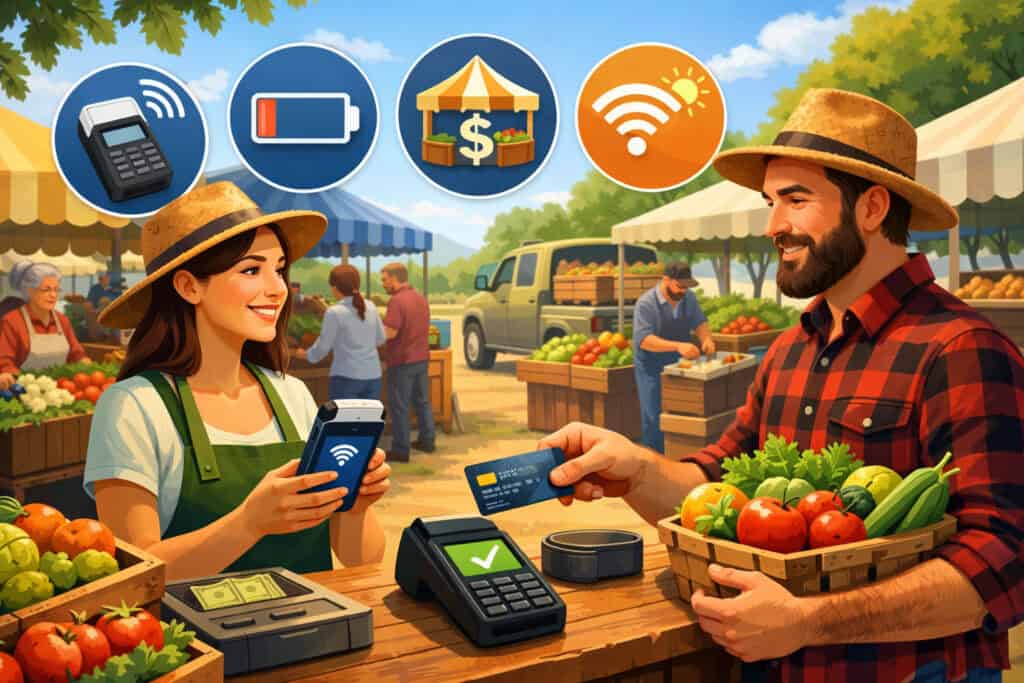
Outdoor selling changes everything. A typical counter checkout has stable power, strong internet, and a controlled environment. Farmers markets don’t. The best card readers for farmers markets must handle fluctuating network quality and still complete transactions quickly.
A reader that’s “fine” in a storefront might frustrate you at a market when customers are waiting with perishables and you’re juggling bags, change, and receipts.
Another key difference: many vendors rely on a phone as the POS. That means your whole payment experience depends on battery, brightness, app stability, and Bluetooth performance.
The best card readers for farmers markets should pair quickly, stay paired, and allow fast retry if a payment fails. When you’re processing 80–200 small tickets in a short market window, those seconds matter.
Fees matter more at markets, too, because average ticket sizes can be small. With $6, $9, or $14 transactions, a few cents per sale adds up fast. The best card readers for farmers markets are transparent about rates and help you nudge customers toward contactless methods that reduce checkout time and abandoned sales.
For example, Square publicly outlines its processing fees and categories, which makes it easier to estimate cost per market day.
Finally, the market environment pushes you toward simple workflows: quick product buttons, easy tipping, and painless refunds. The best card readers for farmers markets don’t just “take cards”—they help you run the booth like a tiny, efficient retail operation without slowing you down.
The core features to demand in card readers for farmers markets
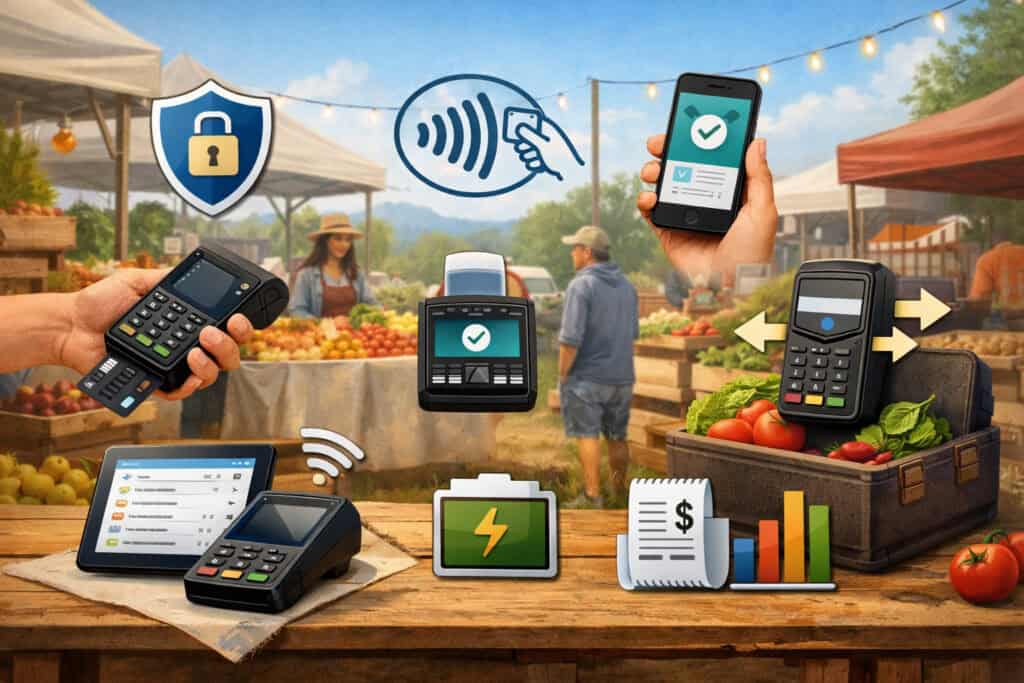
The best card readers for farmers markets share a core set of features that prevent chaos at checkout. First is contactless + chip acceptance. Customers increasingly expect tap-to-pay, and the best reader makes it fast and consistent. If a reader only supports swipe, you’ll deal with more declines and more friction.
Second is offline or “limited connectivity” modes. True offline payment varies by provider, and there are not all systems treated offline the same way. But the best card readers for farmers markets at least give you a realistic path when signal drops—whether that’s storing transactions for later, switching networks, or using a second device as a hotspot.
Third is battery and portability. Many market vendors run four to six hours without access to power. The best card readers for farmers markets either sip power (Bluetooth readers paired to your phone) or have their own battery designed for mobile selling. You should plan for a power bank either way, but the right hardware reduces stress.
Fourth is simple catalog + pricing tools. Even if you only sell 15 items, having buttons for “dozen eggs,” “2 lb tomatoes,” or “small bouquet” speeds checkout. The best card readers for farmers markets integrate with a POS app that supports quick items, modifiers, discounts, and taxes without turning your checkout into a spreadsheet.
Fifth is payout speed and reporting. Market vendors often restock multiple times per week. Cash flow matters. A strong POS should clearly report daily sales and show net deposits in an easy-to-audit way.
Lastly is support for modern tap-to-pay paths. Smartphone-based contactless acceptance continues to expand, and platforms like Apple’s Tap to Pay on iPhone show where the market is heading: fewer dedicated devices, more phone-as-terminal options.
Even if you still prefer a physical reader today, the best card readers for farmers markets should align with that future.
Best card readers for farmers markets for most vendors: Square Reader + Square POS
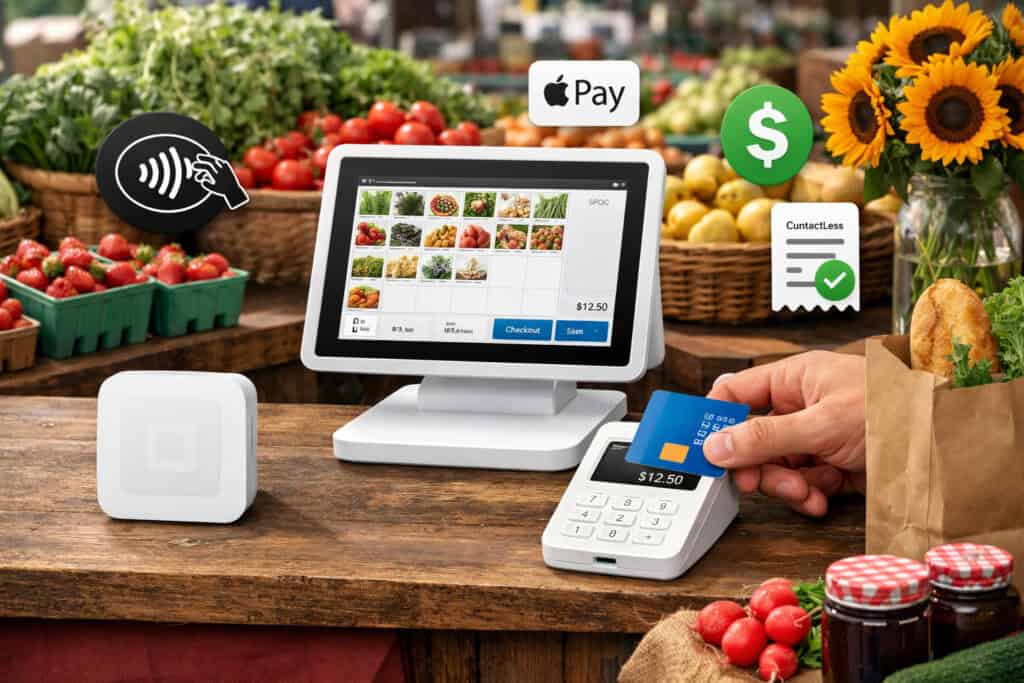
For many vendors, the best card readers for farmers markets start with Square because it’s built for quick setup, straightforward mobile selling, and easy scaling from “one booth” to “multi-staff, multi-device.”
Square’s ecosystem is also popular because you can start small and add tools (inventory, invoices, online ordering) later without rebuilding everything.
Square’s hardware lineup includes lightweight readers for magstripe and contactless/chip, and it’s easy to buy replacement devices quickly. Square’s own hardware shop is a reliable source for compatible devices.
The biggest day-to-day benefit is speed: open the POS app, tap an item button, and accept a payment in seconds. That’s what you need when the line gets long.
Fees are a major reason Square frequently lands on “best card readers for farmers markets” lists. Square clearly publishes its fee structure, which helps vendors estimate processing cost per ticket type and avoid surprises.
While rates can vary by plan or product, the transparency and consistency are useful for market vendors who want predictable margins.
Square is especially strong for:
- New vendors who want a fast launch
- Vendors who need simple inventory and item buttons
- Booths with one to three staff members
- Sellers who want to add online orders later
If you’re searching for best card readers for farmers markets that balance simplicity, speed, and a broad feature set, Square is a top default because it solves the most common market problems without heavy setup.
Best card readers for farmers markets if you sell online too: Shopify card reader + Shopify POS
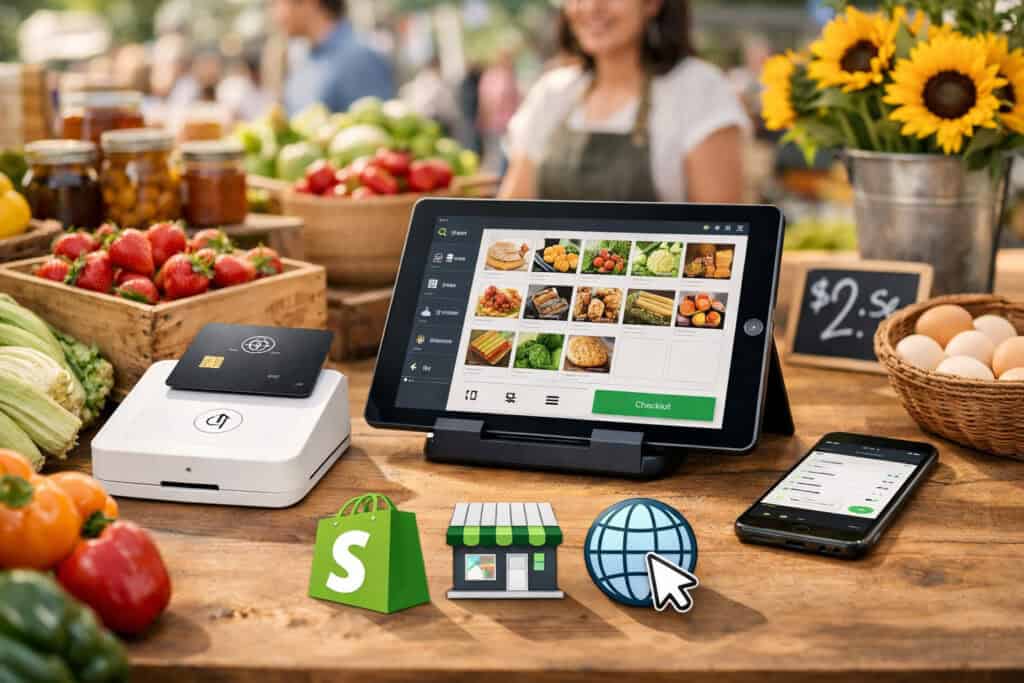
If your market booth is part of a bigger brand—online store, subscriptions, pre-orders, shipping—then the best card readers for farmers markets may be the ones that unify in-person and online inventory.
Shopify’s POS ecosystem is designed around omnichannel selling, and Shopify publishes guidance on POS hardware setups and what devices retailers typically need.
The biggest advantage is one “source of truth” for products and stock. Instead of manually reconciling what you sold at the market versus what’s available online, Shopify’s workflow can reduce double-selling and stock confusion. For vendors who offer pre-orders, seasonal boxes, or recurring items, this matters.
Shopify Payments has rate structures and card-type details documented in its help center, which is useful when you’re estimating effective cost for different customer payment methods.
That level of documentation helps vendors compare real costs when choosing the best card readers for farmers markets across platforms.
Shopify tends to be a strong pick for:
- Vendors with an established ecommerce store
- Brands that sell at markets, pop-ups, and events
- Sellers with many variants (sizes, bundles, flavors)
- Teams that want customer profiles and marketing flows tied to purchases
One realistic consideration: Shopify can feel “bigger” than what a first-time market vendor needs. But if your goal is growth, the best card readers for farmers markets may be the system that prevents you from outgrowing your checkout in six months.
Best card readers for farmers markets for managed merchant accounts: Clover Go
Some vendors prefer (or already have) a traditional merchant account through a processor relationship and want hardware that fits that model.
In that case, Clover Go can be a strong contender among the best card readers for farmers markets, especially when you want a recognizable POS platform and a path to more full-featured Clover devices later.
Clover offers a specific pricing page for Clover Go bundles, which is useful if you want to compare upfront costs and package options. For a market vendor, what matters is how quickly your team can run a sale, how stable the connection is, and whether the reporting is clear enough for end-of-day reconciliation.
Clover can be a good fit for:
- Vendors who already have (or want) a merchant account relationship
- Sellers who may later move to a countertop Clover device
- Booths that want add-on apps and Clover’s ecosystem
A practical note when evaluating the best card readers for farmers markets in the Clover family: fees and contracts can vary depending on the processor and reseller path, so you’ll want to compare the full package, not just the reader price. Independent reviews often highlight how Clover’s costs depend on the plan and provider.
If you want the Clover ecosystem and mobile acceptance without committing to a full station today, Clover Go can belong on your shortlist of best card readers for farmers markets.
Best card readers for farmers markets for PayPal-first sellers: PayPal POS (formerly Zettle)
If a big chunk of your customers already pay through PayPal, or you run a PayPal-heavy online business, then PayPal’s POS ecosystem can make sense as one of the best card readers for farmers markets—especially if you want a unified place to manage balances, transfers, and business tools.
PayPal’s own POS pricing page discusses its hardware options and general approach to POS fees. For fee specifics, reputable third-party reviewers report in-person rates and compare how PayPal POS stacks up against alternatives. For example, NerdWallet’s PayPal POS review lists in-person pricing and key decision factors.
PayPal POS can be a strong fit for:
- Vendors who invoice customers during the week and sell in-person on weekends
- Sellers who already use PayPal for online checkout
- Vendors who want quick access to funds in a PayPal balance workflow
When thinking about best card readers for farmers markets, PayPal’s value is usually about ecosystem convenience: it can reduce the number of platforms you manage. If that convenience saves time and lowers errors, it can be worth it even if your fee math is similar to other options.
Best card readers for farmers markets on a tight budget: SumUp
If you want a low-commitment option—especially as a new vendor testing markets—SumUp is often mentioned among the best card readers for farmers markets because it’s designed for simple, mobile selling without complex monthly plans.
SumUp documents its pricing and transaction fees in its support materials, which helps vendors avoid guesswork when calculating costs. That clarity matters when your booth is just getting started and every percent of margin matters.
SumUp can be a good match for:
- First-time vendors testing product-market fit
- Low-volume sellers who don’t need advanced inventory
- Vendors who want a quick backup reader alongside a primary system
The tradeoff is that some budget-friendly systems can feel limited when you expand: more staff, more SKUs, more reporting, and more integrations. Still, for vendors who want a straightforward way to accept payments and keep checkout moving, SumUp can earn its place in a “best card readers for farmers markets” list—especially as an entry-level start.
Best card readers for farmers markets by vendor type
The best card readers for farmers markets change depending on what you sell and how you sell it. A coffee booth has different needs than a produce stand, and a vendor selling packaged goods has different workflows than a seller doing custom bundles or made-to-order items.
Produce, baked goods, and high-speed lines
For high-speed lines, the best card readers for farmers markets are the ones with fast item buttons, quick tipping prompts (if relevant), and reliable contactless acceptance. Square is commonly strong here because it’s designed for rapid mobile checkout, and Square’s fee transparency helps you forecast the impact of small-ticket transactions.
If you do 200 transactions per market day, shaving even 5 seconds per customer can significantly reduce line pressure.
Multi-SKU brands with variants
If you have many SKUs, variants, or frequent product updates, the best card readers for farmers markets may be the system that keeps your product catalog synced across channels.
Shopify’s POS hardware guidance reflects this broader retail mindset and is built around complete setups rather than only “take a payment.” This matters if your market is one of several sales channels.
Vendors who need staff permissions and shift tracking
If you rotate staff, the best card readers for farmers markets should offer user roles, basic time tracking, and clean end-of-day reporting. Many systems can do this, but it’s often easier in platforms that expect multi-user retail environments.
Vendors who want a merchant account relationship
If you prefer negotiated pricing, dedicated support, or a managed merchant account approach, the best card readers for farmers markets may include Clover Go because it fits that ecosystem and can scale to more robust Clover devices.
A smart way to choose: decide what you’ll look like in 12–18 months. The best card readers for farmers markets are rarely the “flashiest”—they’re the ones that won’t force you to switch systems when your booth grows.
Connectivity and offline strategy for card readers for farmers markets
Connectivity is the silent deal-breaker. Many vendors buy a reader, set it up at home, and assume it will work the same way at the market. Then market day arrives—and the signal drops. The best card readers for farmers markets need a connectivity plan, not just a device.
Start with a simple “three-layer” strategy:
- Primary phone on a strong carrier for your market location
- Backup hotspot (or second phone) on a different carrier
- Battery plan: power bank + charging cable + spare
The best card readers for farmers markets are also the ones that recover quickly after interruptions. Bluetooth readers should reconnect easily and not require a full app restart. If the POS supports offline workflows, understand the rules: what transactions can be stored, what happens if a transaction fails later, and what your liability is.
Also consider physical placement. At many markets, moving two feet can change your signal quality because of crowds, tents, and nearby structures. The best card readers for farmers markets setup includes a consistent “checkout zone” where your phone and reader stay in the best signal spot, instead of wandering around the booth.
Finally, keep receipts optional but available. Text/email receipts reduce paper dependency and speed transactions. The best card readers for farmers markets let you toggle receipt preferences quickly, so you can keep the line moving while still offering proof of purchase.
Fee math: how to evaluate card readers for farmers markets without losing margin
To pick the best card readers for farmers markets, you should run fee math against your average ticket size, not someone else’s. Two systems with similar percentage rates can feel very different depending on per-transaction cents, refunds, chargebacks, and payout timing.
Square publicly explains its fee categories and helps merchants understand what they pay for different transaction types. That makes it easier to estimate daily processing cost. Similarly, PayPal POS reviews often list their in-person fee structure and how it’s applied, which can help you compare.
Here’s a practical evaluation approach:
- Estimate your average ticket (example: $12)
- Estimate number of transactions (example: 120)
- Compare total estimated fees per market day across 2–3 options
- Add hardware cost amortized over a season (example: 20 markets)
The best card readers for farmers markets are often the ones that minimize friction and increase conversion, not just the ones with the lowest rate. If a better checkout flow helps you capture 8 extra sales per day, that can easily outweigh a small fee difference.
Also, don’t ignore “hidden cost” categories:
- Paid add-ons you might need later (advanced inventory, ecommerce sync)
- Multiple device needs (extra readers for a second line)
- Support quality when something breaks on market morning
When you treat the best card readers for farmers markets as a revenue tool—not just an expense—you tend to choose more wisely.
Setup checklist for farmers market day success
Even the best card readers for farmers markets fail if the setup is sloppy. A strong setup checklist reduces surprises and makes your booth feel professional.
Hardware checklist
Bring: reader, backup reader (if possible), power bank, charging cables, phone stand, and a way to protect gear from heat or light rain. Outdoor markets punish electronics. The best card readers for farmers markets are durable, but even durable devices can overheat in direct sun.
POS checklist
Pre-load your item buttons and prices. Turn on tipping only if it matches your category and customer expectations. Set taxes correctly for your products. Configure receipt settings. Do a $1 test transaction the day before.
Network checklist
Test your carrier at the market location if possible. If you can’t, bring a second network option. The best card readers for farmers markets are paired with the best “connectivity plan,” not just the best device.
Workflow checklist
Train helpers on:
- How to retry a declined payment
- How to switch from tap to chip
- How to issue a refund
- How to find the last transaction quickly
A smooth workflow is part of what makes the best card readers for farmers markets feel “best.” Customers remember speed, clarity, and confidence.
Security, compliance, and customer trust at the booth
Customers are more willing to use cards when they trust your setup. The best card readers for farmers markets support secure chip and contactless transactions, and your POS should never store sensitive card data in unsafe ways.
Use legitimate hardware sources and keep your POS app updated. If your system supports phone-based tap acceptance, understand that major platforms are pushing this forward with secure NFC-based approaches, including Tap to Pay on iPhone capabilities documented by Apple.
This trend is part of why many vendors expect the best card readers for farmers markets to become “smaller” over time—possibly shifting from dedicated hardware to phone-as-terminal.
At the booth, small trust cues help:
- Clear signage: “Cards & contactless accepted”
- Keep the device facing the customer during tap/chip steps
- Offer receipts digitally
- Avoid asking customers to read numbers out loud
Security isn’t only technical—it’s also presentation. The best card readers for farmers markets make payments feel normal and professional, which reduces hesitation and increases completed sales.
Future prediction: where card readers for farmers markets are heading next
The best card readers for farmers markets in the near future will look more like software than hardware. Smartphone tap-to-pay acceptance is expanding and will likely become a default path for many small vendors—especially those who want fewer devices to charge, pair, and replace.
Apple’s Tap to Pay on iPhone documentation shows how the phone can function as a secure contactless acceptance point.
As this expands across providers, more vendors will start with “phone-only” acceptance and add hardware only when volume demands it.
Expect these trends to shape the best card readers for farmers markets over the next seasons:
- More contactless adoption: Tap payments reduce friction and speed lines, and customers increasingly expect it.
- Offline resilience as a selling point: Providers will compete on how gracefully they handle weak connectivity and how clearly they explain offline risk.
- Faster payouts and cash-flow tools: Vendors want quicker access to funds, especially during peak season when restocking is constant.
- Better inventory intelligence for small sellers: Even “simple” POS systems are adding smarter reports, best-seller tracking, and multi-location inventory logic—so market vendors can operate like mini retailers.
- Hardware simplification: Expect fewer cable-based readers and more compact Bluetooth or phone-based acceptance, reducing the “gear burden” of a market booth.
In short, the best card readers for farmers markets will increasingly be the ones that combine fast, modern acceptance with minimal hardware and strong reliability in unpredictable environments.
FAQs
Q.1: Which is the best card reader for farmers markets for a brand-new vendor?
Answer: For many new vendors, the best card readers for farmers markets are the ones that are quick to set up, easy to learn, and transparent about fees. Square is often chosen because you can start with simple hardware and a phone-based POS workflow, then expand features later. Square also provides a clear fee breakdown that helps new vendors estimate costs without surprises.
That said, if you already run an online store and want inventory sync from day one, Shopify’s POS ecosystem may be the best card readers for farmers markets approach for your situation, because it’s designed for omnichannel operations.
The “best” choice depends on whether you’re testing the market or building a multi-channel business.
Q.2: Do I need Wi-Fi at the market to use card readers for farmers markets?
Answer: You don’t need Wi-Fi specifically, but you do need some reliable connection—usually cellular. The best card readers for farmers markets perform well on cellular, recover quickly from brief drops, and keep checkout steps simple so customers don’t lose confidence.
Your best move is to plan for connectivity: a primary phone on one carrier and a backup hotspot/phone on another. Many “payment failures” at markets are actually network problems, not reader problems. A connectivity plan is part of choosing the best card readers for farmers markets.
Q.3: Are phone-only “tap to pay” options replacing card readers for farmers markets?
Answer: They’re moving in that direction, especially for small vendors and lower volumes. Apple’s Tap to Pay on iPhone is an example of the phone acting as a secure contactless acceptance device.
Over time, this can reduce the need for separate hardware in certain cases. However, many vendors still prefer dedicated card readers for farmers markets for consistency, battery separation, and smoother customer flow at high volume.
The likely outcome is a hybrid: phone-only for very small booths, and dedicated readers for busy sellers who need speed and redundancy.
Q.4: What’s the most important feature in the best card readers for farmers markets?
Answer: Reliability under pressure. The best card readers for farmers markets should support contactless + chip, pair consistently, and handle network hiccups with minimal downtime.
The “best” feature isn’t flashy—it’s the ability to process 100+ transactions without forcing you to troubleshoot in front of a line. After that, the next most important features are simple item buttons, fast refunds, and clear end-of-day reporting so you can close out quickly and move on.
Q.5: How do I keep processing fees from eating my profit at the market?
Answer: Start by calculating fees based on your average ticket size and transaction count. Square’s published fee information is helpful for estimating cost categories and understanding what triggers different rates.
Then optimize checkout to increase completed sales: faster lines, fewer failed payments, and better upsells (bundles, “add-on” items). Often, the best card readers for farmers markets are the ones that increase conversion and throughput, not just the ones with the lowest advertised rate.
Q.6: Should I buy one reader or two for a farmers market booth?
Answer: If your volume is low and your risk tolerance is high, one might work. But most experienced vendors eventually carry a backup. The best card readers for farmers markets strategy is redundancy: a backup reader, spare charging cable, and a second network option.
If something fails, you can switch in under a minute and keep selling. For high-volume booths, two readers also let you run two lines during rushes, which can increase total sales more than the cost of the extra device.
Conclusion
The best card readers for farmers markets are the ones that keep your booth moving when conditions are imperfect—because markets are always imperfect.
Sun glare, weak signal, long lines, and fast-paced selling reward systems that are simple, stable, and quick. For many vendors, Square remains a practical default because it’s built for mobile selling and clearly explains processing fees.
For vendors blending in-person and online sales, Shopify’s POS ecosystem can be a strong “unified commerce” choice with hardware and setup guidance designed for modern retail.
And for sellers who prefer a merchant-account ecosystem, Clover Go can fit the path from mobile acceptance to more robust POS devices.
As payment tech evolves, expect the best card readers for farmers markets to become lighter, more phone-driven, and more resilient—especially as tap-to-pay acceptance expands on smartphones.
But the fundamentals won’t change: customers want fast checkout, you want predictable costs, and your booth needs a system that works even when the environment doesn’t cooperate.