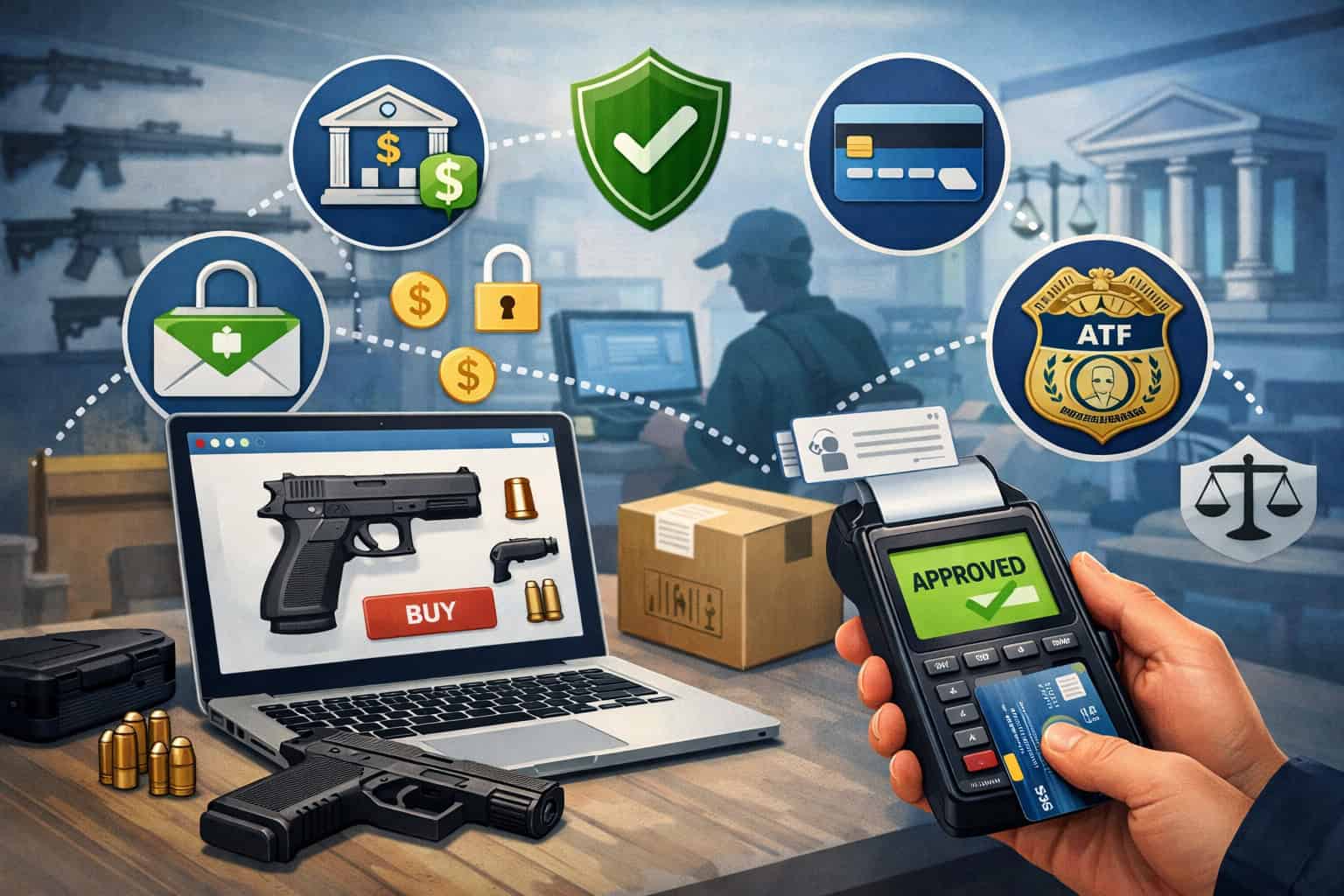
Accepting payments for online firearm sales legally is less about “finding a checkout button” and more about building a compliant system that your bank, payment partners, and regulators can trust.
Online firearm payment processing sits at the intersection of federal rules, state rules, card-network requirements, marketplace policies, shipping/carrier rules, and fraud/chargeback risk. If any one piece is missing, you can end up with frozen funds, terminated accounts, or worse—an investigation that disrupts your business.
The good news: online firearm payment processing can be done legally and sustainably when you approach it like a regulated e-commerce program.
That means you (1) understand when a license is required, (2) route firearm transfers through the correct licensee workflow, (3) use an underwritten, firearms-friendly merchant account (instead of consumer payment apps that prohibit firearms), (4) implement strong identity, age, and fraud controls, and (5) document every step so your processor can defend your program during audits.
This guide explains how to accept payments for online firearm sales legally with practical, compliance-first steps. It is informational, not legal advice—when you’re unsure, consult qualified counsel and your payment provider’s compliance team.
Understand the legal “shape” of an online firearm transaction
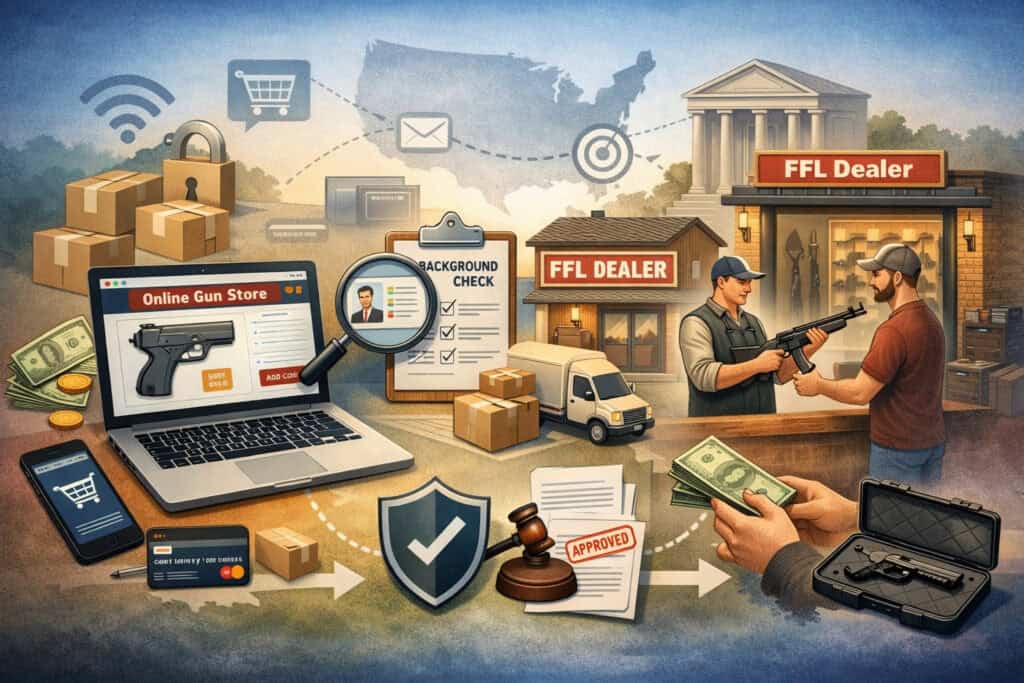
To accept payments for online firearm sales legally, you need to map the transaction into two tracks: money flow and firearm transfer flow. The money can move instantly online, but the firearm transfer is regulated and must follow specific handoff rules. Online firearm payment processing succeeds when the payment record matches a lawful transfer path.
At the federal level, a common compliant model is: the seller (often a licensee) takes the online order and payment, but the buyer takes possession only after the firearm is transferred through the appropriate licensee process in the buyer’s state of residence.
Federal guidance emphasizes that the receiving licensee in the buyer’s state completes the required paperwork and background check before the buyer takes possession, and recordkeeping should reflect shipment to the receiving licensee—not directly to the end purchaser.
This matters for online firearm payment processing because your processor and acquiring bank will ask: “How do you ensure the buyer doesn’t receive a firearm unlawfully?”
If your website, checkout, receipts, and shipping confirmations don’t clearly show a compliant transfer flow (for example, “ship to participating dealer / pickup after completion of required checks”), you can look like an illegal direct-to-consumer firearm shipper—even if you are not.
Also note that rules around who must be licensed have been tightening. In 2024, ATF finalized a rule clarifying when a person is considered “engaged in the business” of dealing in firearms and therefore must be licensed under the expanded statutory standard.
For online firearm payment processing, this means casual “side sellers” face higher risk if they repeatedly sell for profit without licensing.
When you need an FFL (and why payment partners care)

If you want to accept payments for online firearm sales legally, you must be confident about whether you are required to hold a Federal Firearms License (FFL) or operate through an FFL’s transfer process.
Payment partners treat “licensing clarity” as a gating item for approval because it determines whether your sales are lawful and whether the processor can support your business without facilitating prohibited activity.
Federal rules generally restrict a licensee from selling a firearm directly to a nonlicensee who resides in another state. Instead, the lawful path is typically shipment to a licensee in the purchaser’s state, where the purchaser takes delivery. That’s the backbone of compliant online firearm payment processing across state lines.
In addition, the 2024 ATF final rule interpreting the Bipartisan Safer Communities Act standard is designed to capture more sellers who are repeatedly selling for profit as being “engaged in the business,” which increases the number of people who must be licensed and run transfers properly.
If you’re building an e-commerce brand (not occasional hobby sales), assume you’ll need licensing and a full compliance workflow.
Why payment partners care:
- A bank underwriting your online firearm payment processing will ask for your license, policies, and documented controls.
- Card networks and acquiring banks expect regulated merchants to have enhanced compliance and risk mitigation.
- If you can’t show licensing alignment, you may be classified as an unacceptable risk and declined.
Build a compliant transfer workflow for online sales
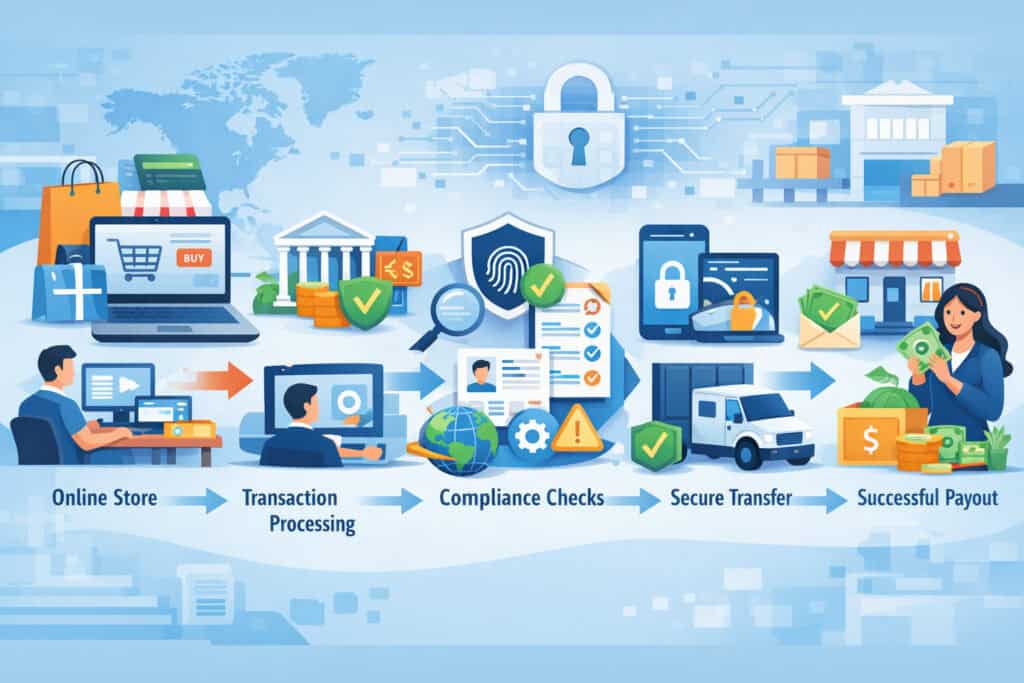
Online firearm payment processing is not “sell → ship to home.” A compliant online sale typically looks like “sell online → ship to receiving dealer → buyer completes required steps → buyer picks up.”
Federal guidance highlights that the receiving dealer in the buyer’s state is responsible for the transaction record (Form 4473) and background check, and that the shipping dealer’s records should reflect transfer to the receiving dealer.
A practical compliant workflow that payment providers like to see includes:
- Dealer locator at checkout: buyer selects a receiving dealer before the order can be finalized.
- Dealer verification: you verify the receiving dealer’s license status before shipping (keep evidence).
- Clear checkout disclosures: “Firearms ship only to a licensed dealer for pickup after completion of required steps.”
- Order status tied to compliance gates: paid order is “processing” until the receiving dealer is confirmed.
- No direct shipment to a buyer address for regulated items.
This structure helps you accept payments for online firearm sales legally because it shows (a) the money was taken for a lawful sale, and (b) delivery is controlled by the regulated transfer path.
It also reduces chargebacks: customers are less likely to dispute when your policy is crystal clear and repeated in the product page, cart, and confirmation email.
Finally, maintain consistency. Your website terms, shipping policy, refund policy, and customer support scripts should match. In online firearm payment processing, inconsistency is a common reason banks get nervous.
Choose the right payment setup (and avoid “prohibited” consumer apps)
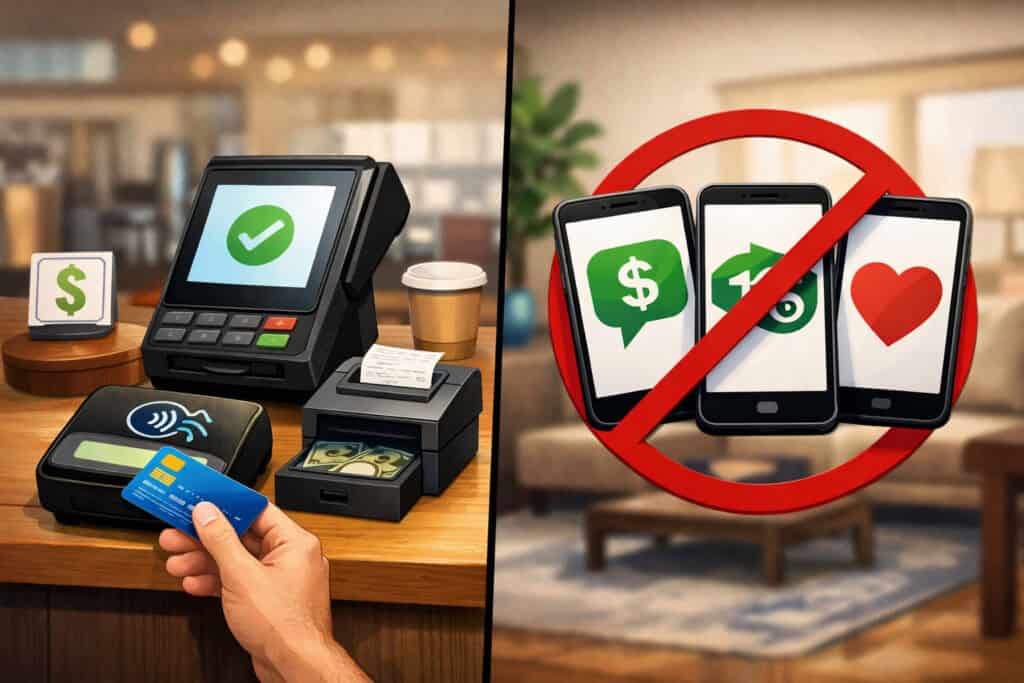
A major mistake is trying to run online firearm payment processing through consumer-first platforms that explicitly prohibit firearms. Even if your sale is lawful, violating a platform policy can lead to immediate termination and long fund holds.
Examples of policies you should treat as high risk for firearm transactions:
- PayPal prohibits transactions involving ammunition, firearms, and certain firearm parts/accessories.
- Square lists sales of firearms, firearm parts/hardware, and ammunition as prohibited business activity in its payment terms.
If you accept payments for online firearm sales legally, you should not structure your business around payment methods that can shut you down for policy reasons unrelated to legal compliance.
What usually works for online firearm payment processing:
- A fully underwritten merchant account with an acquiring bank that knowingly supports firearms-related e-commerce.
- A compatible payment gateway (or integrated checkout) that supports high-risk underwriting, fraud tools, and clear descriptor controls.
- Explicit approval in writing for your specific product mix (firearms vs. parts vs. accessories) and sales model.
Also be careful with “platform + payments bundle” products. Some storefront channels prohibit weapons, ammunition, explosives, or related accessories on specific shopping surfaces (for example, certain “discovery” or marketplace layers), even if your standalone website is allowed.
Shopify’s “Shop” channel, for example, lists weapons and ammunition as prohibited product types on that channel. For online firearm payment processing, that means you may need to disable certain channels and sell through your primary storefront only.
Underwriting: what banks and processors will request (and how to prepare)
Online firearm payment processing is often categorized as higher-risk e-commerce. That doesn’t mean “impossible.” It means underwriting is more detailed and your approvals depend on documentation quality.
Expect requests for:
- Business formation documents, beneficial ownership, and identity verification.
- Licensing and compliance records (FFL where applicable).
- Product catalog and a clear explanation of what you sell.
- Website review (terms, policies, checkout flow, shipping flow).
- Refund/return policy, customer support contacts, and dispute process.
- Processing projections (monthly volume, average ticket, peak season).
Banks want to see that you can accept payments for online firearm sales legally and manage card-not-present risk. That includes:
- Strong identity verification for high-risk orders.
- Shipping controls are consistent with regulated transfer rules.
- Clear communication to reduce “item not received” and “not as described” disputes.
If you’re vague—“we sell outdoor products”—you risk being treated as deceptive. Underwriters prefer clarity: “We sell regulated firearms online and ship only to a receiving dealer; we do not ship to residential addresses for regulated items; we maintain records of dealer verification.”
Fraud and chargeback controls that matter for firearms e-commerce
Online firearm payment processing must be defensible in disputes. Card networks and issuers don’t adjudicate firearm law. They adjudicate whether the cardholder experience was clear and whether the merchant met the promised terms.
Controls that help you accept payments for online firearm sales legally and reduce disputes:
- AVS + CVV enforcement on most transactions.
- 3-D Secure for higher-risk orders or first-time customers.
- Velocity checks (too many attempts, too many cards, too many addresses).
- Device fingerprinting and bot protection.
- Manual review triggers (high ticket, mismatch location, freight forwarding indicators).
Operational controls that matter just as much:
- Explicit product-page disclosures about regulated transfer and pickup.
- Signature-required delivery to the receiving dealer address.
- Documented dealer confirmation before shipment.
Also, set realistic timelines. Many disputes come from impatience. If the customer thinks a firearm will ship to their home in 24 hours, you’ll see chargebacks. If your checkout states “Ships to receiving dealer; pickup after completion of required steps,” disputes drop—and online firearm payment processing becomes more stable.
Age verification, identity checks, and “responsible person” policies
To accept payments for online firearm sales legally, implement controls that show you’re not selling to prohibited purchasers and not enabling straw purchases. Your payment partners will not expect you to run a background check online the same way a dealer does at transfer, but they will expect you to take reasonable precautions.
A practical compliance set for online firearm payment processing includes:
- Age gates on the site (and enforced at checkout).
- Identity verification for suspicious orders or high-risk products.
- Address validation and refusal to ship regulated items to non-dealer addresses.
- Clear policy against third-party purchasing (anti–straw purchase language) and a review process for red flags.
Also maintain a “responsible person” compliance program internally. The 2024 ATF rule also defined “responsible person” for certain regulatory contexts and expanded clarity around dealer-like activity.
From a payments standpoint, documenting who owns compliance decisions and how exceptions are handled makes underwriting smoother.
Shipping and fulfillment: align carriers, policies, and checkout language
In compliant online firearm payment processing, your fulfillment practices are evidence. If your shipping records show residential delivery of regulated items, you can trigger processor scrutiny, customer complaints, and legal risk. If your shipping records consistently show shipment to verified receiving dealers, you look like a controlled, compliant merchant.
Key practices:
- Ship regulated firearms only to verified receiving dealers (where required).
- Keep dealer license verification records and shipment logs.
- Ensure your packing slips and tracking notifications match your checkout disclosures.
Also align your refund and cancellation rules with compliance gates. For example:
- If the receiving dealer cannot accept the shipment, define how the order will be rerouted or refunded.
- If the buyer fails to complete pickup requirements, define return handling and restocking rules.
This clarity reduces disputes and supports stable online firearm payment processing. It also reassures banks: “This merchant has a process for the messy edge cases.”
Multi-state rules: what changes when you sell across state lines
State rules vary significantly on what can be sold, how it can be transferred, waiting periods, magazine restrictions, feature restrictions, and required documentation. Because of this, online firearm payment processing is often paired with a “restricted states” matrix and checkout logic that blocks non-compliant orders.
At the federal level, the principle remains that interstate transfers to nonlicensees are restricted and commonly require shipment to a licensee in the buyer’s state for completion of required steps. But state-level overlays can add:
- Additional waiting periods,
- Extra permits or eligibility checks,
- Product feature restrictions,
- Additional recordkeeping.
From a payments perspective, the goal is: don’t accept money for an order you can’t lawfully fulfill. If you take payment and then cancel because of state restrictions, you increase refunds and chargeback risk—hurting your online firearm payment processing approval and pricing over time.
The best approach is preventive:
- Maintain a compliance matrix and update it.
- Use checkout restrictions by state and product attributes.
- Provide clear messaging so customers understand why an item is unavailable.
Platform choices: website builders, marketplaces, and “channel” restrictions
Many sellers assume the biggest challenge is finding a processor. In reality, your commerce platform can be the hidden blocker. Some platforms allow firearm-related storefronts but restrict weapons on certain shopping channels, apps, or surfaces.
For example, Shopify’s “Shop” sales channel lists “weapons, ammunition, explosives, or related accessories” among prohibited product types for that channel. That doesn’t automatically mean your entire standalone store is banned, but it does mean a common growth tactic (“turn on every channel”) can break compliance.
For online firearm payment processing, choose a platform strategy that:
- Lets you control checkout flow and dealer selection.
- Supports third-party gateways and a firearms-friendly merchant account.
- Allows you to disable prohibited channels and still operate the core site.
The mistake to avoid is forcing a firearms business into a platform whose policies push you into workarounds. Workarounds lead to closures, frozen funds, and reputational harm. A stable online firearm payment processing setup is transparent and policy-aligned.
Recordkeeping, audits, and what “good” looks like to payment partners
The difference between “approved” and “approved for years” is documentation. Payment partners assume regulated merchants will be periodically reviewed. Your job is to make those reviews boring.
For online firearm payment processing, “good” looks like:
- A clear product catalog and category mapping (firearms vs. accessories).
- A written compliance policy explaining your transfer workflow.
- Proof that firearms ship only to verified receiving dealers when required.
- Logs of dealer verification and exception handling.
- A dispute playbook with templates and evidence checklists.
ATF compliance guidance emphasizes correct recordkeeping and compliance practices, including proper transfer procedures and background check responsibilities tied to the receiving dealer in the buyer’s state. While your processor isn’t the ATF, they want to know you operate in a way that aligns with these expectations.
Also document your payment descriptors and customer communication. Many chargebacks happen because a descriptor is confusing or your policy wasn’t visible. Clear descriptors + clear policies = fewer disputes = stronger online firearm payment processing longevity.
Common legal and payment mistakes (and how to avoid them)
Online firearm payment processing failures usually come from predictable mistakes:
- Using prohibited payment methods anyway: If a platform prohibits firearms, you may get shut down even if every sale is legal. PayPal and Square policies explicitly prohibit firearms-related transactions.
- Shipping/fulfillment mismatch: If your site says “ships to dealer only” but you sometimes ship elsewhere, your risk profile spikes. Underwriters assume inconsistency equals uncontrolled risk.
- Unclear terms: Vague policies create disputes. In online firearm payment processing, disputes create reserves, rolling holds, or termination.
- Accepting orders you can’t fulfill: Refund-heavy merchants look risky. Use state/product restrictions upfront.
- No compliance owner: When banks ask “who is responsible for compliance?” you need a real answer, with documents and logs.
Avoiding these mistakes is often the fastest path to stable approvals and better pricing.
Future predictions: where online firearm payment processing is heading
Online firearm payment processing is likely to see three ongoing trends:
1) More scrutiny on “who must be licensed”: The 2024 ATF final rule clarifying “engaged in the business” signals a continued focus on sellers who repeatedly sell for profit without proper licensing and controls. Payment partners tend to mirror enforcement priorities—so expect underwriting to increasingly ask about licensing, sourcing, and sales frequency.
2) Continued policy fragmentation across states: State-level variations will continue to shape what can be sold and how. That pushes merchants toward better compliance tooling—state rules matrices, automated restrictions, and documented exception handling.
3) Payments ecosystem volatility around firearms classification: Merchant classification debates (including merchant category code discussions) have produced a patchwork of state responses and ongoing industry attention.
Even when the intent is not to track item-level purchases, the public and political attention can influence how banks view firearms merchants. This makes stable online firearm payment processing more dependent on transparency, strong controls, and partners who explicitly support the category.
The takeaway: the merchants who invest in compliance operations—like a regulated fintech program—will have the easiest time maintaining approvals and scaling.
FAQs
Q.1: Is it legal to accept credit card payments for online firearm sales?
Answer: Yes, it can be legal to accept credit card payments for online firearm sales legally when the underlying sale and transfer comply with federal and state rules, and when your payment provider permits the category.
The critical point is that payment legality and provider policy are two separate gates. A lawful sale can still violate a platform’s acceptable use policy.
For example, some consumer payment platforms explicitly prohibit firearms-related transactions. PayPal’s acceptable use policy prohibits transactions involving ammunition, firearms, and certain parts/accessories.
Square’s payment terms list firearms, firearm parts/hardware, and ammunition as prohibited business activity. If you try to run online firearm payment processing through prohibited channels, you risk sudden termination and frozen funds.
A stable approach is to use a fully underwritten merchant account where your acquiring bank knowingly supports online firearm payment processing. Underwriting will usually require licensing documentation and a clear transfer workflow that aligns with regulated delivery practices (for example, shipping to a receiving dealer where required).
Q.2: Can I use PayPal, Venmo, Cash App, or Square for online firearm payment processing?
Answer: In most cases, you should not plan your business around these for firearms because policy risk is high. PayPal’s policy explicitly prohibits firearms and ammunition transactions.
Square’s payment terms also prohibit firearms, parts/hardware, and ammunition. Even if you are trying to accept payments for online firearm sales legally, policy violations can still result in account closure, holds, and dispute limitations.
Online firearm payment processing works best when your provider has explicitly approved your business model in writing. That typically means a firearms-friendly merchant account (not a consumer P2P wallet) and a gateway configured for higher-risk e-commerce controls like AVS/CVV rules, 3-D Secure, and manual review tooling.
If a provider “might allow” your category only under restricted review, treat that as a case-by-case underwriting process—not a default approval. Industry updates have noted movement toward “restricted” status with additional due diligence in some ecosystems, which reinforces the need to get approval explicitly and document it.
Q.3: How do I prove to my processor that I’m compliant?
Answer: For online firearm payment processing, proof is documentation plus repeatable workflow. Processors typically want to see:
- Your licenses (when applicable) and a description of your business model.
- A step-by-step transfer workflow showing how buyers take possession legally (for example, shipment to a receiving dealer in the buyer’s state where required).
- Website policies: shipping, returns, terms, and regulated item disclosures.
- Fraud controls: AVS, CVV, 3-D Secure strategy, manual review, and shipping confirmation methods.
- Records: dealer verification logs, shipment logs, exception handling, and dispute evidence templates.
Federal guidance emphasizes that the receiving dealer in the buyer’s state is responsible for key transfer steps like the transaction record and background check, and that records should reflect the transfer to the receiving dealer. Aligning your operational records with that model makes your compliance story consistent.
Q.4: What changed recently that affects online firearm sales?
Answer: A major recent change impacting who must be licensed is the 2024 ATF final rule clarifying “engaged in the business” as a dealer in firearms under the Bipartisan Safer Communities Act standard.
While this doesn’t change the core idea that lawful transfers must follow regulated pathways, it can increase the number of sellers who must be licensed when they repeatedly sell for profit.
For online firearm payment processing, that translates to more underwriting focus on:
- Whether you are required to be licensed,
- How frequently you sell,
- Whether your operations resemble a dealer business,
- And whether your transfer controls are consistent and documented.
If you’re scaling e-commerce volume, you should expect higher scrutiny and build your program accordingly.
Q.5: Can I sell on Shopify and still have compliant online firearm payment processing?
Answer: You may be able to run a storefront, but you must pay attention to channel and policy restrictions. For example, Shopify’s “Shop” channel lists weapons, ammunition, explosives, or related accessories among prohibited product types for that channel.
That means you might need to disable certain channels and keep sales on your primary storefront with an approved firearms-friendly processor.
From the online firearm payment processing perspective, what matters is:
- Your platform supports your gateway/merchant account setup,
- Your policies and checkout flow match your compliance model,
- And you are not violating a platform’s channel rules that could lead to suspension.
Always separate “platform ability” from “payments approval.” You need both.
Conclusion
To accept payments for online firearm sales legally, build your business like a regulated e-commerce program: clear licensing posture, a compliant transfer workflow, a firearms-friendly underwritten merchant account, strong fraud/chargeback controls, and consistent documentation.
Federal guidance reinforces that interstate sales to nonlicensees generally require shipment to a receiving dealer in the buyer’s state, where required steps like the transaction record and background check occur before the buyer takes possession—so your checkout and fulfillment must reflect that reality.
Just as important, don’t confuse “legal” with “allowed by a consumer payment app.” PayPal and Square policies explicitly prohibit firearms-related transactions, which can break your online firearm payment processing overnight even if you did everything legally.
Sustainable growth comes from partners that approve your category explicitly and from operational controls that make audits and disputes easy to defend.