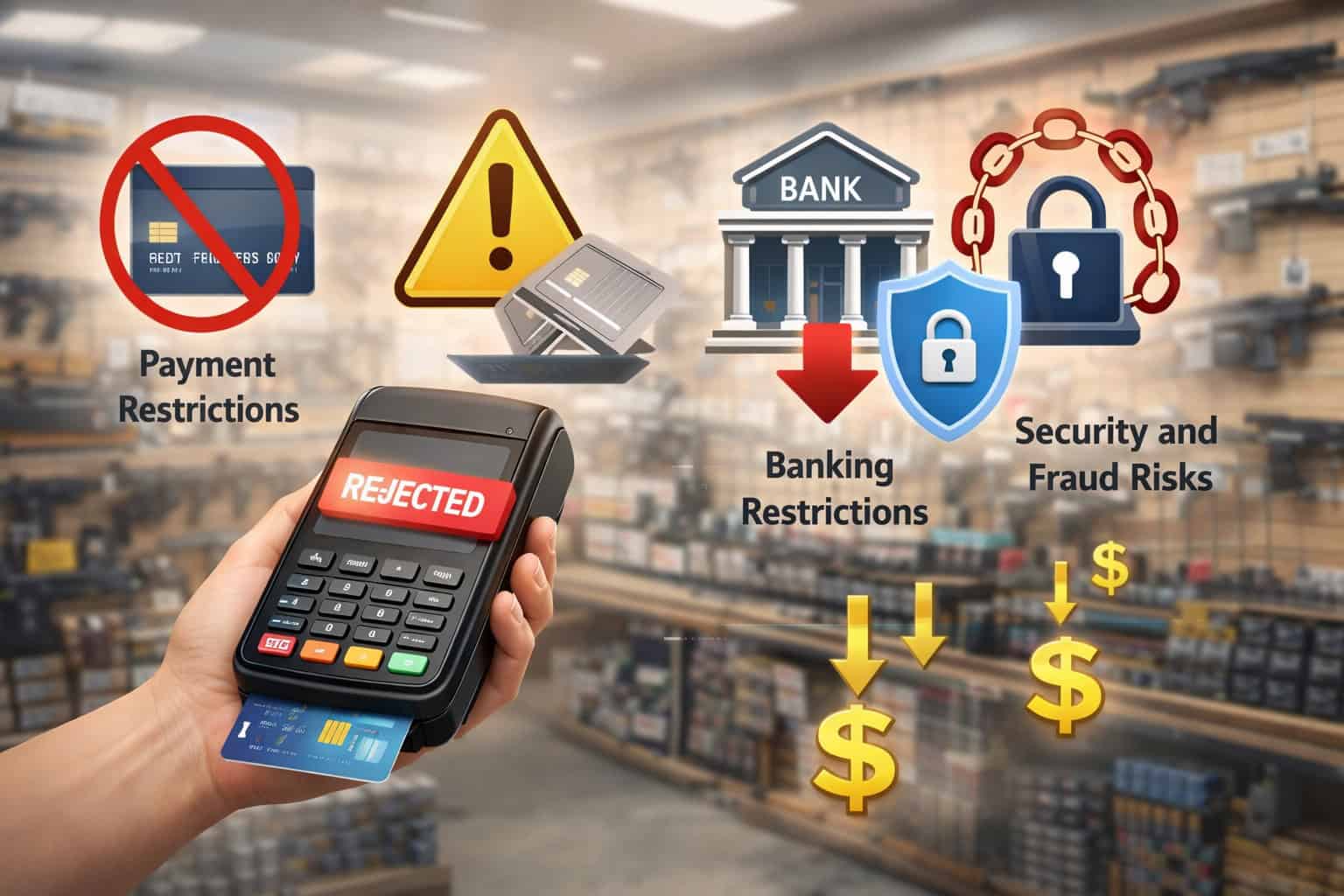
Running a firearms business requires more than stocking the right products and serving customers well. It also requires a payment setup that can support a regulated, closely reviewed retail category without creating friction at checkout or surprises behind the scenes.
That is where many merchants run into trouble. The firearms industry payment challenges businesses face are not always obvious at the start, but they can quickly affect approvals, account stability, daily cash flow, and customer confidence.
For many firearms retailers, payment acceptance is not as simple as opening a standard merchant account and plugging in a card terminal.
A gun shop, FFL dealer, online seller, ammunition merchant, or accessories business may face stricter underwriting, added documentation requests, account reviews, website scrutiny, rolling reserves, higher fraud monitoring, or sudden limits from providers that are uncomfortable with the category.
These issues can show up before an account is approved, during onboarding, or months later after processing begins.
This article explains what firearms industry payment challenges mean in practical terms and why they matter. It breaks down the most common payment processing challenges for firearms businesses, how different business models are affected, what underwriters and providers usually review, and how payment problems influence operations, customer trust, and growth.
You will also learn how to reduce risk, strengthen your application, and build a more reliable payment environment for long-term stability.
What Payment Challenges Mean in the Firearms Industry

When people talk about firearms industry payment challenges, they are usually referring to the obstacles a business faces when trying to accept cards, process online payments, keep a merchant account in good standing, and maintain predictable access to funds.
These challenges often involve more review, more restrictions, and more moving parts than many merchants expect.
In a standard retail environment, a business owner may sign up for payment services online, receive fast approval, and begin accepting payments with little delay. Firearms-related merchants often have a different experience.
They may be asked for extra documents, a clearer website, additional compliance details, detailed product descriptions, or business history that proves the company is organized and transparent. Even after approval, they may deal with limits, reserve requirements, or ongoing account monitoring.
To understand firearm payment processing problems clearly, it helps to define the main pieces of a payment setup. These terms are often used together, but they are not the same thing.
Merchant account, processor, gateway, POS, and card reader explained
A merchant account is the account that allows a business to accept card payments and receive funds from those transactions.
It is part of the financial infrastructure behind card acceptance. If there is a problem with underwriting, risk review, chargebacks, or compliance, the merchant account is often where restrictions show up first.
A payment processor is the company or system that moves transaction data between the business, card networks, and issuing banks. The processor helps authorize, route, and settle card payments.
When merchants talk about processor restrictions, delayed funding, or transaction monitoring, they are often referring to this layer.
A payment gateway is the technology that securely transmits payment information for online transactions. It connects an eCommerce checkout to the processor and other parts of the payment system.
Payment gateway issues for firearms businesses can include unsupported product types, incompatible shopping carts, limited fraud settings, or platform-level restrictions.
A POS system is the broader point-of-sale setup used in-store. It can include software for inventory, reporting, checkout workflows, customer management, and hardware connections.
A firearms merchant may use a POS that handles in-store sales well but still struggle with online integration or category-specific payment rules.
A card reader is the physical device used to accept card-present payments. It reads chip cards, contactless payments, or magstripe cards at the counter. It is just one piece of the larger payment stack.
Why payment challenges in this category are more complex
Payment problems in this industry are rarely caused by one single issue. More often, they happen because underwriting standards, compliance concerns, provider policies, product mix, sales channels, and technical tools all intersect.
A store may be approved for in-person sales but not for online orders. Another may process accessory sales without trouble but face new review after adding ammunition. A different merchant may be fully legitimate yet still be declined because the provider is not comfortable with the category.
That is why firearm merchant services challenges should be viewed as both risk-management and operations issues. The right payment setup is not only about accepting cards.
It is also about protecting continuity, keeping checkout efficient, reducing avoidable flags, and making sure the business is represented accurately to the providers supporting it.
Why Firearms Businesses Face More Payment Processing Issues

Many firearms merchants ask the same question: why is payment acceptance harder here than in other retail categories? The answer is not that every firearms business is unsafe or unreliable.
The issue is that payment providers and acquiring partners often apply greater scrutiny to industries they consider higher risk, more regulated, or more likely to attract disputes, policy concerns, or reputational sensitivity.
High-risk payment processing for firearms retailers typically reflects the way providers view the category, not necessarily the quality of a single merchant. Even well-run stores can encounter extra reviews.
A clean shop, professional website, good business records, and responsible sales practices help, but they do not erase the fact that many payment companies treat firearms-related merchants differently from low-risk retail categories.
This higher level of caution affects approvals, pricing, reserve structures, gateway options, and long-term account stability. It also creates an environment where merchants must be more intentional about how they present their business and manage their payment systems.
High-risk classification and provider risk appetite
One of the biggest payment processing challenges for firearms businesses is the high-risk label. In payment processing, “high risk” does not always mean illegal, irresponsible, or problematic.
It usually means the business is in a category that may face increased underwriting review due to regulatory complexity, dispute potential, transaction risk, or provider comfort level.
Firearm payment processing risks can stem from several factors. Some providers worry about chargebacks, returns, or transaction disputes. Others focus on product-level restrictions or internal policies.
Some banks and processors are cautious about category reputation, while others have strict limits based on card network rules, underwriting standards, or partner bank preferences.
This matters because not every provider has the same risk appetite. One company may be comfortable boarding an FFL dealer with a compliant website and clean history, while another may decline the same business immediately. That is why merchants often get conflicting answers when they apply to multiple providers.
A firearms retailer can waste time, money, and momentum by applying with processors that do not actually support the category. This creates frustration and sometimes repeated denials that make later approvals harder to manage cleanly.
Regulation, compliance, and category sensitivity
Another reason challenges with payment processing for gun stores are more common is that providers want confidence that the merchant operates transparently and within applicable rules.
They may review licenses, corporate records, product types, sales methods, shipping procedures, refund policies, and website content to assess whether the business is structured properly.
Firearms payment compliance concerns can also extend to how products are described online, how restricted items are presented, and whether required information is easy to find.
A site that lacks contact details, terms and conditions, return language, or product clarity can look riskier than it really is. To an underwriter, missing details may suggest poor controls, incomplete operations, or greater dispute exposure.
This category sensitivity means firearms businesses often need stronger documentation and a more polished payment environment from the start. What might be overlooked in another industry can become a major issue here.
The Most Common Payment Processing Problems for Gun Shops and Firearms Retailers
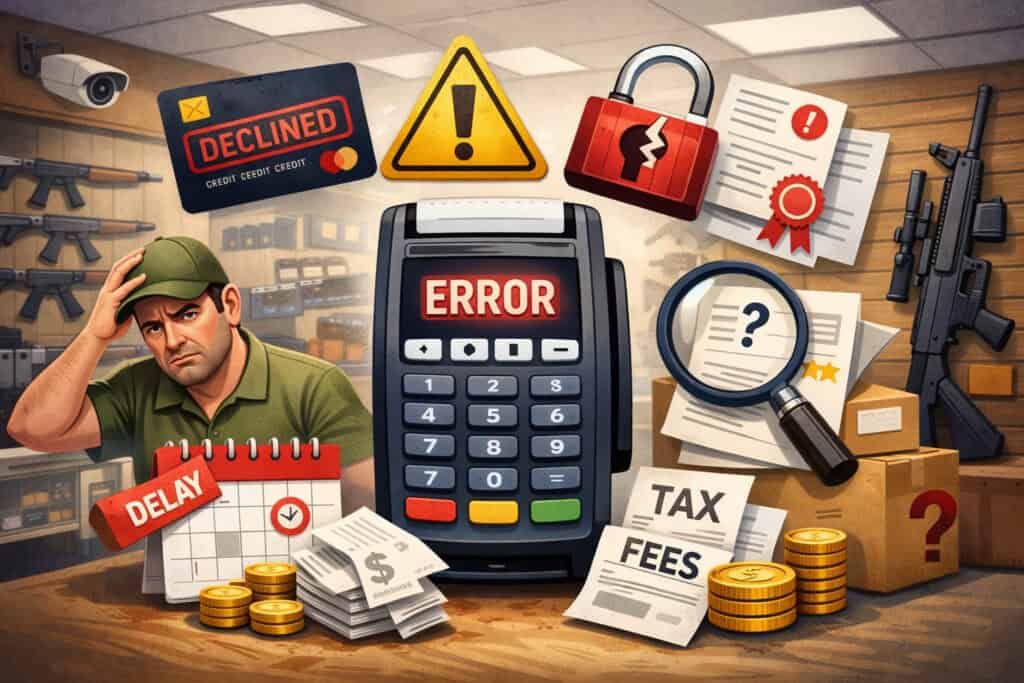
Gun shop payment processing issues can appear at any stage, from the first application to ongoing account maintenance. Some businesses are denied before approval. Others are approved but later face holds, reserves, or processing limits.
Online merchants may discover their gateway or platform does not support their product mix. In-store retailers may run into POS integration trouble. Multi-channel businesses often deal with both.
The most common firearm payment processing problems usually fall into a few major categories: underwriting, funding, technology, compliance, disputes, and provider policy restrictions. Understanding each one helps merchants plan more effectively and avoid preventable mistakes.
Account denials, delayed approvals, and underwriting challenges
Underwriting challenges for gun stores are among the first obstacles many businesses encounter. Underwriters assess whether a business is suitable for the provider’s portfolio and whether it appears likely to process transactions safely and predictably. In this category, that review is often more detailed.
A denial can happen because the provider does not support firearms at all, because the application lacks required documents, because the business model is unclear, or because the website creates unanswered questions.
Sometimes the merchant is approved only after repeated requests for licenses, processing history, corporate documents, bank statements, supplier invoices, or fulfillment details.
Business transparency matters here. If the provider cannot easily understand what the business sells, how transactions are processed, and how customer issues are handled, approval becomes harder.
The same is true when the business has no prior processing history and the underwriter must rely entirely on documents and website review.
New businesses can still be approved, but they often face more scrutiny because there is less historical data to evaluate. Established merchants may have an easier path if their records are organized and their previous processing activity shows stable volume and low dispute levels.
Account holds, rolling reserves, and funding delays
Even after approval, firearm business merchant account problems can continue if the provider sees activity it considers outside the expected risk profile. That may lead to account holds, delayed deposits, reserve requirements, or requests for additional documentation.
An account hold usually means funds are temporarily paused while the provider reviews transactions or risk signals. This can happen after a sudden spike in volume, a change in average ticket size, unexpected sales patterns, dispute activity, or compliance questions.
For a retailer depending on daily deposits to cover payroll, inventory, and overhead, even a short hold can create stress.
A rolling reserve means the processor keeps back a percentage of each batch for a set period before releasing it. Providers use reserves to protect themselves against future chargebacks or losses.
For firearms merchants, rolling reserves may be more likely if the provider sees elevated risk, limited history, or uncertainty in the business model.
Funding delays do not always mean something is wrong. Sometimes they reflect manual review or provider caution. Still, unpredictable funding can hurt cash flow and make the business harder to manage.
Gateway limitations, website issues, and integration problems
Payment gateway issues for firearms businesses are common, especially for online or multi-channel sellers. A merchant may choose a gateway or platform that works well for general eCommerce but later discover category restrictions, unsupported products, or features that do not fit the business.
Some gateways may not support the full product mix. Others may allow approval at first but become problematic if the business expands into categories that receive closer review.
Integration issues can also arise when the eCommerce platform, inventory system, POS, and processor are not aligned. This can lead to broken checkout flows, incomplete data syncing, duplicate reporting, or inconsistent fraud settings.
Website quality is another major factor. A firearms retailer with a confusing site, missing policies, weak product descriptions, no visible contact information, or unclear checkout terms may face approval delays or ongoing account scrutiny.
Providers want to see that customers can understand what they are buying, how returns are handled, and how to contact the business if there is a problem.
For eCommerce merchants, website setup is not just a marketing issue. It is part of risk review.
Chargebacks, fraud filters, and transaction screening problems
Chargebacks in the firearms industry can be especially damaging because disputes do more than create one-off losses. They also affect account stability, processor confidence, and sometimes the long-term viability of a merchant relationship.
A chargeback happens when a cardholder disputes a transaction through the issuing bank. Common reasons include claims of unauthorized use, product misunderstanding, dissatisfaction, fulfillment confusion, or failure to recognize the business name on a statement.
In this category, chargebacks may also be increased by poor communication, weak product clarity, or mismatched expectations around restricted items and policies.
Fraud screening creates its own challenge. If screening is too light, more suspicious transactions get through and later turn into disputes.
If it is too aggressive, real customers get declined, manual review becomes excessive, and checkout friction increases. Firearm payment processing risks often require a careful balance between fraud prevention and sales conversion.
Merchants also face issues when fraud tools, gateway settings, and processor rules are not coordinated. That can lead to false declines, incomplete review workflows, or gaps in order screening that expose the business to avoidable losses.
How These Challenges Affect Different Types of Firearms Businesses

Not every firearms-related merchant faces the same payment risks. A local storefront with mostly card-present transactions has a different profile from a web-based seller shipping permitted products.
An FFL dealer handling regulated transfers faces different scrutiny from an accessories store that sells compliant gear and apparel. Ammunition sellers, range operators, and multi-channel merchants all have their own patterns of exposure.
That is why payment restrictions for firearm retailers should never be discussed as if every business is identical. The details of the sales model, product mix, order flow, and customer interaction matter.
Providers often look closely at these differences, and merchants should understand how those distinctions affect approvals and ongoing stability.
Brick-and-mortar gun shops, FFL dealers, and range-based businesses
Traditional storefront gun shops often benefit from one important factor: card-present sales. When customers pay in person using EMV-enabled terminals, the transaction can look lower risk than remote card-not-present activity.
That said, in-store merchants still face merchant account issues for gun shops because category scrutiny does not disappear just because the sale happens at a counter.
FFL dealers may face additional review because providers want to understand how transfers, documentation, and sales procedures work. The business may be legitimate and well-run, but underwriting still tends to be more detailed.
A store that combines retail, transfers, accessories, and training may also need to explain its revenue mix clearly so the provider can understand what percentage of transactions come from each activity.
Range-based businesses may have a somewhat different profile if they process lane fees, memberships, rentals, classes, and product sales. That mixture can be helpful if it shows diversified revenue, but it can also complicate underwriting if the application or website does not explain the business model clearly.
In-store retailers also need reliable hardware, EMV support, receipt clarity, and staff training. A compliant merchant account can still become unstable if frontline payment handling is inconsistent or poorly documented.
Online firearms retailers, ammunition sellers, and accessories merchants
Online merchants usually face greater payment friction because card-not-present sales are reviewed more carefully across many industries, and even more so in firearms-related commerce.
Challenges with payment processing for gun stores that sell online often include stricter website reviews, more fraud screening, gateway limitations, shipping policy scrutiny, and a stronger focus on product clarity.
Ammunition sellers may encounter category-specific concerns depending on provider policies, fulfillment methods, and overall risk appetite. Accessories merchants sometimes assume they will be treated like standard retail businesses, but that is not always true.
If the site branding, product adjacency, or broader business identity is closely tied to firearms, underwriting may still treat the account cautiously.
For online merchants, website readiness is critical. The provider may evaluate whether the site clearly explains products, age-related expectations where relevant, fulfillment timing, cancellation policies, refund terms, and customer service access. Missing pages or vague language can raise preventable red flags.
Multi-channel sellers face added complexity because they need the in-store and online sides of the business to work together. Reporting, fraud settings, order management, inventory sync, and deposit timing all need to be coordinated carefully to avoid operational problems and compliance confusion.
What Payment Providers and Underwriters Usually Look For
One of the most practical ways to reduce firearm merchant services challenges is to understand how providers evaluate a business before and after approval. Underwriters are trying to answer a few core questions.
Is the business legitimate? Is it transparent? Does the website accurately represent what is being sold? Are customer expectations clear? Does the merchant appear organized enough to manage disputes, compliance, and transaction risk?
A provider may not explain every internal rule, but the broad areas of review are usually consistent. Businesses that prepare for this review process tend to have smoother approvals and better long-term account stability.
Documentation, transparency, and processing history
Documentation plays a major role in approval decisions. Providers may ask for business formation documents, banking details, licenses, prior merchant statements, supplier information, voided checks, identification, and sometimes additional details about inventory, sales methods, or expected volume.
The goal is not just to collect paperwork. It is to build confidence that the business is real, transparent, and operating as described.
Processing history can be especially valuable. If a merchant can show stable monthly volume, reasonable average ticket size, low chargeback activity, and consistent deposit patterns, underwriters have more confidence.
New businesses without history are not automatically declined, but they may face more caution because there is less performance data available.
Transparency is just as important as documentation. If the application says one thing but the website suggests another, the mismatch can slow or stop approval. If the merchant processes under one business name but markets under another without explanation, that can also create questions. Consistency builds trust.
Firearms businesses should assume the provider will compare the application, website, product catalog, support pages, and business records. The cleaner and more aligned those pieces are, the better.
Website setup, policy pages, and product clarity
For online sellers and many multi-channel merchants, the website is part of the underwriting file. It is not an afterthought. Providers want to know whether customers can clearly understand what the business offers and what terms apply to a purchase.
That means visible contact information, business identity, refund or return policies, shipping details, privacy language, terms and conditions, and product descriptions all matter. Product pages should not be vague or misleading.
Checkout flows should make sense. Support options should be easy to find. A site that looks incomplete or confusing can increase concern even if the business itself is sound.
Product clarity is especially important in this category. Underwriters want to know what is being sold, whether descriptions are accurate, and whether the site presents restricted or regulated items in a responsible and understandable way.
Ambiguity creates risk. The provider may worry that customers will misunderstand purchases, dispute charges, or claim they were misled.
How Payment Issues Affect Operations, Customer Experience, and Cash Flow
Payment problems do not stay confined to the finance department. They affect the entire business. When a merchant account is unstable, a gateway is unreliable, or checkout approval rates decline, the impact spreads quickly across customer experience, staff workload, inventory planning, and revenue predictability.
This is why firearms industry payment challenges deserve strategic attention. They are not just technical annoyances. They shape how smoothly the business operates and how confidently customers complete purchases.
Checkout friction, trust, and approval rates
A customer may never know the details of your processor relationship, but they will immediately notice a poor checkout experience. If transactions fail unexpectedly, fraud filters block legitimate orders, online checkout feels confusing, or in-store staff cannot resolve payment issues quickly, confidence drops.
For online merchants, even minor friction can reduce completed orders. A slow gateway response, repeated card declines, or a clunky verification process may send shoppers elsewhere. For in-store businesses, outdated hardware or unreliable terminals can make the operation feel less professional and cause avoidable delays.
Trust is also shaped by billing clarity. If the descriptor on a customer’s statement is unclear, a legitimate sale may turn into a dispute simply because the cardholder does not recognize the charge. If policies are not visible at checkout, customers may feel surprised later and file a complaint rather than contacting the merchant directly.
Approval rates matter too. A business can have strong demand and still lose sales if its payment stack declines too many valid transactions. That is one reason gun-friendly payment solutions need to balance fraud prevention with customer usability.
Cash flow, staffing pressure, and growth limitations
Cash flow is where payment instability often hurts the most. Delayed deposits, rolling reserves, or account holds can make it harder to pay suppliers, meet payroll, fund marketing, or plan inventory purchases. Even healthy businesses can feel squeezed when access to funds becomes inconsistent.
Staffing pressure rises as well. Employees end up spending time answering payment-related customer questions, handling manual reviews, tracking down missing settlements, reprocessing failed orders, or responding to chargebacks. That time could have been spent on sales, fulfillment, or customer service.
Longer term, unstable payment systems can limit growth. A merchant may hesitate to expand online, launch new product lines, add a second location, or invest in better eCommerce tools if the underlying payment infrastructure feels fragile. In that way, firearm business merchant account problems can become business growth problems.
A stable payment environment supports better decision-making. When deposits are predictable, approvals are smoother, and disputes are controlled, management can focus more on customers and less on damage control.
Practical Ways to Reduce Payment Problems and Improve Stability
There is no magic switch that removes all firearm payment processing risks. But there are practical steps businesses can take to improve approval odds, reduce account friction, and build a payment setup that is more resilient over time.
The strongest results usually come from preparation, clear communication, good documentation, and thoughtful technology choices.
Merchants that take a proactive approach tend to experience fewer surprises than those who treat payment acceptance as a plug-and-play utility. In this category, preparation matters.
Prepare your business for approval and long-term account health
Start with your business records. Make sure core documents are current, organized, and easy to provide. If you have prior processing statements, review them before submitting them. Know your average ticket, monthly volume, refund patterns, and dispute trends. Underwriters appreciate merchants who understand their numbers.
Next, clean up your website and customer-facing materials. Include visible contact details, clear product descriptions, refund and return policies, shipping information, terms and conditions, and any other pages needed to make the buying process understandable.
Remove broken links, incomplete pages, or placeholder text. If your business has multiple sales channels, explain that clearly.
Be transparent about what you sell. Do not try to disguise the nature of the business to get approved more easily. That approach often backfires later and can result in account closure or withheld funds if the provider discovers a mismatch between the application and actual processing activity.
Also, communicate expected sales patterns. If you anticipate promotions, seasonal spikes, large-ticket transactions, or a major inventory release, let the provider know. Predictability reduces unnecessary review.
Choose tools and support that fit the category
Not every payment setup is built for this business type. Firearm-friendly underwriting is important, but so are the everyday tools that support operations. Businesses should look for providers that can clearly explain what they support, how they handle risk review, and what technologies integrate well with the merchant’s sales model.
Features worth prioritizing often include:
- Transparent pricing and fee disclosure
- EMV support for in-store transactions
- Reliable online checkout tools
- Fraud controls that can be tuned, not just turned on or off
- Reporting that makes reconciliation easier
- Integration options for eCommerce and POS environments
- Responsive support when issues arise
- Chargeback assistance and dispute documentation guidance
Strong support matters because payment problems rarely arrive at convenient times. A merchant that cannot reach knowledgeable help during a hold, gateway outage, or dispute spike is at a major disadvantage.
Common Mistakes Firearms Businesses Should Avoid
Many payment processing challenges for firearms businesses are not fully preventable, but some are made worse by common merchant mistakes.
These mistakes often come from reasonable assumptions, such as believing any processor can handle the category, assuming website details do not matter, or waiting until a crisis to review chargeback patterns.
Avoiding these mistakes can save time, reduce friction, and improve long-term account stability.
Applying with the wrong providers and hiding key details
One major mistake is applying broadly without verifying category support. A merchant may assume that a well-known payment brand can handle the business, only to be declined or later restricted because the provider does not actually support firearms-related activity at the level needed.
Another mistake is being vague during the application process. Some merchants worry that full transparency will reduce their approval chances, so they understate product categories, omit online activity, or describe the business too generally.
This may help them get through an initial form, but it can create bigger problems later if the provider discovers a mismatch.
The better approach is to be accurate and prepared. A provider that truly supports the category will want honest details. A provider that does not support it is not a good fit anyway.
Neglecting website quality, policies, and dispute prevention
Some merchants focus heavily on products and marketing but neglect the policy and trust pages that matter during underwriting and dispute review. Missing return terms, incomplete contact details, vague shipping language, and poor product descriptions can all create friction with both providers and customers.
Dispute prevention is another area where businesses often react too late. If a shop waits until chargebacks rise before reviewing receipts, descriptors, fraud settings, customer communication, and order confirmation processes, the account may already be under added scrutiny.
It is also a mistake to treat fraud tools as a set-it-and-forget-it feature. Filters should be reviewed over time to make sure they are catching suspicious activity without blocking too many real buyers. The best setup is rarely the most aggressive one. It is the one that fits the business.
Frequently Asked Questions
Q.1: Why are firearms businesses often considered high risk by payment providers?
Answer: Many providers classify firearms-related merchants as high risk because the category receives more scrutiny from an underwriting, compliance, and policy perspective. That can be tied to dispute concerns, provider-specific restrictions, product sensitivity, or the belief that the business may require closer monitoring than standard retail.
It does not automatically mean the merchant is unsafe or untrustworthy, but it does mean approvals and account management may involve more review.
Q.2: Can a gun shop get denied even if the business is legitimate?
Answer: Yes. A legitimate business can still be denied if the provider does not support the category, if the application lacks documentation, if the website is incomplete, or if the underwriter is not comfortable with the overall risk profile.
Denials are not always a judgment on the quality of the merchant. In many cases, they reflect provider policy or incomplete onboarding preparation.
Q.3: What causes payment holds for firearms retailers?
Answer: Holds can happen for several reasons, including sudden increases in volume, unusually large transactions, chargeback activity, unexpected product mix changes, or documentation questions.
Sometimes a provider simply wants to verify that recent activity matches what was originally approved. Clear communication and advance notice about sales changes can help reduce the chance of surprise holds.
Q.4: Do online firearms sellers face more payment issues than storefront businesses?
Answer: Often, yes. Online merchants usually face more scrutiny because card-not-present transactions carry different fraud and dispute risks than in-person sales.
Website review, gateway compatibility, product clarity, checkout design, and fraud settings all play a larger role when sales happen online. That does not mean online approval is impossible, but it usually requires stronger preparation.
Q.5: What should a firearms business include on its website before applying for payment processing?
Answer: A solid website should include visible contact information, clear product descriptions, refund and return policies, shipping details, terms and conditions, and a checkout experience that reflects the actual business model.
The site should look complete and professional, with no broken pages or vague language. Providers often use the website to judge transparency and customer communication quality.
Q.6: How can firearms merchants reduce chargebacks?
Answer: Reducing chargebacks usually starts with clearer customer communication. Use recognizable billing descriptors, send order confirmations, keep policies visible, maintain accurate product descriptions, and respond quickly to customer questions before they turn into disputes.
Good fraud tools also matter, but many chargebacks come from confusion rather than true fraud. That is why order clarity and support access are so important.
Q.7: What should merchants look for in a payment provider?
Look for a provider that clearly supports the business category, offers transparent pricing, provides tools for both in-store and online payments if needed, and has experience with risk review in this space.
Good reporting, chargeback support, EMV capability, flexible fraud controls, and responsive customer service are all valuable. The goal is not just approval. It is long-term stability.
Conclusion
The firearms industry payment challenges merchants face are real, but they are easier to manage when the business understands where those challenges come from and how to prepare for them.
Payment friction in this category often stems from high-risk classification, stricter underwriting, provider restrictions, documentation gaps, website weaknesses, chargebacks, fraud settings, and technology mismatches across channels.
The good news is that many of these issues can be reduced with a stronger foundation. Clear documentation, honest applications, a complete website, transparent policies, consistent processing history, well-tuned fraud tools, and provider relationships that actually fit the business all contribute to better results.
When those pieces are in place, approval becomes smoother, account stability improves, and day-to-day operations feel far more predictable.
For gun shops, FFL dealers, online firearms retailers, ammunition sellers, accessories businesses, and multi-channel merchants, the goal should not be to find a shortcut around risk review.
It should be to build a payment environment that is accurate, durable, customer-friendly, and aligned with how the business really operates. That approach supports stronger checkout experiences, better customer trust, healthier cash flow, and a more reliable path for growth over time.