
Gun stores run on thin margins, high inventory costs, strict recordkeeping, and fast-changing demand. The good news is that POS data (point-of-sale data) is one of the most powerful assets you already own—and most stores underuse it.
Every transaction, return, transfer, discount, and loyalty redemption creates POS data that can reveal what’s actually driving profit (not just sales). When you treat POS data like a decision system instead of a digital cash register, you can fix dead inventory, reduce shrink, improve attach rates, price with confidence, and staff smarter—without adding more workload.
Profitability in this category is rarely “one big fix.” It’s dozens of small improvements that compound: better reorder timing, fewer stale SKUs, tighter discount discipline, clearer margin targets by category, and more consistent upsell routines. POS data gives you the measurement layer needed to make those improvements repeatable.
It also helps you stay audit-ready by keeping product, serial, and customer workflows consistent—especially when your POS connects with electronic bound book / 4473-style processes and serial tracking features common in firearms-focused setups.
This guide shows how to turn POS data into practical actions that improve cash flow, margins, and operational efficiency. It’s written for store owners and managers who want clear steps, not theory—and it includes future-looking predictions on where POS analytics is heading, including AI-assisted forecasting, personalization, and loyalty evolution.
Building a POS Data Foundation That Actually Improves Profit

Before you chase advanced dashboards, you need reliable inputs. The fastest way to waste time is to make decisions from messy POS data—duplicate SKUs, inconsistent categories, incorrect costs, and missing attributes like caliber, brand, or serial-number status.
A clean foundation makes every report trustworthy, which is why top-performing retailers treat data hygiene as a profit lever.
Start by standardizing your product catalog. Every SKU should have: category (firearms, ammo, optics, accessories, apparel, services), vendor, cost, MSRP/MAP notes (where applicable), taxability flags, and key attributes that affect buying (caliber/gauge, platform type, brand family, compatibility).
Then define consistent transaction types: sale, return, special order deposit, transfer fee, gunsmithing labor, range membership, and fees. If you don’t separate these, your margins will look better or worse than reality.
Next, ensure your inventory workflows match your compliance workflow. Many firearms-focused POS setups emphasize serial number tracking and integration with electronic recordkeeping tools so inventory and disposition data aren’t re-keyed multiple times. That reduces errors and keeps you audit-ready while saving labor.
Finally, set your “single source of truth” rules: where costs come from (receiving), how price overrides are logged, how discounts are approved, and how returns affect margin reports. Once those rules exist, POS data becomes dependable enough to guide purchasing, pricing, and staffing decisions—not just accounting.
Profitability KPIs Every Gun Store Should Track in POS Data

To improve profit, you need to measure profit the right way. Many stores focus on revenue, but revenue can grow while profit falls—especially when discounting rises, costs drift upward, or inventory sits too long. The right KPIs, built from POS data, tell you whether your store is earning or merely moving product.
Start with gross margin by category and by brand family. Firearms often carry lower gross margin than accessories, services, and certain add-ons.
That’s not a problem if you manage it intentionally: use firearms to drive traffic, then use attach-rate strategy to lift total basket profit. Your POS data should show margin dollars (not just margin percent), because dollars pay the bills.
Next, track inventory efficiency: inventory turnover and GMROI (gross margin return on inventory investment). GMROI helps you see whether the money tied up in inventory is generating enough gross profit. It’s a standard retail metric and is especially useful when you carry high-ticket items and seasonal products.
Add operational KPIs: items per transaction, average transaction value, return rate, discount rate, and employee-level sales/attach performance. These are where small wins compound.
If your POS data shows the attach rate for optics or magazines is low, you can fix it with scripts, bundling, and training. If discount rate spikes on certain SKUs, you can refine pricing or stop overbuying.
Finally, track “aged inventory” (days-on-hand). Profit leaks when inventory becomes stale, because it eventually gets discounted or becomes dead stock. A simple weekly aging report from POS data can protect cash flow better than almost any other habit.
Inventory Optimization With POS Data: Turning Dead Stock Into Cash Flow
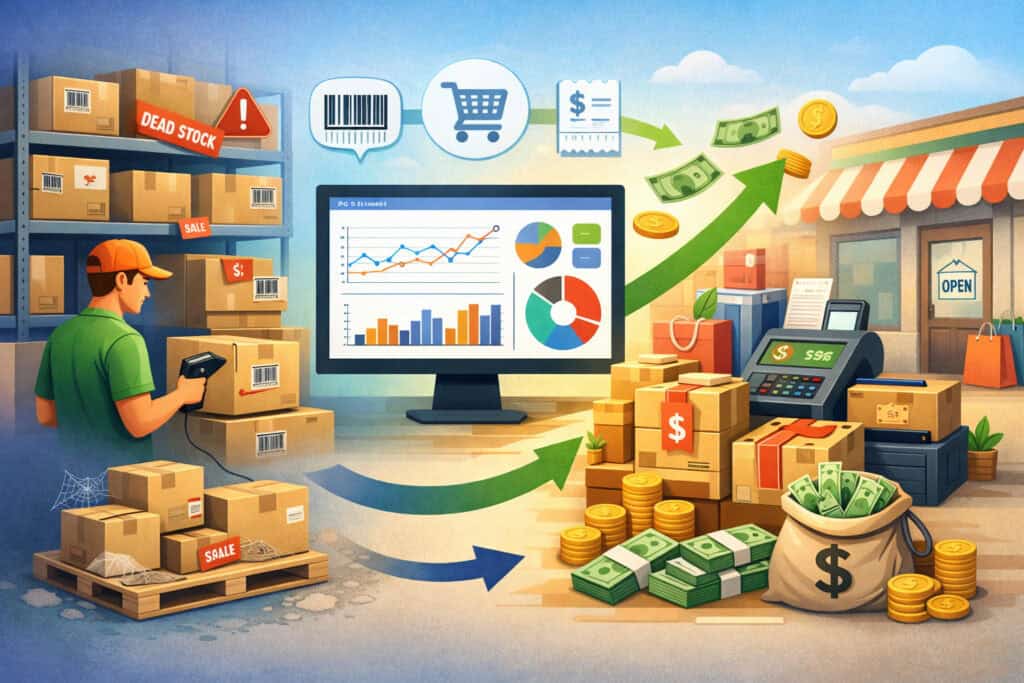
Inventory is usually the biggest cash commitment in a gun store. When inventory is healthy, it feels invisible—shelves look good, customers find what they want, and reorders happen smoothly.
When inventory is unhealthy, it quietly drains profit through carrying costs, markdowns, and missed opportunities. POS data is the fastest way to see the difference.
Use POS data to identify three critical groups: winners, sleepers, and losers. Winners are fast-moving SKUs with strong margin dollars. Sleepers move slowly but consistently and may be valuable for assortment credibility.
Losers are the items that sit, consume cash, and only sell after discounts. The key is to reduce losers without harming the customer experience.
Create reorder points based on real sales velocity, not gut feel. Velocity should be measured by units per week and adjusted for seasonality (hunting seasons, holiday promotions, local events). Then combine velocity with lead times so your store doesn’t overstock “just in case.”
If your POS supports it, automate reorder suggestions and flag unusual spikes that could indicate a trend or a one-time event. Broader POS trends for 2025 emphasize AI-assisted demand forecasting and inventory optimization, and these features are increasingly common in modern POS platforms.
Use POS data aging reports to design a markdown discipline. Instead of random discounts, set rules: at 60 days, add bundle value; at 90 days, run a targeted promotion to the right customer segment; at 120+ days, consider liquidation, vendor return programs (if available), or trade-in strategies. The goal is to protect margin while freeing cash for high-demand products.
Serial-Tracked Inventory and Compliance Workflows That Reduce Costly Errors
For firearms and serialized items, “inventory accuracy” isn’t just a profitability issue—it’s a business continuity issue. When serialized inventory is mishandled, you risk reconciliation problems, customer delays, and compliance exposure.
A POS workflow that tracks serial numbers at receiving, stocking, sale/transfer, and return reduces mistakes that can cost hours (or days) to unwind.
Modern firearms-focused solutions commonly promote features such as serial number tracking and electronic A&D / 4473-style integration to minimize duplicate data entry and help keep records consistent across systems. That matters because one of the hidden costs in many stores is labor: re-checking serials, reconciling paper logs, correcting receiving errors, and hunting for missing items. Better workflows reduce that labor and improve customer throughput.
From a POS data standpoint, serialized tracking also improves analytics. You can measure true sell-through by model variation, see which serialized items sit longer, and identify pricing issues at a granular level.
It also supports better transfer management: tracking transfer fees, time-to-complete, and conversion rates (how often a transfer customer buys ammo or accessories).
Finally, electronic recordkeeping has defined requirements, and federal guidance has established conditions for maintaining acquisition and disposition records electronically.
That’s why system design, backups, access controls, and audit trails matter—not just convenience. When your POS workflow supports clean serialized handling, you’re improving both profit and operational resilience.
Vendor, Category, and Caliber-Level Purchasing Decisions Powered by POS Data
A common profitability trap is buying based on “what I can get” instead of “what sells profitably.” Availability matters, but if you don’t separate profitable demand from noisy demand, you’ll overbuy the wrong items and understock winners. POS data lets you build a purchasing strategy that fits your local market.
Start by segmenting POS data into meaningful groups: category (ammo vs. optics vs. firearms), vendor, and “use case” (home defense, competition, hunting, training).
Then add the attributes that drive choice: caliber/gauge, brand family, and price bands. You’ll quickly see patterns: some calibers drive frequent repeat purchases, while certain firearm types create accessory-heavy baskets.
Use this insight to negotiate smarter. If a vendor line has strong sell-through but weak margin, you may need better pricing tiers, different mix, or more accessory bundling.
If a vendor line has high margin but low velocity, you may need better merchandising, staff education, or a reduced assortment. The point is to stop treating purchasing as “ordering product” and start treating it as “investing cash.”
Build a “core assortment” list from POS data: the SKUs that consistently sell with predictable demand. Protect these with minimum stock levels. Then allocate a smaller budget for experimentation—new products, limited runs, seasonal gear. That protects profitability while still letting you adapt to trends.
If your POS supports advanced reporting or integrations, keep an eye on broader POS technology direction: many 2025 POS platforms are adding better analytics, demand forecasting, and unified data layers to support faster decisions. The stores that win will be those that use POS data to make buying decisions weekly, not quarterly.
Pricing and Margin Strategy: Using POS Data Without Racing to the Bottom

Discounting feels like the easiest lever to pull, but it’s also the fastest way to destroy margin—especially when it becomes a habit instead of a targeted tactic. The goal is to price in a way that protects margin, matches market reality, and still feels fair to customers. POS data gives you the evidence to do that.
Start with price waterfall visibility: list price → discount → final price → margin dollars. If your POS logs overrides and promotions, your POS data can show where margin is leaking. Often it’s not a single giant markdown—it’s hundreds of small overrides, “manager specials,” and inconsistent bundle deals that add up.
Next, use POS data to measure price elasticity by category. Accessories may tolerate modest increases because customers value convenience and compatibility.
Ammo may be more price sensitive depending on local competition and availability. Firearms pricing can be influenced by model popularity, seasonality, and the store’s ability to offer value beyond the sticker (service, speed, expertise).
Consider a “margin mix” strategy. If firearms margins are tight, you can still improve total profit by lifting attach rate and protecting accessory margins. Use POS data basket analysis to see the most common add-ons for each firearm type, then build bundles that preserve margin while improving customer experience.
Finally, set markdown rules based on inventory aging and sell-through rather than emotion. Your POS data aging report should trigger specific actions: re-merchandise first, bundle second, discount last. This protects brand value and keeps your store from becoming a discount-first destination.
Promotions, Bundles, and Attach Rate: Turning Transactions Into Profit
Attach rate is one of the most controllable drivers of profitability. It’s also one of the easiest to improve with consistent routines. When a customer buys a firearm, POS data should help you predict what else they are likely to need—then measure whether your team actually sold it.
Use POS data to identify top attachment pairs: firearm + case, firearm + cleaning kit, optic + mount, ammo + ear/eye protection, range membership + training class, transfer + ammo. Then build standardized bundles with clear value.
The trick is to bundle items that improve the customer’s outcome, not random add-ons. When bundles feel helpful, customers accept them more often, and your staff feels more confident offering them.
Measure attach rate by employee and by shift. If the attach rate drops on weekends, you might have a staffing or training issue. If the attach rate is high for one employee, document what they say and replicate it. POS data makes coaching objective instead of personal.
Also measure promo profitability. A “10% off accessories” promotion might look great on sales, but if it trains customers to wait for discounts, it can reduce long-term margin.
Instead, use targeted promotions based on customer segment and purchasing history. Broader retail loyalty and personalization trends for 2025 emphasize predictive, targeted offers rather than blanket discounts.
When you treat attach rate as a KPI and use POS data to reinforce behaviors, your store gets a structural profit lift—without relying on more foot traffic.
Customer Insights From POS Data: Loyalty, Segmentation, and Higher Lifetime Value
Gun store customers are not one audience. Some are first-time buyers who need education and support. Others are enthusiasts who buy frequently. Some shop for a single season.
Others are members who visit weekly. The best way to serve each group—and increase profitability—is to segment customers using POS data and tailor your marketing, inventory, and service accordingly.
Start with basic segmentation: new vs. returning, frequency (visits per quarter), recency (days since last purchase), and monetary value (total spend).
Then layer in category preference: firearms-heavy buyers, ammo-repeat buyers, optics buyers, range members, training clients. Your POS data can show which segments generate stable profit and which segments are high maintenance with low margin.
Use this segmentation to design better loyalty. Loyalty shouldn’t just be points—it should be behavior shaping. Reward profitable behaviors: repeat ammo purchases, training enrollment, accessory bundles, membership renewal. Avoid rewarding margin destruction (like discounts on already tight categories) unless it’s strategic.
Retail loyalty trends heading into 2025 emphasize hyper-personalization, predictive offers, and gamified engagement models. You don’t need a giant budget to benefit. Even simple triggers—like a “welcome back” offer for lapsed customers or targeted accessories based on last purchase—can increase repeat visits.
Finally, track customer lifetime value (CLV) using POS data. A customer who buys one firearm and never returns is less valuable than a customer who buys ammo monthly, attends training, and renews membership. When your team understands this, they stop chasing only big-ticket sales and start building repeatable profit.
Omnichannel Signals: Connecting In-Store, Online, Transfers, and Services
Many stores now operate across multiple channels: in-store sales, online inquiries, special orders, transfers, gunsmithing, and training/range services.
If these systems don’t talk, you get a fragmented view of the customer and the business. A strong omnichannel approach means your POS data captures the full customer journey, not just the final transaction.
Start by tracking lead sources and intent where possible: did the customer call about a model, request a special order, or come in for a transfer? Even if you don’t have a full CRM, you can tag transactions and notes in the POS.
Then measure conversion: what percentage of transfer customers buy something else the same day? What percentage of gunsmithing customers purchase accessories? What percentage of training students become repeat buyers?
Use POS data to manage services like products. Track labor time, parts margins, and rework rates. A gunsmithing job with repeated adjustments can be unprofitable even if revenue looks good. If your POS separates labor and parts, you can identify which service types are profitable and which need repricing or workflow changes.
For omnichannel retail trends, many modern POS platforms are pushing toward unified data layers and more advanced analytics to connect customer behavior across channels.
The prediction is clear: stores that unify POS data across sales and services will improve both customer experience and profitability, because they can offer better recommendations, better follow-up, and better inventory planning.
Operational Efficiency With POS Data: Staffing, Shrink, and Process Control
Profit isn’t only pricing and purchasing. It’s also an operational discipline. Two stores can sell the same volume with very different profit outcomes depending on shrink, returns, labor efficiency, and process consistency. POS data makes these operational profit drivers visible.
Start with labor-to-sales efficiency. Compare staffing levels to transaction volume and average transaction value by hour and day. Many stores overstaff slow periods and understaff peak periods, leading to missed sales and stressed employees.
Use POS data to build schedules around reality: when traffic happens, which categories sell when, and how long transactions take.
Next, tackle shrink and inventory accuracy. Shrink can come from theft, receiving errors, mis-scans, and bad returns processing. POS data can highlight red flags: frequent voids, unusual refunds, repeated price overrides, and mismatches between on-hand and sold counts. Don’t treat this as “catching people.”
Treat it as a tightening process: better receiving checklists, tighter permissions, consistent return rules, and more frequent cycle counts.
Process control matters even more when you handle serialized inventory and regulated workflows. Systems that reduce double entry and standardize processes can cut errors and reduce labor. This is a profitability story because errors have a cost: staff time, customer dissatisfaction, and operational risk.
Finally, build a weekly operating rhythm: review dashboards, take action, assign owners, and revisit results. The stores that improve profit consistently aren’t doing heroic work—they’re doing consistent work, guided by POS data.
Fraud, Returns, Discounts, and Employee Permissions: Protecting Margin Without Killing Service
Many margin leaks don’t happen through big mistakes. They happen through “helpful” exceptions: unauthorized discounts, overly generous returns, incomplete documentation on refunds, or inconsistent handling of damaged goods. These issues are hard to see without POS data, and once you see them, they’re usually fixable.
Start with discount governance. Define which discounts are allowed, when, and by whom. Set POS permissions so not everyone can override prices. Then audit the data weekly: which SKUs are discounted the most, which employees override pricing most often, and what times of day see the most voids. Patterns usually reveal process gaps.
Returns deserve special attention. Returns can be legitimate customer service, but they also hide shrink and fraud. Your POS data should track return reasons and connect them to original receipts. If you see high return rates in certain categories, investigate product quality, staff recommendation patterns, or mismatched customer expectations.
Also review “exception transactions” like cancelled sales, suspended transactions, gift card usage (if applicable), and manual tax adjustments. Even small percentages matter because they hit the margin directly.
The goal isn’t to become rigid—it’s to create consistent rules that protect profit while preserving a strong customer experience. When staff know the rules, they can serve customers faster. When managers have clean POS data, they can fix issues with training and process instead of guesswork.
Advanced Analytics and AI: Where POS Data in Retail Is Going Next
The next wave of profitability isn’t just better reporting—it’s predictive decision-making. Across retail, POS platforms are increasingly adding AI and machine learning features for forecasting, personalized offers, and operational optimization.
For gun stores, the biggest near-term gains will come from applying these capabilities to inventory planning, customer segmentation, and staffing.
Demand forecasting is one obvious area. Instead of ordering based on last month’s totals, predictive tools look at trend acceleration, seasonality, and local patterns to suggest reorder quantities.
That reduces out-of-stocks (lost sales) and overbuys (dead stock). Another area is dynamic merchandising: using POS data to predict which categories will surge and adjusting endcaps and staff focus accordingly.
Personalization is also moving fast. Loyalty systems are evolving toward predictive offers—targeting the right customer with the right incentive at the right time. The key is to avoid blanket discounting and instead use POS data to incentivize profitable behaviors, like training enrollment, membership renewal, or accessory bundles.
A realistic prediction for the next few years: many store owners will rely on “recommended actions” inside their POS—alerts that say, “These SKUs are aging,” “This vendor line is underperforming,” or “This customer segment is lapsing.” The winners won’t be the stores with the fanciest tech—they’ll be the stores that act consistently on what POS data reveals.
FAQs
Q.1: What is POS data, and why is POS data so important for gun store profitability?
Answer: POS data includes the detailed records created by your point-of-sale system: items sold, prices, discounts, costs, taxes, payment types, returns, customer profiles, employee actions, inventory changes, and timestamps.
For gun stores, POS data is especially valuable because it reflects both retail dynamics (merchandising, pricing, loyalty) and operational complexity (serialized inventory, transfers, service transactions).
When you use POS data well, you stop guessing and start managing by facts—what sells, what sits, what drives margin dollars, and what behaviors create repeat business.
The reason POS data matters so much is that profit is usually a system problem, not a single problem. A store may have good sales but poor inventory turns, excessive discounting, weak attach rates, and inconsistent scheduling.
Each issue alone might feel small, but together they compress margins. POS data helps you isolate the exact leaks and fix them with targeted actions, like reorder adjustments, bundle design, permission controls, and segment-based marketing.
Also, many firearms-focused POS setups emphasize serial tracking and integrated record workflows to reduce errors and labor, which directly supports profitability.
Q.2: Which POS data reports should I review weekly to improve profit fastest?
Answer: If you want quick wins, focus on weekly reports that drive action: category gross margin (dollars and percent), discount rate, inventory aging (days-on-hand), sell-through by SKU, top losers (low velocity + low margin), attach rate pairs (like optics/magazines/ammo), return rate, and employee overrides.
These reports expose the most common profit drains: stale inventory, uncontrolled discounting, and missed add-on opportunities.
Weekly inventory aging from POS data is often the biggest cash-flow unlock. It tells you what’s quietly turning into dead stock. Combine that with sell-through and you can set markdown rules before items become a problem.
Then, use attach rate reporting to coach staff and standardize bundles that lift profit per transaction. Finally, review discounts and override logs so you can protect margin without hurting service.
For a deeper layer, add GMROI and turnover to understand whether inventory investment is paying off, a widely used retail approach.
Q.3: How can POS data help me reduce dead inventory without hurting customer experience?
Answer: Dead inventory usually comes from overbuying slow SKUs, missing trend shifts, or failing to act on aging early. POS data helps you prevent it by revealing true sales velocity and seasonality.
Instead of guessing reorder quantities, you order based on units/week and lead time. Then you use POS data aging thresholds to trigger actions before the product becomes stale: re-merchandise, bundle, targeted promotion, and only then discount.
Customer experience improves when you do this correctly because shelves get more relevant. You can expand depth in items your customers actually want and reduce clutter from slow movers. Also, targeted promotions based on POS data segments feel more personalized than storewide discounts and protect your brand value.
Retail POS trends also show that forecasting and inventory optimization features are becoming more common, which will make these decisions easier for retailers who adopt them.
Q.4: Is it safe to use cloud reporting and analytics with firearms-related POS workflows?
Answer: “Safe” depends on how the system is designed and how you run it. In general, electronic recordkeeping and system workflows must meet defined requirements, including controls around records, integrity, and accessibility.
Federal guidance has laid out conditions for maintaining certain firearms records electronically, which is why audit trails, backups, access controls, and consistent processes matter.
From a profitability standpoint, the main advantage of modern integrated systems is reducing double entry, tracking serialized inventory more accurately, and improving workflow consistency—saving labor and reducing errors.
If you evaluate providers, look for clear documentation on security, permissions, backups, and how integrations handle inventory/record syncing.
This is not just an IT decision. It’s an operations decision. The right setup helps you use POS data confidently for profit decisions without creating avoidable risk.
Q.5: What’s the biggest future trend in POS data that gun stores should prepare for?
Answer: The biggest trend is moving from “reports” to “recommended actions.” POS platforms are adding AI-assisted forecasting, personalization, and operational optimization features that interpret POS data and suggest what to do next—what to reorder, who to target with offers, what to markdown, and how to staff.
Loyalty and customer engagement are also evolving toward predictive, personalized offers and more interactive loyalty mechanics. For gun stores, this means you’ll increasingly compete on customer experience and relevance, not just product availability.
The stores that build clean data foundations now—consistent SKUs, accurate costs, clear transaction types—will be the ones who benefit most from these next-gen capabilities later.
Conclusion
Improving gun store profitability isn’t about one “secret” tactic. It’s about building a disciplined system where POS data tells you what to buy, how to price, how to sell, and how to run the business week after week.
When your product catalog is clean, your transaction types are consistent, and your workflows support accurate inventory—including serialized tracking where needed—your POS data becomes reliable enough to drive decisions.
From there, the path to profit is practical: track margin dollars by category, control discounting, improve attach rate with bundles, and use aging reports to protect cash flow.
Add customer segmentation and loyalty based on POS data, and you’ll increase repeat purchases and lifetime value without relying solely on new foot traffic. Then tighten operations: schedule smarter, reduce shrink, and standardize exceptions so margin doesn’t leak through overrides and refunds.
Looking forward, the stores that win will treat POS data as a strategic asset. POS technology trends are moving toward predictive analytics, AI-assisted forecasting, and personalized loyalty offers.
If you build your data foundation now and commit to a weekly operating rhythm, you’ll be ready to adopt those capabilities—and you’ll see profitability improvements long before the tech becomes “standard.”