
Accepting credit cards, debit cards, digital wallets, and online payments may appear to work the same way for every business. A customer presents a card, the transaction is authorized, and the merchant receives the funds after processing fees are deducted.
Behind that familiar checkout experience, however, the merchant account structure can vary significantly. The acquiring bank and payment processor evaluate the merchant’s business model, products, transaction methods, expected sales volume, refund exposure, fraud controls, and compliance responsibilities before deciding whether to support the account.
Understanding firearms merchant accounts vs standard merchant accounts is especially important for firearm retailers, FFL dealers, shooting ranges, gunsmiths, training facilities, accessory sellers, outdoor sporting goods stores, and online firearm-related businesses.
These merchants may operate lawfully and responsibly while still facing more detailed underwriting than an ordinary retailer or service provider.
The difference is not simply whether a business sells firearms. Underwriters may also consider ammunition, regulated accessories, average ticket size, card-not-present activity, shipping practices, licensing, chargeback history, multiple sales channels, and the processor’s own acceptable-use policies.
A payment account that does not accurately reflect the merchant’s operations can create serious problems. These may include rejected transactions, delayed settlements, funding holds, reserves, processing limits, risk reviews, or account termination.
The objective is not to find a way around underwriting. It is to establish a payment relationship that accurately represents the business and supports its approved products and payment channels.
What Is a Standard Merchant Account?
A standard merchant account is a payment processing account commonly used by businesses that fall within broadly accepted retail, service, professional, hospitality, and eCommerce categories. It allows a merchant to accept electronic payments and receive settled funds in its business bank account.
The merchant account connects several participants in the payment process. These generally include the customer, merchant, payment gateway or terminal, processor, acquiring bank, card network, and card-issuing bank.
When a customer makes a purchase, the transaction information is transmitted for authorization. If approved, the transaction is included in a settlement batch and the merchant receives the funds according to the agreed funding timeline.
Standard merchant services can support:
- Credit and debit card acceptance
- EMV chip card transactions
- Contactless payments
- Digital wallets
- Online checkout
- Invoicing
- Virtual terminal transactions
- Recurring billing
- Mobile payment acceptance
- Payment links
- Transaction reporting
- Refund and dispute management
The word “standard” does not mean that every application receives automatic approval. All merchant accounts involve some level of merchant account underwriting. The difference is that businesses with familiar products, predictable transaction patterns, low chargeback exposure, and straightforward sales channels may qualify through a simpler review.
An ordinary local retailer selling commonly accepted consumer merchandise, for example, may need to provide its legal business name, owner information, banking details, expected monthly volume, average ticket size, and basic website information. A more complex business may need additional documentation even if it is not considered a specialized category.
Common Uses for Standard Merchant Services
Standard merchant services are used across a wide range of business types. Restaurants may use countertop terminals, handheld POS devices, online ordering integrations, and tip management features. Professional offices may accept invoice payments through a virtual terminal or secure payment link.
Retail stores commonly use integrated POS systems that combine payment acceptance with inventory management, sales reporting, customer profiles, and employee permissions. Service businesses may use mobile readers or invoicing tools to accept payments at a customer’s location.
Online shops generally connect a payment gateway to their shopping cart. The gateway securely transmits transaction information between the website and payment processor while supporting tools such as address verification, card security code checks, tokenization, and fraud screening.
Standard merchant accounts may also be used for recurring services. These can include memberships, maintenance plans, software access, educational programs, and other scheduled payments, provided the processor approves the business model and billing practices.
Even within standard payment processing, the merchant must use the account only for approved activities. Adding a new product category, substantially increasing monthly volume, processing unusually large transactions, or changing from in-store sales to online sales may require notification or additional review.
A standard account is therefore not an unrestricted payment account. It is an account approved for the specific business type, transaction profile, products, and sales channels disclosed during underwriting.
Why Standard Accounts May Not Fit Every Business
Payment processors and acquiring banks do not evaluate every industry in the same way. Some businesses present additional operational, financial, regulatory, reputational, or chargeback exposure that may not fit a standard underwriting program.
An industry may receive additional review because it involves:
- Regulated or age-restricted products
- High average ticket sizes
- Delayed fulfillment
- Significant card-not-present sales
- Recurring billing
- Complex shipping requirements
- Elevated fraud exposure
- High refund or dispute rates
- Products restricted by processor policies
- Rapid transaction-volume changes
Firearm-related commerce may involve several of these considerations at the same time. A gun shop may accept high-ticket card-present purchases, sell accessories online, process range memberships, take deposits for special orders, and collect training fees through payment links.
A processor that supports ordinary retail activity may not support all of those firearm-related transactions. Even when a provider allows some sporting goods products, its policies may exclude firearms, ammunition, particular accessories, online transactions, or certain fulfillment arrangements.
This is why a standard account should not be treated as a temporary workaround. A merchant must confirm that its exact products and payment methods are permitted before processing begins.
What Is a Firearm Merchant Account?
A firearm merchant account is a payment processing account underwritten for an approved firearm-related business. Its core purpose is the same as any other merchant account: authorizing transactions, settling funds, managing refunds, and supporting electronic payment acceptance.
The difference is the underwriting alignment. The processor and acquiring bank understand that the merchant may sell firearms, ammunition, firearm accessories, range services, training, repair services, or other related products.
An appropriately structured firearm merchant account may support approved card-present and card-not-present payments without placing the business into a general retail category that does not accurately describe its operations.
Approval is not automatic, and the phrase “gun-friendly payment processing” does not mean that every product or transaction is permitted. Each provider and acquiring bank may maintain its own product restrictions, geographic limitations, sales-channel requirements, and risk standards.
Firearm merchants must still comply with applicable licensing obligations, card-network rules, payment security requirements, processor policies, and their merchant agreement. The account only addresses payment acceptance; it does not replace any legal, licensing, recordkeeping, transfer, age-verification, or shipping obligations.
Federal guidance explains that businesses engaged in dealing, manufacturing, or importing firearms—or manufacturing or importing ammunition—may need the appropriate federal license. Merchants should review the applicable federal firearms licensing information and obtain professional guidance for questions about their individual activities.
Who May Need a Firearm Merchant Account?
A specialized account may be appropriate whenever a meaningful part of the business involves firearm-related products or services that a standard payment provider does not expressly support.
Potential users include:
- Licensed firearm retailers
- FFL dealers
- Gun shops
- Shooting ranges
- Firearm training facilities
- Gunsmiths
- Firearm repair businesses
- Ammunition sellers
- Firearm accessory retailers
- Outdoor sporting goods stores
- Online firearm-related sellers
- Businesses accepting deposits for firearm orders
- Event-based firearm vendors
- Businesses collecting range membership fees
Whether a particular business needs an FFL merchant account depends on what it sells, how it conducts transactions, and the processor’s policies. An outdoor retailer that sells only ordinary apparel may qualify for standard merchant services, while the same retailer may need specialized underwriting after adding firearms or ammunition.
Similarly, an accessory business should not assume that every product is treated the same. Underwriters may distinguish between ordinary sporting accessories and products subject to additional regulatory or processor restrictions.
A mixed-product retailer should provide a detailed revenue breakdown. This helps the underwriter understand how much income comes from firearms, ammunition, accessories, training, range services, apparel, repairs, and other activities.
Why Firearm Payment Processing Is Reviewed Differently
Firearm payment processing may receive more detailed review because the processor must determine whether the merchant, products, transaction channels, and fulfillment practices fit its policies and risk appetite.
The review may examine whether licensing applies and whether current documentation is available. Underwriters may also review the product catalog to identify firearms, ammunition, accessories, services, and any products the provider does not permit.
Sales channels are another major consideration. Card-present transactions at a physical retail counter generally create a different fraud profile from online orders, telephone payments, manually keyed transactions, or emailed payment links.
An online firearm-related business may receive closer website review because the processor cannot observe the transaction in person. The underwriter may inspect product pages, checkout procedures, contact information, refund terms, shipping policies, privacy disclosures, and customer service details.
Higher average ticket sizes may also affect the risk decision. A disputed high-value order can create more exposure than a dispute involving an inexpensive everyday purchase.
These factors do not mean that every firearm merchant will experience excessive fraud or chargebacks. They explain why firearm business payment processing is often placed within a specialized underwriting program rather than an ordinary retail approval path.
Firearms Merchant Accounts vs Standard Merchant Accounts: Key Differences
The central similarity between the two account types is straightforward: both enable merchants to accept electronic payments and receive settled funds.
The most important differences involve business eligibility, underwriting depth, documentation, approved products, sales channels, pricing, reserves, monitoring, and account-management expectations.
| Feature | Firearms Merchant Accounts | Standard Merchant Accounts |
| Business fit | Firearm retailers, approved FFL dealers, ranges, gunsmiths, training facilities, and related sellers | General retail, service, professional, hospitality, and ordinary eCommerce businesses |
| Underwriting | Detailed review of the business, products, ownership, licensing, website, sales channels, and risk controls | Often simpler for established lower-risk businesses with familiar products |
| Documentation | May include FFL documentation, licenses, product catalog, website policies, bank statements, and processing history | Usually includes business formation, ownership, banking, volume, and basic operational information |
| Risk review | Strong focus on product eligibility, chargebacks, fraud, fulfillment, licensing, and approved channels | Primarily based on ordinary transaction, fraud, and credit risk |
| Sales channels | In-store, online, telephone, invoice, range, event, and mobile channels may require separate approval | Common retail and online channels may be accepted through standard programs |
| Pricing | Commonly based on detailed risk and processing characteristics | May be more predictable for lower-risk categories |
| Reserves | May apply depending on financial strength, history, product mix, and fulfillment risk | Less common for stable, low-risk merchants |
| Website review | Often detailed when firearm-related products are sold or paid for online | May be lighter for simple lower-risk products |
| Monitoring | May include closer review of volume, tickets, product changes, disputes, and sales channels | Based on ordinary fraud, chargeback, and performance monitoring |
| Account stability | Depends heavily on accurate disclosure and processor-policy alignment | Depends on compliance with standard policies and expected transaction activity |
The difference between firearms merchant accounts and standard merchant accounts is therefore not limited to pricing. A specialized account may involve more work during onboarding, but it is designed to place the merchant in a payment program that recognizes the actual business model.
Why the Difference Matters for Gun Shops
A gun shop merchant account should accurately reflect what the store sells and how customers pay. When the payment provider understands the business from the beginning, it can evaluate the account based on the correct products, average ticket size, monthly volume, and transaction channels.
Problems often occur when a merchant processes firearm-related sales through an account approved for another category. The mismatch may become visible through transaction descriptions, the merchant’s website, customer disputes, unusually high tickets, compliance monitoring, or a routine risk review.
Possible consequences include:
- Requests for additional documents
- Temporary funding holds
- Rolling reserves
- Reduced processing limits
- Delayed settlement
- Rejected transactions
- Restrictions on online payments
- Account suspension
- Account termination
A correctly underwritten gun store merchant account does not guarantee that holds or reviews will never occur. Merchant accounts are continuously monitored. However, accurate classification reduces the risk of a provider discovering that the business is materially different from what was approved.
Why Standard Payment Processing May Create Risk
Standard payment processing becomes risky for a firearm business when the account’s acceptable-use policy does not support the merchant’s products or sales channels.
A merchant may receive a fast approval based on limited application information. That initial approval should not be interpreted as confirmation that every product is allowed. Some applications are approved automatically and reviewed more closely after transactions begin.
Misclassification can also create inaccurate processing limits. An account approved for low-ticket general merchandise may trigger monitoring when it begins processing high-value firearm orders.
Incomplete disclosure may create similar problems. A merchant that mentions its physical retail store but does not disclose online sales may be processing card-not-present transactions outside the account’s approved scope.
Businesses should obtain clear answers regarding product acceptance, online sales, telephone orders, virtual terminal use, mobile transactions, payment links, events, memberships, and any other planned channel.
Underwriting Differences Between Firearm and Standard Merchant Accounts

Merchant account underwriting is the process used to evaluate whether a business qualifies for payment processing and under what conditions.
The underwriter is not reviewing only the merchant’s creditworthiness. The review may consider financial stability, fraud exposure, chargeback risk, product eligibility, fulfillment timelines, business history, sales methods, and regulatory responsibilities.
Both standard and firearm-related applications may request:
- Legal business information
- Tax identification information
- Ownership details
- Business bank information
- Expected monthly volume
- Average and maximum ticket size
- Processing history
- Chargeback history
- Refund practices
- Website address
- Payment methods
- Sales-channel information
The main difference is the depth and emphasis of the review. A standard business selling familiar, immediately delivered products may require fewer supporting documents. A firearm merchant may need to show that its licenses, products, website, payment channels, and operational policies fit the provider’s program.
Underwriting conditions can differ even among similar gun shops. A long-established card-present retailer with stable statements and low disputes may receive different terms from a new online seller with no processing history and high-ticket orders.
Standard Merchant Account Underwriting
Standard underwriting usually begins by verifying that the applicant is a legitimate business with an operating bank account and identifiable owners.
The processor may review the business’s industry classification, website, expected transaction volume, average ticket, refund policy, delivery timeframe, and payment methods. Owners may also undergo identity and financial verification.
A lower-risk merchant may be approved using relatively limited documentation. However, additional information may be required when the applicant is new, has weak credit, expects unusually high volume, sells through multiple channels, or has previous processing problems.
The merchant’s requested features also influence the review. An in-store terminal creates a different exposure from a virtual terminal that allows employees to manually enter card data. Recurring billing and card-not-present payments may require additional controls.
After approval, transaction activity is compared with the original application. A sudden increase in volume, unusually large transactions, rising chargebacks, or a major business-model change can trigger a risk review.
Firearm Merchant Account Underwriting
Firearm merchant account underwriting generally includes the standard checks plus a more detailed review of the merchant’s firearm-related activities.
An underwriter may request:
- FFL documentation where applicable
- State or local business licenses where applicable
- Product categories and revenue breakdown
- Current product catalog
- Website URL and policy pages
- Physical store information
- Online checkout details
- Shipping and fulfillment procedures
- Prior processing statements
- Refund and cancellation procedures
- Maximum ticket information
- Chargeback records
- Fraud-prevention controls
- Customer verification procedures
- Sales-channel details
The underwriter may compare the application with the website and public business information. Inconsistencies can cause questions or delays.
For example, an application may describe the business as an accessory retailer while the website prominently advertises firearm sales. Even when both activities are lawful, the inconsistency makes it difficult to assess the account accurately.
A complete application allows the processor and acquiring bank to evaluate the real business rather than making assumptions. Businesses preparing to apply can review common firearms merchant account approval requirements before submitting documentation.
Documentation Firearm Businesses May Need
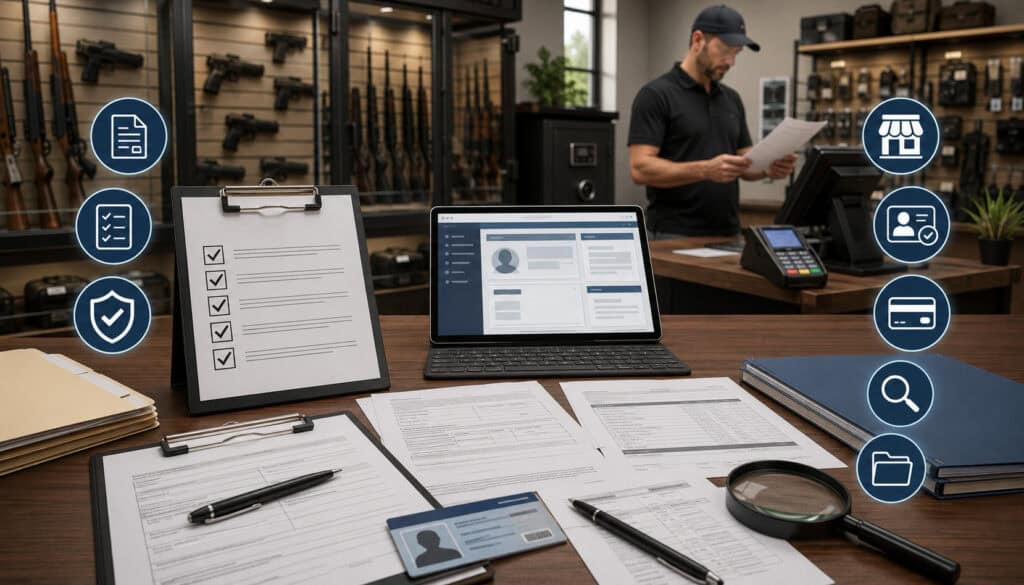
Organized documentation can make underwriting more efficient and reduce repeated requests. Exact requirements vary, but firearm businesses should be prepared to provide evidence of their identity, ownership, operations, products, finances, and payment history.
Commonly requested materials may include:
- Legal business name and DBA
- Business address and contact details
- Tax identification information
- Articles of organization or incorporation
- Owner and beneficial ownership details
- Government-issued identification
- Business license where applicable
- FFL documentation where applicable
- Voided business check or bank letter
- Recent business bank statements
- Prior processing statements
- Product catalog or inventory list
- Website URL
- Expected monthly volume
- Average and maximum ticket size
- Percentage of card-present sales
- Percentage of card-not-present sales
- Refund policy
- Shipping policy
- Privacy policy
- Terms and conditions
- Chargeback history
- Fulfillment information
- Payment security information
New businesses may not have prior processing statements. In that case, the underwriter may rely more heavily on the owner’s background, business plan, projected sales, available capital, website quality, and operational controls.
The merchant should submit current, readable documents. Expired licenses, incomplete statements, mismatched addresses, missing pages, or unclear ownership records can delay the review.
Why FFL and Product Information May Be Reviewed
The underwriter needs to understand precisely what the merchant sells and whether the business has the licenses required for its activities.
Federal licensing requirements depend on the nature of the business. Merchants should review applicable agency guidance and consult an appropriate professional regarding their specific obligations. Payment approval does not establish that a merchant has satisfied licensing or regulatory requirements.
Product information also helps the processor identify items that fall outside its policies. A provider may approve certain firearms and accessories while restricting other product categories.
The product catalog should distinguish among major revenue sources, such as:
- Firearms
- Ammunition
- Optics
- Holsters
- Cases
- Cleaning supplies
- Apparel
- Range services
- Training
- Repair work
- Membership fees
This level of detail also helps determine average ticket expectations. A business focused on apparel and cleaning products may have a different transaction profile from a retailer processing high-value firearm purchases.
Why Website Policies Matter for Online Sales
An online storefront gives customers and underwriters a direct view of the merchant’s products, sales terms, and customer service practices.
Clear website policies help customers understand what they are purchasing, when orders will be fulfilled, how refunds work, and how to contact the business. This can reduce misunderstandings that later become disputes.
Before applying, an online firearm-related business should review its:
- Refund and cancellation policy
- Shipping and delivery policy
- Privacy policy
- Terms and conditions
- Contact page
- Customer service information
- Product descriptions
- Checkout disclosures
- Billing descriptor information
- Secure checkout configuration
The policies should be accessible before payment is submitted. Important restrictions should not be hidden in small text or disclosed only after checkout.
A website should also match the application. The business name, DBA, address, phone number, product categories, and customer service information should be accurate and consistent.
Payment Channels Compared for Firearm and Standard Accounts
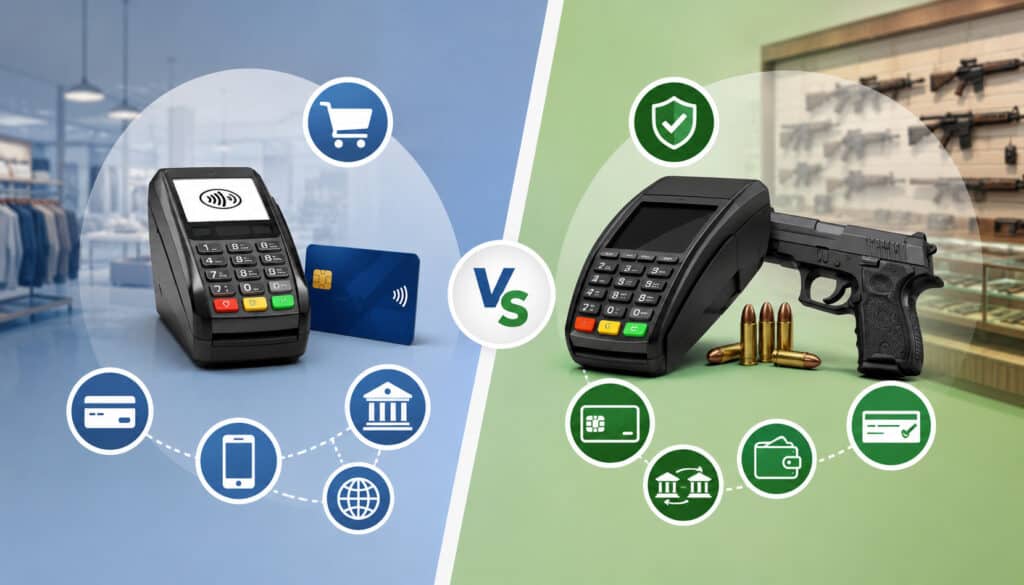
A merchant account is approved not only for a business category but also for particular ways of accepting payments. Each sales channel can create a different fraud, chargeback, and data-security profile.
Common payment channels include:
- Countertop POS terminals
- Integrated retail POS systems
- Mobile card readers
- Online checkout
- Virtual terminals
- Telephone orders
- Invoice payments
- Payment links
- Recurring membership billing
- Event-based sales
- ACH payments
A standard retailer may receive approval for in-store and online payments through an ordinary program. A firearm-related business may need explicit approval for each channel, especially when transactions involve online orders, manually entered cards, remote fulfillment, or high-ticket purchases.
Merchants should not assume that approval for a physical terminal automatically permits online or telephone transactions. The processor may use different pricing, fraud controls, processing limits, or gateway configurations for card-not-present payments.
Card-Present and In-Store Payments
Card-present payments occur when the customer and payment card are physically present during the transaction. These payments are commonly accepted through EMV-enabled terminals, contactless readers, and integrated POS systems.
An EMV chip transaction generates transaction-specific data that is more difficult to reuse than information from a copied magnetic stripe. Contactless cards and compatible digital wallets can provide similarly secure transaction methods when properly implemented.
Card-present transactions may present lower fraud exposure than manually keyed transactions because the terminal can electronically validate the payment credential. However, merchants still need strong controls.
Useful practices include:
- Using supported EMV terminals
- Restricting manual-entry permissions
- Training staff to inspect suspicious transactions
- Providing detailed receipts
- Matching receipts to orders
- Securing terminal access
- Reviewing refunds and voids
- Monitoring unusual ticket sizes
Gun store payment processing may also integrate with inventory, customer records, range management, or accounting software. Merchants should confirm that the POS system and processor are compatible before purchasing equipment or signing a long-term agreement.
Online and Card-Not-Present Payments
Card-not-present transactions occur when the physical card is not inserted, tapped, or swiped at the merchant’s terminal. Online checkout, telephone orders, virtual terminal payments, invoices, and many payment links fall within this category.
These payments may receive closer review because stolen card information can be used remotely. The merchant may also have greater difficulty proving that the legitimate cardholder authorized the purchase.
Fraud controls may include:
- Address Verification Service
- Card verification value checks
- Device and IP analysis
- Velocity limits
- Transaction-risk scoring
- Manual review
- Customer identity checks
- Order confirmation
- Shipping documentation
- Gateway fraud filters
Payment security requirements apply to both standard and firearm merchants. PCI guidance notes that card-present and card-not-present environments handle payment data through different channels that must be appropriately evaluated and protected. Merchants can review the payment security guidance for merchants when assessing their environment.
Pricing, Fees, Reserves, and Funding Differences
Merchant account pricing reflects more than the merchant’s industry. It may be influenced by transaction method, card type, average ticket, monthly volume, fraud exposure, chargeback history, business age, financial stability, and provider risk policies.
Potential costs include:
- Transaction rates
- Per-transaction authorization fees
- Monthly account fees
- Payment gateway fees
- Virtual terminal fees
- PCI-related fees
- Chargeback fees
- Retrieval fees
- Batch fees
- Equipment costs
- Software fees
- Early termination fees
- Statement fees
- Address verification fees
- Recurring billing fees
Standard merchant accounts for established lower-risk businesses may have more straightforward pricing. Firearms merchant services may be priced according to a more detailed risk profile.
A specialized account should not automatically be considered expensive or inexpensive. The merchant needs to review the complete cost structure and compare it with the operational value of correct underwriting.
A low advertised rate may be less important than stable processing, accurate product approval, compatible technology, responsive risk support, and understandable contract terms.
Why Firearm Merchant Account Pricing May Vary
Two firearm merchants may receive different pricing because their operations create different payment risks.
Pricing and account terms may depend on:
- Products sold
- Percentage of firearm-related revenue
- Average ticket size
- Maximum transaction size
- Monthly processing volume
- Card-present percentage
- Online transaction percentage
- Fulfillment timeframe
- Processing history
- Chargeback ratio
- Refund activity
- Business age
- Financial condition
- Gateway configuration
- Fraud controls
A long-established physical store processing mostly EMV transactions may present a different profile from a new online merchant expecting large remote orders.
Businesses should compare effective processing costs rather than focusing on one quoted percentage. The effective cost includes transaction fees, monthly charges, gateway expenses, equipment, chargebacks, reserves, and other recurring costs.
Merchants should also ask whether pricing is based on interchange-plus, tiered, flat-rate, or another model. The agreement should explain how rates can change and whether particular transaction types carry additional costs.
Understanding Reserves and Funding Holds
A reserve is money retained by the processor or acquiring bank as protection against potential chargebacks, refunds, fraud, or account losses.
A rolling reserve may hold a percentage of each settlement for a defined period. A fixed reserve may require a specific balance. Some accounts may instead be subject to delayed funding or transaction-level holds.
Reserves can be influenced by:
- Limited processing history
- High average tickets
- Future delivery
- Rapid growth
- Elevated chargebacks
- Financial instability
- Unusual refund activity
- Significant card-not-present volume
- Product or fulfillment risk
A funding hold may also occur when activity differs from the approved profile. Examples include a sudden volume spike, an unusually large transaction, a sharp increase in refunds, or suspected fraud.
Businesses should ask how reserves are calculated, how long funds may be held, when reserves are reviewed, and what happens to held funds after account closure.
Chargeback and Fraud Risk Differences
A chargeback occurs when a cardholder disputes a transaction through the card-issuing bank. The merchant may be required to provide evidence showing that the transaction was valid and fulfilled according to the disclosed terms.
Common dispute causes include:
- Fraud or unauthorized use
- Product not received
- Product not as described
- Duplicate processing
- Incorrect transaction amount
- Refund not processed
- Unrecognized billing descriptor
- Cancellation disagreement
- Delayed fulfillment
- Customer service problems
Firearm businesses may face closer monitoring when transactions involve expensive merchandise, remote orders, manual card entry, special orders, deposits, or delayed fulfillment.
A chargeback does not necessarily mean that the merchant acted improperly. However, repeated disputes can increase costs, create reserves, reduce processing limits, or threaten the account.
The best strategy is to prevent avoidable disputes before they occur and maintain organized records for those that cannot be prevented.
Chargeback Prevention for Firearm Merchant Accounts
Chargeback prevention begins with clear communication. Customers should know the business name that will appear on their statement, the total price, delivery expectations, cancellation rules, refund eligibility, and how to contact customer service.
Helpful practices include:
- Use a recognizable billing descriptor.
- Provide itemized receipts.
- Send order confirmations.
- Display refund terms before checkout.
- Document customer acceptance of important policies.
- Maintain shipping and delivery records.
- Respond quickly to customer questions.
- Process approved refunds promptly.
- Track dispute reasons.
- Store transaction evidence securely.
- Review recurring problem products.
- Train employees on refund procedures.
For special orders or deposits, explain when the payment becomes nonrefundable, where permitted, and obtain clear customer acknowledgment.
A dispute-management process should assign responsibility for receiving notices, gathering evidence, submitting responses, and reviewing outcomes. Missed deadlines can cause the merchant to lose disputes regardless of the quality of its evidence.
Fraud Prevention Across Firearm Sales Channels
Fraud prevention should reflect the way transactions are accepted.
In-store controls may focus on EMV use, staff permissions, suspicious behavior, manual-entry restrictions, refund approvals, and terminal security. Online controls may include AVS, card verification checks, device analysis, velocity rules, and manual review.
Warning signs may include:
- Multiple declined cards
- Repeated purchase attempts
- Unusual order quantities
- Requests to split payments
- Billing and shipping inconsistencies
- Rush-shipping demands
- Orders significantly above the normal ticket size
- Multiple cards from the same device
- Customer resistance to verification
- Rapid orders from newly created accounts
No individual warning sign proves fraud. The merchant should evaluate the complete transaction and follow documented review procedures.
Tokenization and encryption can reduce exposure by limiting how raw payment data is stored or transmitted. Access to payment systems should be restricted to employees who need it, and passwords or login credentials should never be shared casually.
Website and Compliance Expectations
A website used for firearm-related commerce is part of the merchant’s underwriting profile. Even when customers complete regulated steps outside the payment process, the website still communicates what the business sells and how transactions are handled.
The site should accurately identify the merchant and make customer service information easy to find. Product descriptions, prices, checkout terms, refund rules, and shipping information should be consistent.
Important website elements may include:
- Legal or DBA business name
- Physical or mailing address
- Customer service phone number
- Customer service email
- Product descriptions
- Refund and cancellation policy
- Shipping and delivery policy
- Privacy policy
- Terms and conditions
- Secure checkout
- Accepted payment methods
- Fulfillment explanations
- Relevant age or product notices
- Billing descriptor information
A secure checkout page does not by itself make the entire website secure. Merchants should maintain software updates, restrict administrative access, use reputable hosting and payment services, and monitor the site for suspicious changes.
The PCI Security Standards Council recommends protecting card data in both physical and card-not-present environments and using appropriately secure service providers for eCommerce payment activity.
Website Review for Firearm Merchant Accounts
During website review, the underwriter may examine the home page, product pages, shopping cart, checkout flow, business information, and policies.
The review may seek answers to questions such as:
- What products are sold?
- Which products generate most revenue?
- Is the merchant identity clear?
- Are refund terms visible?
- Are shipping expectations explained?
- Is customer service information available?
- Does the checkout use a secure connection?
- Does the site contain prohibited products?
- Does the website match the application?
- Are remote sales and fulfillment procedures clear?
A site under construction may delay approval because the underwriter cannot verify the business model. Merchants should avoid submitting an application while major product or policy pages are incomplete unless the provider has agreed to a pre-launch review process.
Any major post-approval change should be evaluated carefully. Adding new product categories, subscription services, online ordering, or another domain may require processor approval.
Standard Account Website Review
Standard merchant accounts may also require website review. Processors need to confirm that the business is legitimate, products are allowed, prices are clear, and customers can understand the purchase terms.
The review may be less extensive for a lower-risk merchant with inexpensive products, immediate delivery, simple refunds, and no regulatory complications.
Nevertheless, standard online merchants should maintain the same core policy pages. Weak customer communication can create chargebacks regardless of industry.
A website that lacks contact details, refund terms, delivery information, or a secure checkout may raise concerns even when the products are ordinary.
The distinction is therefore one of emphasis and complexity rather than a complete absence of review. Every eCommerce merchant should expect the processor to examine what is being sold and how customers are treated.
Benefits of Using a Firearm-Specific Merchant Account
The primary benefit of a firearm-specific account is alignment between the merchant’s actual operations and the payment provider’s underwriting program.
When products and channels are disclosed accurately, the processor can assess realistic transaction limits, fraud controls, documentation needs, pricing, and settlement terms.
Potential benefits include:
- Accurate business classification
- Clearer processor expectations
- Approval for disclosed products
- Support for approved sales channels
- Better understanding of firearm retail operations
- More appropriate fraud controls
- Reduced misclassification risk
- Realistic volume and ticket limits
- Better preparation for risk reviews
- Improved long-term account stability
This does not eliminate every operational problem. Chargebacks, suspicious transactions, policy changes, or unusual activity can affect any merchant account.
The advantage is that ordinary firearm-related activity should not be a surprise to the provider when the account has been correctly evaluated.
Merchants can review broader information about gun-friendly merchant services when comparing how specialized processing programs approach underwriting, channels, and risk management.
Better Fit for Firearm Business Operations
A firearm-related business may combine several revenue streams that do not fit neatly into ordinary retail processing.
A shooting range, for example, may collect:
- Walk-in range fees
- Recurring membership payments
- Training deposits
- Retail accessory purchases
- Firearm sales
- Ammunition sales
- Repair fees
- Event registrations
An appropriately structured account can evaluate these activities together. The processor can determine which channels are approved and whether separate merchant accounts, terminals, gateways, or descriptors are appropriate.
A gun shop with online and physical sales may need integrated reporting while maintaining different fraud controls for card-present and card-not-present transactions.
The merchant should explain these requirements before selecting technology. A POS system, gateway, or membership platform may have technical limitations even when the merchant account supports the business category.
Reduced Risk of Misclassification Problems
Misclassification occurs when the merchant account does not accurately represent the business’s primary products or activities.
This can happen intentionally, but it can also result from incomplete applications, oversimplified sales descriptions, automated onboarding, or changes made after approval.
Correct classification reduces the likelihood that ordinary transactions will appear inconsistent with the original application. It also allows risk teams to establish realistic expectations regarding average tickets, volume, product types, and sales channels.
The merchant should still monitor its operations. A correctly classified account can become outdated when the business launches a new website, adds restricted products, begins telephone orders, or substantially changes its revenue mix.
Whenever the business changes materially, the merchant should review the account terms and communicate with the provider.
When a Standard Merchant Account May Not Be Enough
A standard account may not be sufficient when the merchant’s products, services, or sales channels require specialized processor approval.
Situations that may indicate the need for specialized processing include:
- Selling firearms
- Selling ammunition
- Operating as an FFL dealer
- Processing online firearm-related orders
- Accepting high-ticket remote payments
- Operating a shooting range
- Collecting recurring range memberships
- Using a virtual terminal for firearm-related orders
- Selling through multiple websites
- Accepting payments at firearm events
- Adding regulated or processor-restricted products
- Experiencing repeated questions about product eligibility
The merchant should not wait until a funding hold or account closure to investigate compatibility. Product acceptance should be confirmed before transactions begin.
A business that sells only ordinary outdoor merchandise may qualify for standard merchant services. If firearms or ammunition are later added, the merchant should notify the processor and determine whether new underwriting is required.
Warning Signs Your Business Needs Specialized Processing
Several warning signs can indicate that the current payment arrangement is not well aligned with the business.
These include:
- Applications are repeatedly declined after product review.
- The provider asks whether the business sells firearms or ammunition.
- Funds are held after high-ticket transactions.
- The account receives a restricted-product notice.
- Online payments are disabled.
- The processor requests licenses after transactions begin.
- The merchant receives questions about its website.
- Transactions exceed approved limits.
- The provider states that firearm sales are not permitted.
- The business has been assigned an inaccurate category.
These events do not always mean the merchant has done something wrong. They may show that the account needs to be reviewed, updated, or replaced.
Businesses should respond promptly and honestly. Ignoring risk requests can lead to more restrictive action.
Why Workarounds Can Create Bigger Problems
Attempting to hide firearm-related activity can transform an underwriting mismatch into a merchant agreement violation.
Unsafe workarounds include:
- Applying under an inaccurate category
- Omitting firearm-related products
- Processing through another business’s account
- Using a personal payment account
- Hiding an online sales channel
- Changing website content during review
- Splitting transactions to avoid limits
- Using an unapproved virtual terminal
- Processing payments for another merchant
These practices can create account termination, held funds, additional reserves, dispute problems, and difficulty obtaining future processing.
Processing for another business is especially risky because the account holder may not control the products, customer service, fulfillment, or chargeback evidence.
The sustainable approach is accurate disclosure and appropriate underwriting.
Best Practices Before Applying for a Firearm Merchant Account
Preparation can improve the quality of the application and help the underwriter understand the business more efficiently.
Before applying:
- Describe the business accurately.
- Disclose every important product category.
- Disclose all sales channels.
- Keep FFL documentation current where applicable.
- Organize business and ownership records.
- Prepare recent bank statements.
- Gather prior processing statements.
- Calculate realistic monthly volume.
- Calculate average and maximum ticket sizes.
- Review chargeback history.
- Update the product catalog.
- Complete website policies.
- Confirm customer service information.
- Review shipping and fulfillment procedures.
- Use secure payment tools.
- Ask about prohibited products.
- Ask about reserves and funding.
- Ask about transaction limits.
- Save copies of submitted documents.
- Respond promptly to underwriting requests.
The merchant should also verify that the requested processing limit allows for seasonal sales or occasional high-value transactions. Estimates should be reasonable and supported by business history or projections.
An application should not exaggerate expected volume. Large unsupported projections may increase concern rather than improving approval terms.
Businesses seeking more preparation guidance can review how to get approved for a firearms merchant account and compare the recommendations with the requirements supplied by their prospective provider.
Be Transparent During Underwriting
Transparency allows the processor to make an informed decision.
The application should explain:
- What the business sells
- Where sales occur
- How customers pay
- How products are fulfilled
- Whether recurring billing is used
- Whether telephone orders are accepted
- Whether payment links are used
- Typical and maximum transaction values
- Expected monthly volume
- Refund and cancellation practices
If the business has previous chargebacks, funding holds, or account closures, provide an accurate explanation. Include the cause, corrective actions, and current risk controls.
An unexplained problem may appear more concerning than a documented issue that has been addressed responsibly.
Prepare for Ongoing Monitoring
Merchant account approval is not the end of risk review. Processors monitor accounts for changes in transaction behavior, disputes, refunds, fraud, and policy compliance.
Monitoring may identify:
- Sudden volume increases
- Higher average tickets
- New card-not-present activity
- Increased chargebacks
- Excessive refunds
- New product categories
- New websites
- Unusual geographic patterns
- Repeated declined transactions
- Changes in fulfillment time
Merchants should maintain internal reports and investigate changes before they become serious.
When a legitimate promotion or seasonal event will cause an unusual sales increase, advance communication may help prevent avoidable concern.
Common Mistakes Firearm Businesses Should Avoid
Many processing problems result from preventable application or account-management mistakes.
Common examples include:
- Applying for standard merchant services without disclosing firearm activity
- Providing expired or incomplete licenses
- Submitting inconsistent business information
- Leaving the website unfinished
- Omitting refund or shipping policies
- Failing to disclose online sales
- Underestimating maximum ticket size
- Ignoring chargebacks
- Adding unapproved products
- Using unapproved payment channels
- Sharing payment-system credentials
- Processing another merchant’s transactions
- Failing to read risk notices
- Ignoring merchant agreement changes
A merchant may focus heavily on obtaining approval and pay too little attention to maintaining the account. Long-term stability depends on continued compliance with the approved business profile.
Applying Under the Wrong Business Category
A broad category such as retail, sporting goods, or consulting may not provide enough information when the business sells firearm-related products.
Using an inaccurate category may produce a fast approval, but it can create instability when the processor later reviews the website or transaction activity.
The correct category should reflect the merchant’s primary activity and disclosed product mix. Mixed-product businesses should provide revenue percentages rather than selecting the least sensitive description.
If an application form does not provide an appropriate category, the merchant should explain the business in an attachment or application note.
Ignoring Contract and Policy Terms
The merchant agreement defines important rights and responsibilities. Businesses should review it before processing begins.
Important provisions may address:
- Prohibited products
- Acceptable-use requirements
- Processing limits
- Reserve rights
- Funding delays
- Chargebacks
- Security obligations
- Contract length
- Early termination
- Equipment ownership
- Rate changes
- Account reviews
- Data access
- Account termination
- Reserve release
The merchant should also review gateway, POS, software, and equipment agreements. Different services may have separate cancellation terms and data responsibilities.
Contract questions should be reviewed by an appropriate professional, particularly when terms are unclear or financially significant.
How to Choose Between Firearm and Standard Merchant Services
The correct choice depends on the merchant’s real operations, not the preferred label or lowest advertised rate.
A business should evaluate:
- Primary products
- Percentage of firearm-related sales
- Licensing requirements
- Physical and online locations
- Card-present volume
- Card-not-present volume
- Monthly processing volume
- Average and maximum tickets
- Refund exposure
- Chargeback history
- Fulfillment timelines
- Recurring payments
- POS and gateway needs
- Processor product policies
- Reserve requirements
- Funding timelines
- Contract terms
A business that does not sell firearm-related products may be adequately served by standard merchant services. A gun shop, FFL dealer, or online firearm-related seller generally needs a provider and acquiring arrangement that expressly accepts its activities.
A mixed-product business should not make assumptions based on its name or largest non-firearm category. It should provide a complete product and revenue profile.
Questions to Ask Before Choosing a Merchant Account
Before signing an agreement, ask:
- Does the program expressly accept my business type?
- Are firearms and ammunition supported?
- Are all my accessory categories permitted?
- What FFL documentation is required?
- Are online firearm-related payments supported?
- Are telephone orders allowed?
- Can I use a virtual terminal?
- Are payment links permitted?
- Can I process range memberships?
- Are recurring payments supported?
- Can I process at events?
- Are separate merchant accounts required for different channels?
- What products are prohibited?
- What are the average and maximum ticket limits?
- What is the approved monthly volume?
- Is a reserve required?
- What is the settlement timeline?
- What can trigger a funding hold?
- What are the chargeback thresholds?
- Which gateways and POS systems are compatible?
- Who owns the equipment?
- What are the cancellation terms?
- How are account reviews handled?
- How should business changes be reported?
Answers should be obtained in writing whenever possible. The merchant should compare those answers with the formal agreement.
Comparing More Than Processing Rates
Rates matter, but they are only one part of the decision.
A useful comparison should include:
- Product acceptance
- Underwriting accuracy
- Sales-channel support
- Account stability
- Funding reliability
- Reserve terms
- Processing limits
- Gateway compatibility
- POS compatibility
- Fraud controls
- Chargeback support
- Reporting quality
- Customer service
- Contract clarity
- Total cost
A very low rate provides limited value if the account does not permit the merchant’s actual products or payment channels.
The most suitable arrangement is one that combines reasonable costs with accurate underwriting, secure technology, understandable policies, and operational compatibility.
FAQs
What is the difference between firearms merchant accounts and standard merchant accounts?
Both accounts enable businesses to accept electronic payments. The primary difference is how the business is classified, underwritten, and monitored.
Firearms merchant accounts are reviewed for firearm-related products, licensing where applicable, sales channels, websites, average tickets, fraud exposure, and processor policies. Standard merchant accounts are commonly designed for businesses with familiar products and simpler risk profiles.
The specialized account is intended to align the payment relationship with the merchant’s actual firearm-related operations.
Why do firearm businesses often need specialized merchant accounts?
Many payment providers apply additional underwriting to regulated, age-restricted, high-ticket, or card-not-present commerce. Firearm businesses may have several of these characteristics.
A specialized account allows the processor and acquiring bank to evaluate the actual products, transaction methods, licenses, fulfillment practices, and risk controls before approving the business.
This can reduce the risk of later discovering that firearm-related activity falls outside the account’s permitted use.
Can a gun shop use a standard merchant account?
A gun shop should use a standard merchant account only when the processor and acquiring bank have expressly approved the shop’s complete product range and payment channels under that program.
A general retail approval should not be assumed to include firearms, ammunition, online firearm-related transactions, or manually keyed payments. The safest approach is to disclose the business fully and obtain written confirmation regarding product and channel acceptance.
What documents are needed for a firearm merchant account?
Requirements vary, but merchants may need business formation records, owner information, bank statements, a voided check or bank letter, business licenses, FFL documentation where applicable, a product catalog, website information, processing statements, expected volume, average ticket information, and policy documents.
Online sellers may also need clear refund, shipping, privacy, and terms-and-conditions pages. Providing complete, current, and consistent documents can reduce delays.
Why are firearm merchant accounts considered higher risk?
The term “higher risk” may reflect underwriting and processor policy considerations rather than a judgment about the merchant.
Factors can include regulated products, high-ticket transactions, card-not-present sales, fraud exposure, chargeback amounts, licensing requirements, shipping complexity, and reputational concerns.
The specific risk assessment depends on the business model. A stable card-present retailer may be evaluated differently from a new online seller with large remote transactions.
Do firearm merchant accounts have different fees?
They may. Pricing can depend on product mix, transaction channels, monthly volume, average ticket size, processing history, chargebacks, financial stability, gateway requirements, and risk controls.
Some merchants may also encounter reserves, delayed funding, or additional gateway costs. Businesses should compare the total cost and contract terms rather than evaluating only one advertised transaction rate.
What happens if a firearm business uses the wrong merchant account?
The processor may request additional documentation, place a hold on funds, impose a reserve, restrict transactions, reduce processing limits, or terminate the account.
The outcome depends on the agreement, the nature of the mismatch, transaction activity, and the provider’s policies. Accurate disclosure during underwriting is the most effective way to reduce misclassification problems.
How can a business choose the right firearm payment processing setup?
Begin by documenting all products, sales channels, licenses, average tickets, expected monthly volume, fulfillment methods, and technology needs.
Then confirm that the prospective provider supports the exact business model. Compare product policies, underwriting requirements, reserves, funding timelines, processing limits, gateway compatibility, POS options, fraud controls, chargeback support, pricing, and contract terms.
Professional review may be appropriate when legal, regulatory, banking, or contractual questions affect the decision.
Conclusion
Understanding firearms merchant accounts vs standard merchant accounts is essential for any firearm-related business that wants stable, secure, and accurately underwritten payment processing.
The two account types perform the same fundamental function, but they may differ significantly in business eligibility, documentation, product review, approved sales channels, pricing, reserves, funding timelines, chargeback monitoring, and ongoing risk management.
A standard merchant account may work well for ordinary retail or service activity, but it should not be assumed to support firearms, ammunition, high-ticket remote orders, range memberships, or other firearm-related transactions.
A specialized firearm merchant account gives the processor and acquiring bank an opportunity to review the merchant’s actual operations before payments begin. This can create clearer expectations and reduce problems caused by inaccurate business classification.
Firearm businesses should prepare current licenses where applicable, organized financial records, realistic processing estimates, detailed product information, complete website policies, and accurate descriptions of every sales channel.
They should also invest in chargeback prevention, fraud monitoring, secure payment technology, employee training, PCI compliance, clear refund practices, and responsive customer service.
No merchant account eliminates every risk. Transaction spikes, fraud, chargebacks, policy changes, new products, or unapproved channels can trigger reviews even after approval.
Long-term stability depends on continued transparency. Businesses should choose merchant services that match their products, licenses, payment channels, average tickets, monthly volume, and risk profile—and communicate promptly when those operations change.
This article provides general educational information rather than legal, regulatory, banking, or contractual advice. Businesses should consult appropriate professionals and review current agency guidance, processor policies, and merchant agreements when making decisions for their specific operations.