
Informational only: this article is not financial or legal advice. Firearms businesses should consult qualified payment, compliance, and legal professionals before making decisions.
Firearms businesses often face a more detailed approval process than many standard retailers because payment providers evaluate both financial risk and regulatory exposure.
Merchant account underwriting for firearms businesses usually looks at licensing, product categories, website disclosures, sales channels, chargeback risk, transaction monitoring, payment security, and whether the processor’s sponsor bank supports the business model.
For an FFL dealer, range, gunsmith, training provider, or ecommerce seller, underwriting is not just a formality. It helps processors decide whether the account can be approved, what documents are needed, what processing limits may apply, and whether added risk controls are necessary.
Because firearms-related commerce is regulated, underwriters typically want to understand how transactions are handled from the first customer interaction through checkout, transfer, fulfillment, refunds, and dispute response.
Official licensing guidance confirms that businesses engaged in dealing, manufacturing, or importing firearms must apply for the appropriate federal firearms license, which is why FFL documentation is a central part of underwriting review.
What Is Merchant Account Underwriting for Firearms Businesses?
Merchant account underwriting is the review process payment processors and acquiring banks use before allowing a business to accept card payments.
In a firearms context, the process is more detailed because the underwriter must evaluate financial risk, regulatory fit, business transparency, website practices, transaction history, and whether the products sold are supported by the payment provider.
In everyday terms, underwriting answers a few core questions: Is this business legitimate? Is it properly licensed? Does it sell products the processor allows? Are customers clearly informed about refunds, shipping, transfers, and restrictions? Does the business have a history of excessive disputes or unusual transaction activity?
For firearms retailers, firearm merchant account underwriting may involve a review of business formation documents, ownership details, FFL records, prior processing statements, bank statements, product pages, ecommerce checkout flow, and written policies.
Businesses that sell online may receive additional scrutiny because card-not-present transactions often carry more fraud and chargeback exposure.
A helpful way to think about underwriting is that it is not only an approval decision; it is also a risk-mapping process. The underwriter uses the application and documents to decide how the account should be structured.
That may include pricing, reserve requirements, settlement timing, gateway setup, monthly volume limits, fraud controls, and future review triggers.
Firearms businesses should also understand that not every payment provider supports the category. Some mainstream providers restrict firearms, ammunition, parts, accessories, or related services.
This is why specialized information about getting approved for a firearms merchant account can be useful when preparing for underwriting.
Why Firearms Businesses Receive High-Risk Underwriting Review
Firearms businesses are commonly reviewed through a high-risk lens because underwriters must consider product sensitivity, regulatory requirements, card-not-present exposure, chargeback risk, reputational policies, and sponsor-bank rules.
“High risk” does not automatically mean a business is unsafe or poorly managed. It means the processor needs a more complete picture before approving firearm business payment processing.
Product category is one reason. Firearms, ammunition, parts, and certain accessories may be subject to specific legal, transfer, shipping, or age-related controls. Underwriters want to see that the merchant understands these controls and presents them clearly to customers.
The sales channel also matters. A storefront with in-person card payments may be reviewed differently from an ecommerce seller accepting firearm ecommerce payments. Online sales can involve more fraud screening, customer identity concerns, shipping disclosures, FFL transfer procedures, and refund disputes.
Chargebacks are another major factor. A processor may ask whether the business has prior processing history, how often customers request refunds, whether disputes are tied to delivery delays or transfer confusion, and whether the business has clear policies that customers see before checkout.
Processor rules also shape approval. Some providers avoid the category entirely, while others support it only when the merchant has the right documentation, product controls, and website disclosures.
Firearm-friendly guides often emphasize that proper underwriting, clear descriptors, transparent policies, and accurate merchant setup are essential for long-term account stability.
| Underwriting Factor | Why It Matters | How Businesses Can Prepare |
| FFL documentation | Confirms the business is licensed for its activities | Keep current license records, business registrations, and ownership details organized |
| Product categories | Determines whether the processor supports the items sold | Provide accurate product descriptions and avoid hiding restricted categories |
| Ecommerce policies | Shows customers understand transfer, shipping, refund, and checkout terms | Publish clear policy pages and make them easy to find |
| Processing history | Helps underwriters evaluate chargeback risk and sales consistency | Provide recent statements and explain unusual spikes or disputes |
| Average ticket size | Affects fraud, reserve, and exposure calculations | Share realistic projections based on actual sales data |
| Chargeback risk | High disputes can delay or prevent approval | Track disputes, improve communication, and document fulfillment |
| Payment security | Protects customer data and reduces fraud exposure | Use secure checkout, fraud tools, and controlled employee permissions |
| Compliance documentation | Supports responsible operations | Maintain updated business, licensing, and policy records |
Business Licensing and FFL Documentation
Business licensing is one of the first areas underwriters review because it helps confirm that the applicant is a real operating business with appropriate authorization for its activities.
For FFL dealers, this often includes the federal firearms license, business registration, ownership information, physical location details, tax records, and sometimes proof of operating history.
The FFL merchant account underwriting process may also involve reviewing whether the business name, legal entity, website name, bank account name, and application details match. Inconsistencies can create delays because underwriters need confidence that the account is being opened for the correct business and product category.
Underwriters may also look at the type of business model involved. A retail gun store, ecommerce FFL, gunsmith, range, training provider, and accessories seller may each present different underwriting questions. The clearer the documents are, the easier it is for the processor to understand the account.
A good preparation step is to create a document folder before applying. Include the FFL, business license, owner identification, bank letter or voided check, prior merchant statements, website URL, refund policy, and product description summary.
Ecommerce and Website Review
For online sellers, website review is a major part of high-risk merchant account underwriting for firearms. Underwriters do not only look at the design of the site; they review whether the website clearly explains what is sold, how checkout works, how transfers are handled, what restrictions apply, and what customers can expect after purchase.
A strong ecommerce site should include clear terms and conditions, refund and cancellation policies, shipping information, privacy policy, secure checkout indicators, contact details, and any transfer procedures that apply. If firearm purchases must be transferred through an FFL, the website should explain that process before the customer pays.
Underwriters may also review product pages to ensure the business is not selling unsupported items through the same merchant account. Vague product descriptions, missing policy pages, unclear transfer instructions, or unsupported checkout flows can delay firearms payment processor approval.
For businesses building online sales, guides on firearm-friendly payment processing can help clarify why processors look closely at payment gateway fit, documentation, and supported product categories.
Chargeback and Processing History
Chargeback risk is one of the most important underwriting concerns because disputes create financial exposure for processors and acquiring banks. During an underwriting review for gun stores, prior merchant statements can show whether the business has stable volume, reasonable refund activity, and acceptable dispute levels.
Underwriters may review monthly sales volume, average ticket size, refund ratios, chargeback counts, chargeback reasons, transaction spikes, seasonal patterns, and whether disputes were resolved.
A merchant with clean processing history may have an easier review than one with frequent customer complaints, delivery disputes, or unexplained volume changes.
New businesses without processing history can still be approved, but they may need to provide stronger supporting documentation. This can include realistic volume projections, supplier information, product lists, website policies, and a description of how customer service issues are handled.
Pro Tip: Keep short written notes on chargebacks and refunds. If an underwriter asks about past disputes, a clear explanation with corrective steps can be more helpful than simply submitting raw statements.
The FFL Merchant Account Underwriting Process Step by Step
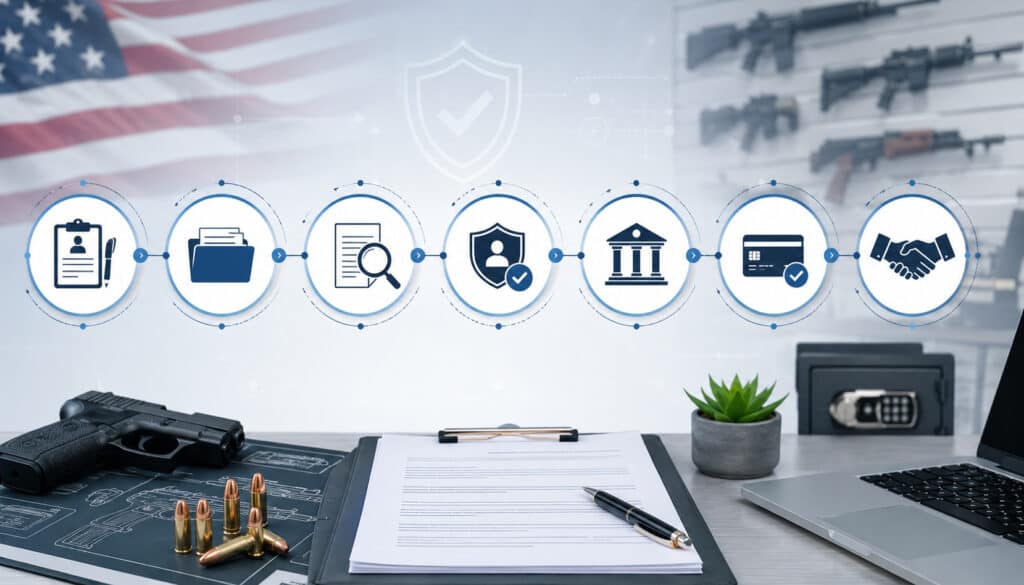
The FFL merchant account underwriting process usually begins with an application and ends with account setup, but several review stages may happen in between.
The processor needs to verify the business, understand the sales model, review documentation, assess risk, confirm sponsor-bank compatibility, and decide whether account conditions are necessary.
First, the merchant submits an application with business information, ownership details, expected processing volume, average ticket size, sales channels, website URLs, product categories, and banking information.
Accuracy matters. If the business sells firearms, ammunition, accessories, gunsmithing services, training, or range memberships, the application should reflect that clearly.
Next, the processor requests documents. These may include FFL records, business license, owner identification, voided check or bank letter, prior processing statements, bank statements, product descriptions, website policies, and gateway details. The exact list depends on the merchant’s sales channels and history.
Then underwriting reviews the file. This can include business verification, website review, product review, risk scoring, chargeback review, compliance documentation checks, and pricing evaluation.
Some businesses may receive follow-up questions about transfer procedures, shipping restrictions, refund rules, or prior processing history.
Finally, the processor issues an approval, conditional approval, request for more documents, or decline. Conditional approval may include reserves, limits, delayed funding, or periodic reviews. Businesses looking for firearms merchant services should expect the process to focus on fit, transparency, and long-term account stability.
Initial Application Review
The initial application review helps the processor decide whether the business is eligible for deeper underwriting. At this stage, the processor may look at legal business name, ownership, business address, website, phone number, expected monthly volume, average ticket, transaction methods, and product categories.
For firearms businesses, the application should clearly identify what is sold and how sales occur. A gun store that accepts in-person payments, an FFL ecommerce site, and a range selling memberships may all need different underwriting notes. If the application is too vague, the processor may pause the file and ask for clarification.
Payment methods also matter. Card-present retail sales, ecommerce transactions, invoices, recurring memberships, deposits, and mobile payments can each affect risk review. The more accurately the merchant describes payment activity, the easier it is for underwriters to match the account to the correct risk profile.
Risk Assessment and Approval Decision
Risk assessment is where the underwriter connects all the information in the file. The processor reviews whether the business is properly documented, whether products are supported, whether the website is clear, whether chargeback exposure is manageable, and whether expected volume makes sense.
Approval can be straightforward, but firearms businesses may also receive conditional terms. These can include rolling reserves, monthly volume caps, higher processing rates, delayed settlement, limited product categories, or requests for ongoing statements. Conditional approval is not always negative; it may be the structure that allows the processor to support the account.
A decline can happen if the processor does not support the product category, if documents are missing, if the website lacks required policies, if chargebacks are excessive, or if business information is inconsistent. In some cases, a revised application with stronger documentation may lead to a better outcome with a provider that supports firearms.
Merchants should read approval terms carefully before processing. The underwriting decision affects funding, reserves, chargeback fees, gateway use, termination rights, and future account reviews.
Common Documents Needed During Underwriting

Firearms businesses should prepare for a more document-heavy process than a basic retail merchant account. Underwriters are not only checking identity; they are building a complete profile of how the business operates and whether it fits the processor’s risk rules.
Common documents may include:
- Current FFL documentation, when applicable
- Business license or registration
- Owner or signer identification
- Voided check or bank verification letter
- Recent business bank statements
- Prior merchant processing statements
- Website URL and product category summary
- Refund, cancellation, privacy, and shipping policies
- Customer service contact details
- Fulfillment or transfer procedure explanation
- Supplier or inventory details, when requested
- Gateway or shopping cart information for ecommerce accounts
For gun store merchant account approval, consistency across documents is important. The legal name on the application should match bank records and business registration. Website branding should align with the business being underwritten. Product descriptions should match the actual inventory.
Businesses with prior processing history should include recent statements even if the history is imperfect. Underwriters often prefer visibility over uncertainty. If there were chargebacks or unusual volume spikes, include a short explanation and show what changed.
New businesses can prepare by documenting expected sales channels, average ticket assumptions, inventory categories, customer service procedures, and refund rules. A new merchant does not have processing statements, but it can still show that it has organized operations and clear policies.
Factors That Can Delay Merchant Account Approval
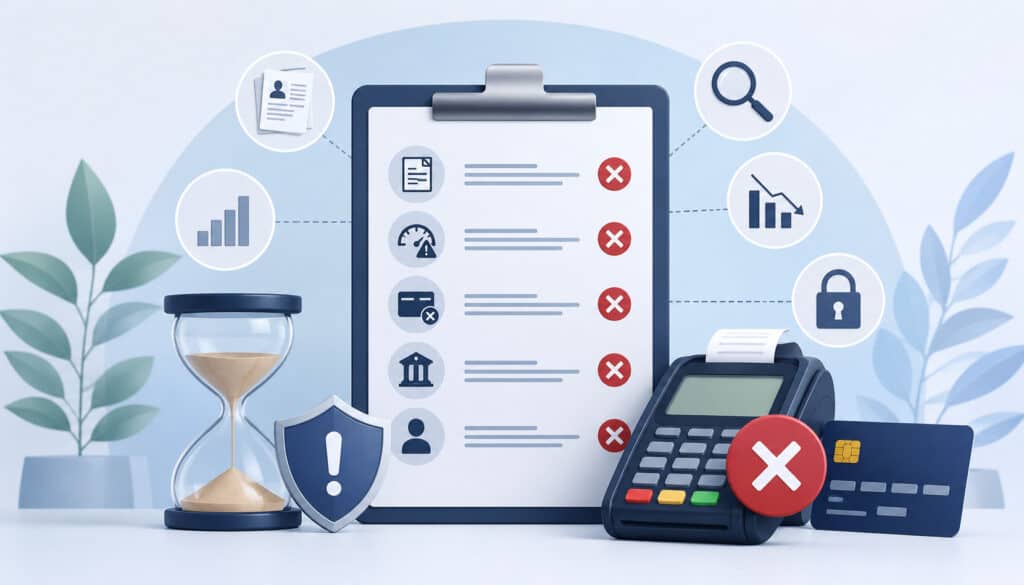
Delays usually happen when underwriters cannot verify the business, cannot understand the product mix, or cannot confirm that the merchant’s operations match processor requirements. Many delays are avoidable with accurate applications and complete documentation.
Incomplete applications are a common problem. Missing owner details, outdated business addresses, unsupported sales descriptions, or vague product categories can cause underwriters to pause the review.
Firearms businesses should be especially careful not to leave out ecommerce URLs, FFL details, or related product categories.
Website issues can also slow approval. If policy pages are missing, checkout is not secure, refund terms are unclear, or transfer procedures are not explained, the processor may request changes before approving the account.
Ecommerce merchants should make sure customers can easily find contact information, privacy terms, refund rules, and shipping limitations.
Chargebacks and prior processing history can create additional reviews. High dispute levels, excessive refunds, sudden volume increases, or terminated accounts may lead to more questions. Underwriters may request extra statements, bank records, or explanations.
Unsupported products are another major delay. Some processors may support certain firearms-related sales but not others. If the merchant sells restricted accessories, parts, ammunition, training, memberships, or mixed inventory, those categories should be disclosed upfront.
High-Risk Merchant Account Terms Firearms Businesses Should Understand
Firearms businesses reviewing high-risk merchant accounts should understand the contract terms that may come with approval. High-risk approval can offer stability when matched correctly, but the terms may differ from standard retail processing.
A rolling reserve is one common term. It allows the processor to hold a percentage of sales for a period to protect against chargebacks, refunds, or unexpected account exposure. For example, a processor may hold part of each batch and release it later if the account remains healthy.
Processing limits are also common. A merchant may be approved for a monthly volume cap or average ticket range. Exceeding those limits without notice can trigger reviews, held funds, or requests for updated financial information. If sales increase, merchants should proactively discuss limit increases.
Settlement timing matters because it affects cash flow. Some accounts may fund quickly, while others may have delayed settlement based on risk profile. Firearms businesses should ask when funds are deposited, whether funding changes after volume spikes, and what events can trigger holds.
Other terms to review include chargeback fees, gateway fees, monthly minimums, early termination clauses, prohibited product rules, reserve language, retrieval fees, PCI-related fees, and account review rights. Merchants should also understand whether the processor can change terms after approval.
A balanced underwriting outcome is not only about getting approved. It is about accepting terms the business can operate under without harming cash flow, customer experience, or long-term stability.
Payment Security and Compliance Expectations
Payment security is a central part of firearms merchant services because processors want to reduce fraud, protect cardholder data, and limit preventable disputes. Security expectations may apply to in-store terminals, ecommerce gateways, employee access, customer records, and fraud monitoring.
For ecommerce merchants, secure checkout is essential. This includes using a reliable payment gateway, encrypted payment pages, tokenization where available, address verification tools, card security code checks, fraud filters, and clear order confirmation workflows. These tools help reduce unauthorized transactions and customer confusion.
In-store merchants should use secure terminals, restrict employee permissions, keep devices updated, and train staff to recognize suspicious transaction behavior. Manual card entry should be limited and documented because keyed transactions can carry more risk.
Customer data protection also matters. Businesses should avoid storing card data in unsafe systems, limit access to payment information, and follow PCI-aware workflows. Even when a third-party gateway handles sensitive payment data, the merchant still has responsibilities around access, policies, and safe handling.
Transaction monitoring is another expectation. Processors may flag sudden spikes, unusual ticket sizes, repeated declines, mismatched billing information, or excessive refunds. A business that monitors activity internally can often respond faster if the processor asks questions.
Security supports approval because it shows the merchant is not treating payment acceptance as an afterthought. It also supports customer trust, fewer disputes, and smoother account reviews.
Common Underwriting Mistakes Firearms Businesses Should Avoid
One of the biggest mistakes is applying with a processor that does not support firearms. Some payment providers accept general retail but restrict firearms, ammunition, or related ecommerce transactions. This can lead to declined applications, frozen funds, or account closures after processing begins.
Another mistake is hiding product categories. Underwriters usually review websites, descriptors, product pages, and transaction activity. If a merchant describes itself too broadly or leaves out firearms-related sales, the account may be approved under the wrong risk category and later disrupted.
Weak website policies are also a common issue. If customers do not understand refunds, transfers, shipping, restrictions, or cancellation terms, disputes become more likely. Underwriters may see unclear policies as a chargeback risk.
Poor chargeback management can harm approval odds. Businesses should not wait until disputes become severe before responding. Tracking dispute reasons, improving order communication, and keeping fulfillment records can make the underwriting file stronger.
Incomplete documentation slows review and can create doubt. Missing FFL records, mismatched business names, outdated bank information, or unclear ownership details may lead to avoidable requests.
Ignoring contract details is another serious mistake. Merchants should review reserve terms, funding timing, prohibited product lists, chargeback fees, and termination clauses. A merchant account is not only a rate quote; it is an operating agreement that affects daily payments.
Best Practices for Improving Underwriting Approval Odds
The best way to improve approval odds is to make the underwriter’s job easier. A clear, complete, and consistent file helps the processor understand the business and evaluate risk without unnecessary uncertainty.
Start by organizing records. Keep FFL documentation, business license, ownership records, bank records, prior statements, website URLs, and written policies ready before applying. If any document has a different name or address, prepare an explanation.
Next, make website policies easy to find. Refunds, cancellations, shipping, transfer procedures, privacy terms, contact information, and product restrictions should be visible before checkout. Ecommerce businesses should also ensure checkout pages are secure and consistent with the product categories being sold.
Reduce chargeback exposure by improving communication. Send order confirmations, explain transfer steps, respond quickly to customer questions, document fulfillment, and make refund rules clear. Many disputes begin when customers feel confused or ignored.
Monitor processing history. Review monthly statements for chargeback ratios, refund patterns, average ticket changes, and unusual volume spikes. If the business is growing quickly, talk to the processor before exceeding approved limits.
Choose providers that understand FFL payment processing and firearms-related underwriting. Firearms businesses often benefit from payment partners familiar with sponsor-bank requirements, ecommerce review, compliance documentation, and high-risk merchant account terms.
The guide on setting up a firearm merchant account offers additional context on preparation, processor selection, and account setup.
Finally, respond quickly to underwriting requests. Delays often come from missing documents or unanswered questions. A fast, organized response can keep the file moving and show that the business operates professionally.
What is merchant account underwriting for firearms businesses?
Merchant account underwriting for firearms businesses is the review process used by payment processors and acquiring banks before approving card acceptance. The review helps determine whether the business is legitimate, properly documented, and compatible with the processor’s risk policies.
Underwriters may review FFL documentation, business registration, owner identification, bank records, processing history, website policies, product categories, refund rules, and ecommerce checkout security. The goal is to understand how the business operates and whether the account can be supported safely.
This process also affects account terms. Approval may include pricing, settlement timing, monthly limits, reserves, gateway requirements, or follow-up reviews. A complete and accurate application can make the process smoother.
Why are firearms businesses considered high risk?
Firearms businesses are often considered high risk because processors evaluate regulated product categories, card-not-present transactions, chargeback exposure, fulfillment complexity, and sponsor-bank restrictions.
The classification is about payment risk and policy fit, not a judgment on the quality of the business.
Online transactions may receive added review because customers may pay before transfer or fulfillment is complete. If policies are unclear, disputes can arise over shipping, eligibility, cancellations, or transfer procedures.
Processors also need to confirm that the merchant sells supported products and maintains appropriate documentation. This is why accurate product disclosure and clear operating procedures are important during underwriting.
What documents do FFL dealers need for underwriting?
FFL dealers commonly need to provide a current FFL, business license or registration, owner identification, bank verification, prior processing statements, bank statements, website URL, product information, and written policies. Some underwriters may request additional documents depending on the sales model.
Ecommerce merchants may need to provide refund policies, shipping terms, transfer procedures, privacy policy, and checkout details. If the business has prior chargebacks, statements and explanations may also be requested.
The exact list varies by processor, but preparation matters. A well-organized document packet helps underwriters verify the account and reduces approval delays.
Why do processors review firearm business websites?
Processors review firearm business websites to understand what is sold, how customers pay, what policies apply, and whether the checkout process creates unnecessary risk. A website can reveal product categories, refund rules, shipping terms, contact information, transfer procedures, and customer disclosures.
For ecommerce firearms sales, the website should explain customer responsibilities before payment. If a transfer through an FFL is required, that process should be visible and understandable. Refund and cancellation terms should also be easy to find.
A website with missing policies, vague product pages, or insecure checkout can delay approval. Strong website documentation supports both compliance review and chargeback prevention.
Can online firearm sales affect underwriting?
Yes. Online firearm sales can affect underwriting because card-not-present payments generally carry more fraud and dispute risk than in-person transactions.
Underwriters may look closely at ecommerce checkout security, product pages, transfer procedures, age-related disclosures, refund terms, and shipping policies.
Online merchants may also need stronger fraud controls, clearer customer communication, and more detailed documentation. If the business sells multiple product categories, underwriters may need to confirm that each category is supported.
This does not mean online firearms businesses cannot be approved. It means the underwriting file should clearly explain how orders, transfers, fulfillment, refunds, and customer support are handled.
What can delay merchant account approval?
Approval can be delayed by missing documents, inconsistent business information, unsupported product categories, unclear website policies, excessive chargebacks, incomplete applications, or unanswered underwriting questions. Delays can also happen when the business model is not clearly described.
For example, if the website sells firearms-related products but the application describes only general retail, the processor may pause the review. If the bank account name does not match the legal business name, underwriters may request clarification.
The best prevention is preparation. Submit accurate information, organize documents, review the website before applying, and respond quickly to follow-up requests.
What are rolling reserves in high-risk underwriting?
A rolling reserve is a risk-control arrangement where the processor holds a percentage of card sales for a set period before releasing it. The reserve helps protect against chargebacks, refunds, fraud losses, or sudden account exposure.
Firearms businesses may see reserve requirements if they are new, sell online, have limited processing history, have higher ticket sizes, or show elevated dispute risk. The percentage and release schedule depend on the processor and underwriting review.
A reserve is not always permanent, but merchants should understand how it affects cash flow. Before accepting approval, ask how much is held, how long it is held, when funds are released, and what conditions could change the reserve.
How can firearm businesses improve approval chances?
Firearm businesses can improve approval chances by preparing complete documentation, using accurate product descriptions, maintaining clear website policies, reducing chargebacks, securing checkout, and choosing processors that support firearms-related commerce.
Strong applications are transparent. They explain what the business sells, how sales are completed, how transfers or fulfillment work, and how customer disputes are handled. Underwriters respond better to clarity than vague or incomplete information.
Businesses should also monitor processing activity after approval. Good chargeback management, consistent volume, secure payment practices, and timely communication with the processor can support long-term account stability.
Conclusion
Merchant account underwriting for firearms businesses focuses on risk management, compliance documentation, transaction history, website clarity, product transparency, chargeback exposure, and payment security. The process may be more detailed than standard retail underwriting, but preparation can make approval smoother.
Firearms businesses should organize FFL records, business documents, prior statements, website policies, refund terms, transfer procedures, and payment security details before applying. They should also be transparent about product categories and sales channels.
A strong underwriting file shows that the business is legitimate, organized, customer-focused, and prepared to manage payment risk. Clear documentation, secure checkout systems, responsive customer service, and chargeback prevention can all improve underwriting outcomes and support stable firearm business payment processing.