FFL dealers often need specialized payment processing because firearm-related commerce is treated differently from standard retail. Even when every sale is lawful and properly documented, processors may apply extra review due to licensing rules, product restrictions, online sales controls, chargeback exposure, and internal risk policies.
That is where high-risk merchant accounts for FFL dealers come in. These accounts help licensed firearm businesses accept card payments while meeting underwriting, compliance, payment security, and operational expectations.
A standard merchant account may work for a general retail store, but firearm dealer payment processing usually requires a processor that understands regulated products, card-not-present transactions, ecommerce limitations, and documentation requirements. Without the right setup, dealers can face account holds, delayed deposits, sudden shutdowns, or declined applications.
For additional background on lawful license responsibilities, the official FFL quick reference and best practices guide explains why recordkeeping and compliant transfer procedures matter.
For payment operations, resources such as gun store credit card processing, gun-friendly credit card processing, and firearms merchant services can help dealers understand how specialized payment support fits into daily business.
What Are High-Risk Merchant Accounts for FFL Dealers?
High-risk merchant accounts for FFL dealers are payment processing accounts designed for licensed firearm businesses that may not fit standard retail underwriting. They allow dealers to accept debit and credit card payments while giving the acquiring bank and processor a clearer view of the business model, products sold, sales channels, and risk controls.
“High risk” does not automatically mean unsafe, unlawful, or poorly managed. In payment processing, the label usually means the processor expects more review before approval and more monitoring after the account goes live.
FFL dealer merchant accounts may be evaluated based on product type, transaction method, website content, refund policy, chargeback history, shipping practices, and documentation.
For example, a storefront selling accessories, training classes, and range memberships may be reviewed differently than an ecommerce business taking online firearms payments.
A dealer with strong documentation, clean processing history, clear policies, and secure checkout will generally present a stronger application than one with missing paperwork or vague website terms.
These accounts typically include tools such as point-of-sale systems, secure payment gateways, virtual terminals, invoicing, fraud filters, reporting dashboards, and chargeback management support. The goal is not just to process payments, but to create a stable payment environment that supports compliant operations.
Why FFL Dealers Are Considered High Risk
FFL dealers are often classified as high risk because firearms-related commerce involves regulated products, specialized licensing, card brand scrutiny, processor policy limitations, and higher documentation expectations. Even if a dealer has a clean operating history, many traditional processors are not built to support firearms business payment solutions.
One reason is regulatory complexity. Dealers must follow licensing, transfer, recordkeeping, and lawful sales procedures. Payment processors are not replacing legal compliance checks, but they still want confidence that the merchant operates responsibly.
Another reason is product category sensitivity. Some processors avoid firearms businesses entirely because of internal policy, reputational concerns, or sponsor bank restrictions. That can make high-risk payment processing for firearms businesses more specialized than general retail processing.
Online and remote transactions can also trigger extra review. Card-not-present payments, invoices, ecommerce orders, and shipped goods carry greater fraud and dispute risk than in-person chip transactions. Underwriters may look closely at website policies, checkout flow, shipping language, restricted product controls, and customer verification practices.
Chargebacks are another factor. Firearm-related purchases may involve higher ticket sizes, special order terms, transfer timelines, shipping rules, and customer expectations. Clear communication helps, but processors still evaluate the likelihood of disputes.
| Risk Factor | Why It Matters | How Dealers Can Prepare |
| Licensing requirements | Shows the business is authorized to operate in its category | Keep FFL documentation current and easy to provide |
| Regulated products | Processors may apply stricter underwriting | Clearly describe product categories and sales procedures |
| Online transactions | Card-not-present sales carry more fraud and dispute risk | Use secure checkout, fraud tools, and clear order policies |
| Chargebacks | Excessive disputes can threaten account stability | Keep receipts, tracking, signed forms, and customer messages |
| Website policies | Vague terms increase underwriting concerns | Publish refund, shipping, transfer, and privacy policies |
| Processor restrictions | Some providers do not support firearms merchants | Work with gun-friendly merchant services from the start |
Regulatory and Licensing Requirements
Regulatory and licensing requirements matter because underwriters want to verify that the merchant is operating as a legitimate firearms business.
FFL payment processing is not just about accepting cards; it is connected to a broader operational environment that includes licensing, recordkeeping, lawful transfer procedures, and responsible business practices.
A processor may ask for FFL documentation, business registration details, ownership information, product descriptions, and website policies. This helps confirm that the business category matches the merchant account application. It also helps avoid misclassification, which can create problems later if the processor discovers firearms-related activity after approval.
Dealers should keep digital copies of licenses, business documents, bank statements, processing history, and written procedures. These materials make the merchant account approval process smoother and reduce back-and-forth during underwriting.
Online and Card-Not-Present Transactions
Online and card-not-present transactions receive extra underwriting attention because the customer and card are not physically present at checkout. This can include ecommerce orders, payment links, keyed-in transactions, emailed invoices, phone orders, and remote deposits.
For firearms businesses, underwriters may review how the website explains product restrictions, transfer procedures, shipping limitations, refund terms, and customer responsibilities. A site that clearly explains how orders are handled gives processors more confidence than one with vague checkout language.
Online firearms payments should be supported by secure gateways, fraud screening, address verification, CVV checks, order review workflows, and clear communication. Dealers should also keep records of customer authorization, order confirmation, shipping details, and any transfer-related communication.
Card-not-present sales are not automatically prohibited, but they must be structured carefully. Firearms merchant services should support both payment security and operational transparency.
Chargeback and Dispute Risk
Chargebacks are a major concern in high-risk credit card processing for firearms because disputes can affect account stability, reserve requirements, pricing, and long-term approval status.
A chargeback may happen when a customer does not recognize a transaction, disagrees with refund terms, claims non-receipt, or disputes the quality or timing of an order.
Dealers can reduce disputes by using clear receipts, recognizable billing descriptors, written refund policies, order confirmations, shipment tracking, signed invoices, and responsive customer service. Staff should document customer conversations and keep records tied to each transaction.
Refund and cancellation policies should be visible before checkout, not hidden after the sale. Special orders, transfer fees, deposits, and restocking fees should be explained in plain language.
How FFL Dealer Merchant Accounts Work
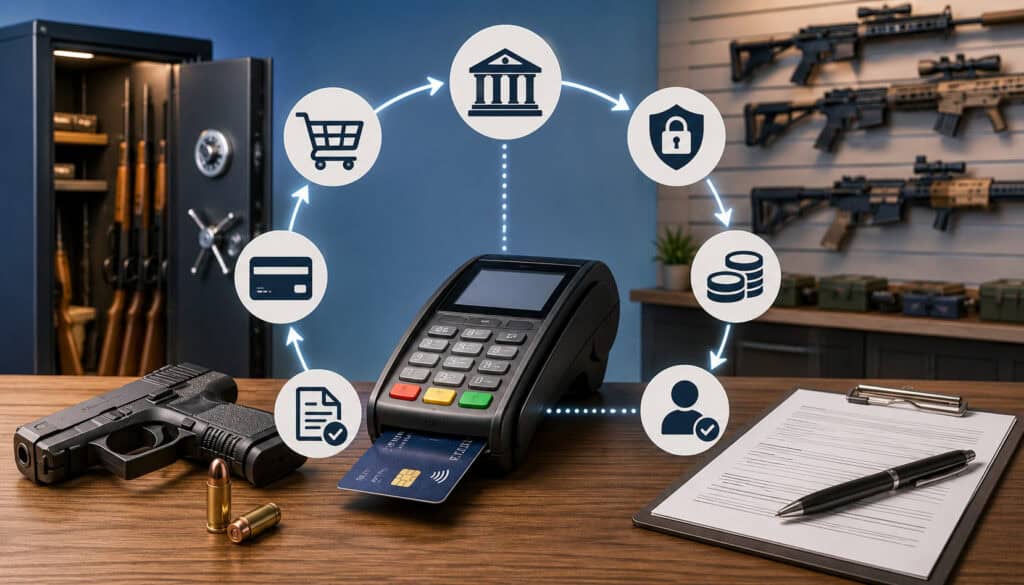
FFL dealer merchant accounts work by connecting the dealer, payment gateway or terminal, processor, acquiring bank, card networks, and customer’s issuing bank. When a customer pays by card, the transaction is authorized, captured, settled, and deposited according to the merchant account terms.
The process begins with an application. The dealer provides business information, ownership details, bank account information, processing needs, sales channels, product categories, website links, and supporting documents. Because firearms businesses are often reviewed as high risk, underwriting may be more detailed than for a standard retailer.
Underwriters evaluate whether the business is properly documented, whether the products are supported, whether the website is transparent, and whether the expected transaction volume matches the business profile. They may also review prior processing statements, chargeback history, refund ratios, and average ticket size.
Once approved, the account is configured for the dealer’s payment tools. This may include in-store terminals, POS systems, ecommerce gateways, virtual terminals, mobile readers, or invoice payments.
A dealer selling at a storefront may need gun store credit card processing with EMV terminals, while a business accepting deposits remotely may need secure invoicing or a virtual terminal.
After transactions are processed, funds are typically deposited after settlement. High-risk accounts may have different funding timelines, reserves, or monitoring rules depending on the processor and risk profile.
Ongoing monitoring is normal. Processors may review transaction patterns, chargebacks, refunds, sales volume spikes, or website changes. Dealers should keep records current and notify their processor before major changes, such as adding ecommerce sales, expanding product categories, or increasing volume.
Features to Look for in Gun-Friendly Merchant Services
Gun-friendly merchant services should do more than approve an account. They should provide payment tools that match how the firearms business actually operates. A dealer may need in-store checkout, ecommerce support, mobile processing, recurring billing for memberships, invoice payments, or secure deposits.
A strong setup usually starts with reliable POS and terminal options. For retail stores, EMV-capable terminals, contactless payments, inventory-friendly POS systems, and receipt customization can make checkout smoother. For ranges, training providers, and event sellers, mobile readers and flexible payment tools may be useful.
Ecommerce support is also important. Dealers that accept online firearms payments need secure gateways, fraud filters, address verification, CVV tools, hosted payment pages, and checkout settings that support policy clarity. Website compatibility matters, especially if the business uses a shopping cart or online catalog.
Virtual terminals and invoicing can help with deposits, custom orders, layaways, accessories, classes, and service payments. However, keyed transactions should be managed carefully because they may carry higher risk and higher fees.
Chargeback support is another essential feature. Dealers should have access to dispute notifications, response tools, transaction records, and guidance on documentation. Transparent pricing is equally important.
High-risk pricing can vary, so dealers should understand transaction rates, monthly fees, gateway costs, reserves, chargeback fees, and contract terms before signing.
Helpful features include:
- Secure payment gateway
- EMV-capable terminals
- Ecommerce compatibility
- Virtual terminal access
- Invoice payment tools
- Fraud filters
- Chargeback alerts
- Clear reporting dashboard
- Transparent fee structure
- Responsive support
Documents FFL Dealers May Need for Approval
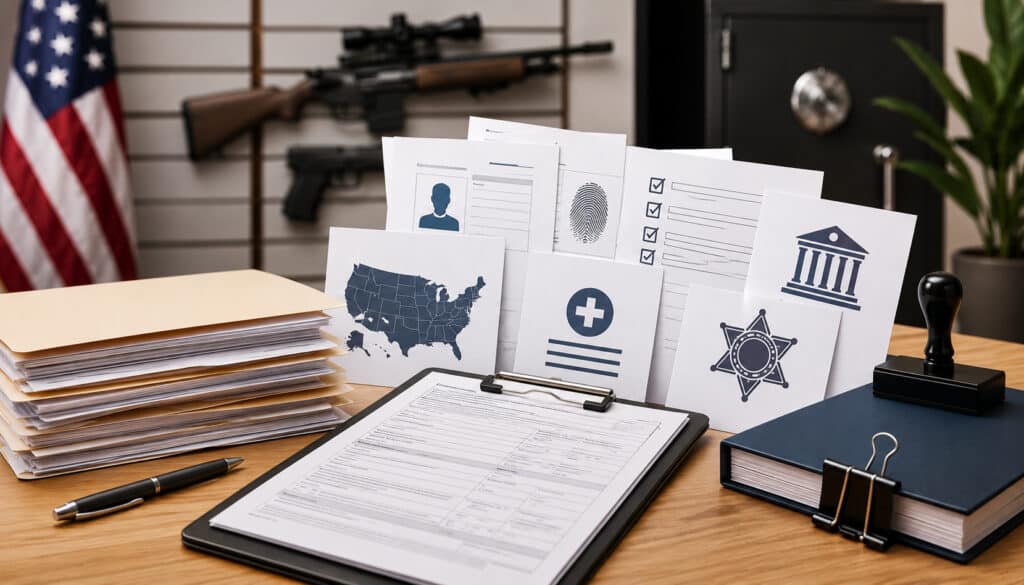
Merchant account approval depends heavily on documentation. FFL dealers should expect to provide more information than a standard retail merchant because underwriters must understand the business model, risk controls, ownership structure, and sales environment.
Common documents include a business license, FFL documentation, ownership identification, bank account verification, business formation records, and recent bank statements.
If the dealer already processes payments, prior processing statements may also be requested. These statements help underwriters review volume, average ticket, refund activity, and chargeback ratios.
Website documentation matters as well. Dealers with ecommerce or online catalogs should have clear product descriptions, shipping policies, return policies, privacy policy, terms of service, customer support contact details, and transfer-related language where applicable.
Underwriters may decline or delay applications when websites are incomplete, under construction, or missing required policies.
Product categories should be explained clearly. A business that sells firearms, ammunition, optics, accessories, training classes, gunsmithing services, or range memberships should identify those categories accurately. This helps prevent confusion during underwriting.
Dealers may also be asked about compliance procedures, customer verification practices, fraud controls, and fulfillment workflows. For higher-volume merchants, additional financials or processing history may be requested.
Before applying, organize:
- FFL documentation
- Business registration records
- Ownership information
- Bank statements
- Processing statements, if available
- Website policy pages
- Product category list
- Refund and cancellation terms
- Shipping and fulfillment procedures
- Customer service contact information
A complete application can improve merchant account approval odds and reduce delays. It also signals that the dealer understands the seriousness of regulated commerce.
Fees and Pricing for High-Risk Credit Card Processing for Firearms
Fees for high-risk credit card processing for firearms can differ from standard retail pricing because the processor may assume more underwriting, monitoring, support, and risk exposure. Pricing depends on transaction volume, sales channel, average ticket, chargeback history, business age, processing history, and product mix.
The most visible cost is the transaction fee. This may include a percentage of the transaction plus a fixed per-transaction amount. Card-present transactions often price differently from card-not-present transactions because ecommerce, invoices, and keyed payments carry higher fraud and dispute risk.
Monthly fees may include statement fees, account fees, PCI-related fees, gateway fees, reporting fees, or support fees. Some businesses may also pay for equipment, POS software, wireless processing, mobile readers, or ecommerce integrations.
Chargeback fees are another cost to understand. Even if the dealer wins a dispute, the processor may still charge a fee for handling the case. Excessive chargebacks can also lead to higher pricing, reserves, or account review.
Some high-risk merchant accounts may include reserve requirements. A reserve is a portion of processed funds held temporarily to protect against chargebacks, refunds, or other losses. Not every dealer will have the same reserve terms, and reserves may depend on underwriting results.
Settlement timing also matters. Some merchants receive deposits quickly, while others may have delayed funding based on risk profile. Dealers should ask how long deposits take, whether weekends or holidays affect funding, and what situations could trigger holds.
Payment Security and Compliance Best Practices
Payment security and compliance best practices help FFL dealers protect customer data, reduce fraud, and maintain processor confidence. Firearms payment processing should be built around secure systems, controlled access, and clear internal procedures.
Encryption and tokenization are important because they reduce exposure of sensitive card data. Dealers should use secure payment gateways, EMV terminals, hosted checkout pages, and processor-approved tools instead of storing card numbers manually. Staff should never write down card details or keep payment information in unsecured files.
PCI-aware workflows are also important. While requirements vary by business setup, merchants should understand their responsibility to use secure systems, limit data exposure, and complete any required validation steps. A secure checkout process protects both the customer and the dealer.
User permissions should be controlled. Not every employee needs access to refunds, reporting, stored customer profiles, or gateway settings. Limiting permissions reduces the risk of errors and misuse.
Refund controls are also valuable. A clear refund approval process can prevent accidental refunds, duplicate credits, or inconsistent customer treatment. Dealers should document refund reasons and connect them to the original transaction.
Fraud monitoring should include address verification, CVV checks, suspicious order review, velocity controls, high-ticket review, and customer communication. For online orders, dealers should be cautious with mismatched billing and shipping details, rushed requests, unusual order sizes, or inconsistent customer information.
Payment security is not just technical. It also depends on staff training, policy consistency, and good recordkeeping.
Common Mistakes FFL Dealers Should Avoid
One common mistake is applying for a standard merchant account without disclosing firearms-related activity. This may lead to approval at first, but it can create serious problems later. If the processor later identifies restricted activity, the account may be frozen, terminated, or placed under review.
Another mistake is submitting incomplete documents. Missing FFL documentation, unclear ownership information, incomplete bank records, or outdated website policies can delay underwriting. Dealers should prepare documents before applying rather than reacting to every request one at a time.
Website issues are also common. A dealer’s site should clearly show contact information, product details, refund terms, shipping policies, privacy policy, and transfer-related expectations. Underwriters may view unclear policies as a risk signal.
Weak refund and cancellation terms can increase disputes. If customers do not understand deposits, special orders, restocking fees, or transfer-related costs, they may file chargebacks instead of contacting the business.
Ignoring chargebacks is another serious mistake. Dealers should respond quickly, provide evidence, and look for patterns. A single dispute may not be a major issue, but repeated disputes can threaten account stability.
Contract terms should also be reviewed carefully. Dealers should understand processing fees, monthly costs, equipment terms, reserve language, termination clauses, and funding rules.
Best Practices for Managing Firearms Payment Processing
Managing firearms payment processing well requires organization, consistency, and the right tools. Dealers should treat payment operations as part of the broader compliance and customer service process.
Start by keeping documents organized. Store current FFL documentation, business records, bank statements, processing statements, policy pages, and chargeback evidence in a secure but accessible system. This makes account reviews and renewals easier.
Maintain clear customer policies. Refund terms, shipping expectations, transfer procedures, cancellation rules, and customer support channels should be easy to find. Clear policies reduce confusion and help customers contact the business before filing disputes.
Review statements regularly. Processing statements reveal fees, downgrades, chargebacks, refunds, and volume changes. Dealers should not wait until costs feel high to review their accounts.
Train staff on payment procedures. Employees should know how to process sales, issue receipts, handle refunds, identify suspicious orders, and escalate unusual situations. Consistency matters, especially when multiple employees use the POS or gateway.
Secure checkout environments are also essential. Use approved hardware, strong passwords, user permissions, and secure network practices. Avoid shared logins and uncontrolled access to sensitive payment tools.
Monitor disputes and customer communication. If chargebacks appear, identify the cause. Are customers confused by the billing descriptor? Are shipping expectations unclear? Are refund policies hard to find? Fixing root causes is more effective than reacting case by case.
Dealers can also review educational payment resources such as gun-friendly merchant services and firearm-friendly payment processing to better understand provider evaluation, underwriting, and payment workflow considerations. For broader high-risk account context, this high-risk merchant account overview may also be useful.
What are high-risk merchant accounts for FFL dealers?
High-risk merchant accounts for FFL dealers are specialized payment accounts that allow licensed firearm businesses to accept debit and credit cards while meeting enhanced underwriting requirements.
They are designed for businesses that may not qualify easily through standard retail processing because of regulated products, card brand scrutiny, online sales risk, or processor restrictions.
These accounts can support in-store terminals, ecommerce gateways, virtual terminals, invoicing, mobile payments, and reporting tools. The exact setup depends on the dealer’s business model. A storefront may need POS equipment, while an online seller may need secure gateway tools and stronger fraud controls.
The purpose is stability. A properly underwritten account helps the processor understand the business from the beginning, reducing the risk of sudden holds or account closures caused by misclassification.
Why are FFL dealers considered high risk?
FFL dealers are considered high risk because firearm-related sales involve regulated products, licensing requirements, documentation expectations, policy restrictions, and potential dispute exposure.
Payment processors evaluate not only whether a business can accept payments, but whether the account fits the processor’s risk rules.
Online sales, card-not-present payments, high-ticket purchases, special orders, and unclear refund terms can add additional review. Some processors also avoid firearms businesses due to internal policy, even when the merchant is fully licensed and operating lawfully.
The high-risk label is mainly an underwriting category. It does not mean the dealer is doing anything wrong. It means the processor wants more information, clearer documentation, and stronger risk controls before supporting the account.
Can FFL dealers accept credit cards?
Yes, FFL dealers can accept credit cards when they work with a processor and acquiring bank that support firearms-related businesses. The key is using a properly approved merchant account rather than a standard account that does not allow firearms activity.
Dealers may accept payments in-store through terminals or POS systems, and some may accept online firearms payments through approved ecommerce gateways. However, the payment setup must match the processor’s policies and the dealer’s lawful sales procedures.
Before accepting cards, dealers should confirm that their product categories, sales channels, and website policies are supported. This is especially important for ecommerce, invoices, deposits, and remote payments.
What documents are needed for approval?
Documents often include FFL documentation, business registration records, ownership information, bank statements, processing history, website policy pages, product category descriptions, and business banking details.
Underwriters may request more information depending on the sales model and expected volume.
For ecommerce dealers, website policies are especially important. Refund terms, shipping language, privacy policy, contact information, and transfer-related details should be complete and easy to find.
Processing history can also help. If the dealer has prior statements with low chargebacks and consistent volume, that can strengthen the application. New businesses can still apply, but they should be prepared to explain expected volume and operating procedures.
Are online firearms payments allowed?
Online firearms payments may be allowed when the processor supports the business model and the dealer follows all applicable rules, transfer procedures, and payment policies.
Underwriters typically review ecommerce activity more closely because online transactions are card-not-present and may carry higher fraud or dispute risk.
A dealer’s website should clearly explain what is sold, how orders are handled, what restrictions apply, how refunds work, and how customers can contact support. Secure checkout, fraud tools, address verification, CVV checks, and order review procedures can also help.
The important point is transparency. Dealers should not assume that any generic ecommerce processor will support firearms-related sales.
How can firearms businesses reduce chargebacks?
Firearms businesses can reduce chargebacks by communicating clearly, setting accurate expectations, keeping strong records, and responding quickly to customer concerns. Many disputes happen because customers do not recognize a charge, misunderstand refund terms, or feel uncertain about order status.
Use recognizable billing descriptors, detailed receipts, order confirmations, tracking records, signed invoices, and clear refund policies. For special orders, deposits, transfer fees, and restocking terms, disclose the policy before payment.
Customer service matters as much as documentation. Fast responses can prevent frustration from turning into disputes. Dealers should also review chargeback patterns and fix recurring issues.
What fees should FFL dealers expect?
FFL dealers may pay transaction fees, monthly account fees, gateway fees, PCI-related fees, chargeback fees, equipment costs, and possibly reserve requirements. Pricing varies based on processing volume, average ticket, card-present versus card-not-present mix, chargeback history, and underwriting risk.
Online and keyed transactions may cost more than in-person chip transactions because they carry more fraud and dispute exposure. Some dealers may also see different settlement timelines depending on account terms.
Dealers should review the full pricing structure, not just the advertised rate. Contract length, reserve language, funding time, support quality, and chargeback handling can all affect the real cost of processing.
How should dealers choose a payment processor?
Dealers should choose a processor that clearly supports firearms merchant services, understands FFL dealer merchant accounts, offers suitable payment tools, and provides transparent pricing. The processor should be willing to review the business accurately rather than forcing it into a generic retail category.
Important features include POS support, ecommerce compatibility, secure gateways, virtual terminals, invoicing, fraud tools, reporting, chargeback support, and clear contract terms. Dealers should also ask about funding timelines, reserves, supported product categories, and documentation requirements.
The best choice is not always the lowest advertised rate. For firearms businesses, account stability, policy fit, and responsive support are often more valuable than saving a small amount per transaction.
Conclusion
High-risk merchant accounts for FFL dealers help licensed firearms businesses accept payments securely while meeting underwriting, compliance, and operational expectations.
Because firearm dealer payment processing involves regulated products, documentation needs, processor restrictions, online transaction concerns, and chargeback risk, standard retail processing may not be enough.
A strong merchant account setup should support the way the dealer actually sells, whether through a storefront, online catalog, invoices, mobile events, or a combination of channels. The right firearms merchant services can provide secure checkout, reliable settlement, fraud tools, reporting, chargeback support, and payment flexibility.
Dealers can improve approval odds and long-term account stability by staying organized, disclosing business activity accurately, publishing clear policies, protecting customer data, monitoring disputes, and choosing gun-friendly merchant services that understand the industry.