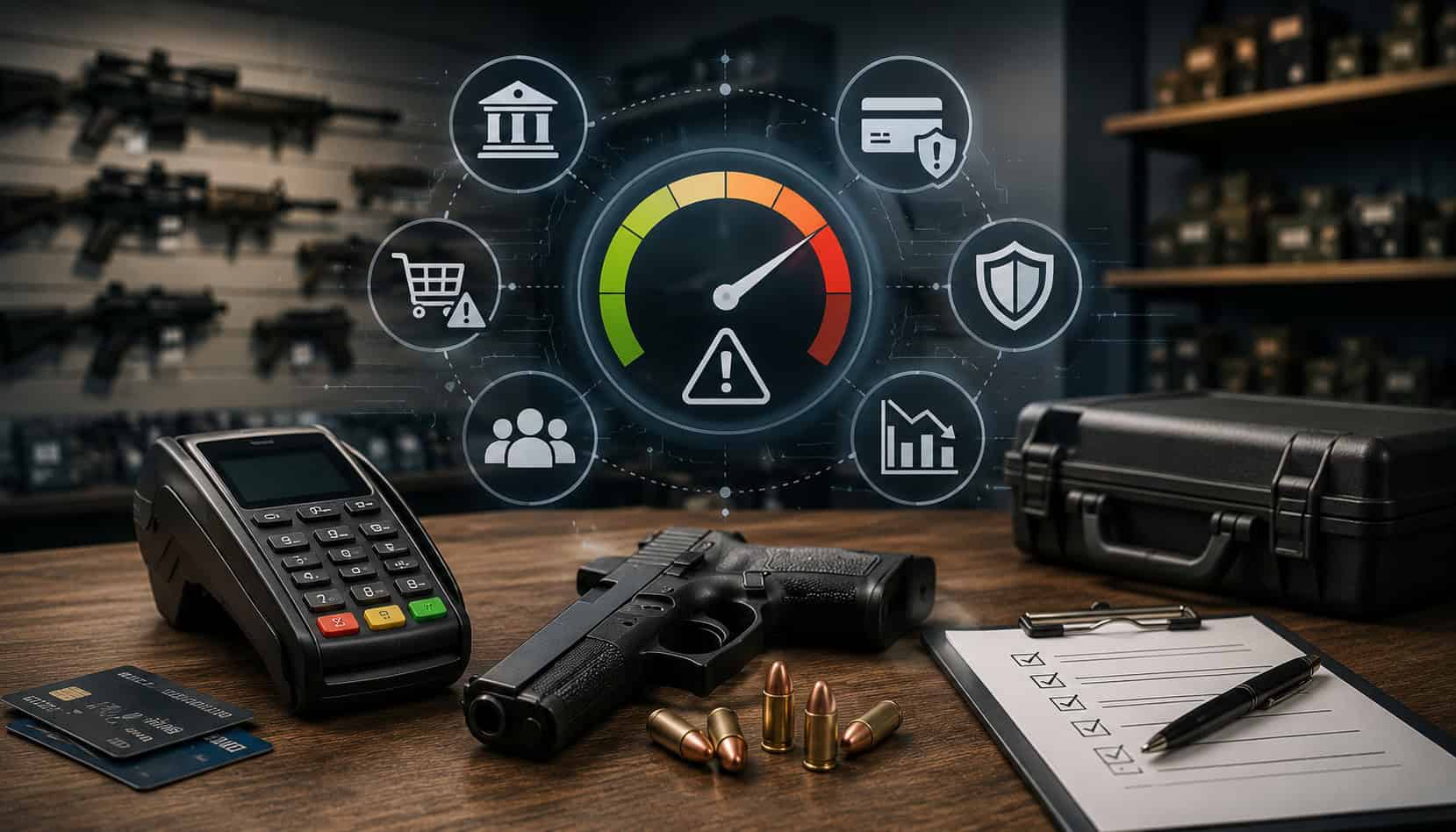
Firearms businesses operate in a payment environment where routine transactions can receive more scrutiny than many other retail categories. The reason is not simply the products being sold. It is the combination of regulated merchandise, processor policies, underwriting standards, online sales controls, chargebacks, fraud exposure, and compliance documentation.
Understanding payment risk in the firearms industry helps lawful businesses protect account stability, reduce disputes, and build stronger relationships with payment providers.
A gun shop, range, training center, gunsmith, ammunition retailer, or online seller may all face different versions of the same challenge: proving that the business is legitimate, well-documented, secure, and compatible with processor rules.
Many firearms merchants need specialized support because some mainstream providers restrict or prohibit firearm-related transactions. Others may approve the business only after deeper merchant underwriting, added reserves, stricter transaction monitoring, or additional documentation. This makes firearms merchant services different from standard retail payment acceptance.
Payment risk does not mean a business is doing anything wrong. It means banks and processors see greater potential for financial loss, regulatory sensitivity, disputes, fraud, or reputational exposure. The practical goal is to understand those risks early and manage them before they create holds, freezes, rejected applications, or account closures.
For merchants comparing options, resources on gun-friendly payment processing and firearms merchant services can help frame what processors typically review.
What Is Payment Risk in the Firearms Industry?
Payment risk is the possibility that a transaction, account, or processing relationship could create financial, compliance, operational, or security problems. In the firearms space, that risk is shaped by the products sold, how sales are completed, how customers are verified, how shipments are handled, and how clearly the merchant documents its policies.
For a storefront, payment risk may involve large-ticket transactions, customer disputes, refund requests, or questions about product eligibility. For ecommerce sellers, online firearm payments may add card-not-present fraud exposure, transfer requirements, age-related controls, shipping restrictions, and processor review of website content.
Firearms industry payment risk also includes account stability risk. A business may be approved by one provider but later experience reserves, rolling holds, delayed funding, or policy changes. This is why firearm merchants often need high-risk merchant accounts designed for regulated or restricted categories.
Common types of payment risk include:
- Financial risk: chargebacks, refunds, reserves, unpaid fees, or sudden volume spikes.
- Compliance risk: missing licenses, incomplete FFL payment processing documentation, unclear transfer rules, or restricted product sales.
- Processor risk: payment processor restrictions, policy updates, account reviews, or category limitations.
- Fraud risk: stolen card use, mismatched billing details, suspicious order patterns, or attempted prohibited purchases.
- Security risk: weak payment security, poor access controls, or unsafe customer data handling.
Why Firearms Businesses Are Considered High Risk
Firearms businesses are often classified as high risk because processors evaluate more than sales volume. They look at product category, regulatory sensitivity, chargeback exposure, fraud risk, card brand expectations, business model, and the likelihood that a merchant could violate provider policies.
Some providers do not support firearm-related sales at all, which can limit available options and make approval more selective.
A business selling regulated goods needs stronger documentation than a general retailer. Processors may review licenses, ownership details, product categories, fulfillment procedures, website policies, refund terms, and historical processing performance. This review helps the processor decide whether the merchant can operate within acceptable risk boundaries.
Firearm payment processing challenges are especially noticeable online. Card-not-present transactions create more fraud exposure than in-person sales because the customer and card are not physically present.
If the business also ships products that require transfer steps, the processor may review whether the checkout flow, shipping language, and order handling are clear.
Card brand and acquiring bank rules also matter. Even when a merchant is lawful and properly licensed, the processor must decide whether the business fits its risk appetite. That is why gun store merchant account risks often include policy restrictions, sudden account reviews, reserves, or higher pricing.
The table below summarizes common firearm merchant account risk factors and practical ways to reduce them.
| Risk Factor | Why It Matters | How Businesses Can Reduce Risk |
| Regulated product category | Processors apply closer review to sensitive or restricted goods. | Keep licenses, product categories, and sales procedures clearly documented. |
| Online firearm payments | Card-not-present sales increase fraud and dispute exposure. | Use AVS, CVV, fraud filters, and clear checkout disclosures. |
| Chargebacks | Disputes can trigger reserves, higher fees, or account review. | Publish refund, shipping, cancellation, and transfer policies clearly. |
| Incomplete applications | Missing details can delay or prevent approval. | Submit ownership, licensing, banking, website, and compliance documentation together. |
| Unclear website policies | Processors may view vague terms as higher risk. | Add visible terms, privacy policy, refund policy, shipping policy, and transfer instructions. |
| Volume spikes | Sudden increases can look suspicious to underwriting teams. | Forecast seasonal changes and notify providers before major volume changes. |
| Unsupported processor use | Some platforms restrict firearm-related transactions. | Use gun-friendly payment processing options that understand the category. |
| Weak payment security | Poor controls can expose cardholder data and increase fraud. | Follow PCI-aware workflows and use secure, tokenized payment tools. |
Merchant Underwriting Risk
Merchant underwriting is the review process a processor or acquiring bank uses before approving a merchant account. For firearms businesses, this review is usually more detailed because the provider needs to understand what is being sold, how sales are completed, and whether the merchant has reliable compliance documentation.
Underwriters may request FFL documentation, business formation records, ownership information, bank statements, processing history, product lists, website URLs, refund terms, and expected monthly volume.
They may also review average ticket size, chargeback history, fulfillment methods, and whether the business sells in-store, online, at events, or through multiple channels.
A strong application reduces uncertainty. If a merchant sells firearms, accessories, training, gunsmithing, or ammunition, the processor should not have to guess. Clear disclosure is safer than trying to fit into a lower-risk category.
Misclassification can create serious account stability problems later, especially if transaction descriptors, website content, or product listings reveal a different business model than the one submitted.
Chargeback and Dispute Risk
Chargebacks are one of the most important firearm payment processing challenges because they directly affect processor confidence. A chargeback happens when a cardholder disputes a transaction through the issuing bank. Even when the merchant wins, too many disputes can make the account look unstable.
Firearms merchants may face disputes from shipping delays, transfer misunderstandings, cancellation disagreements, refund confusion, or customers who do not understand that certain items may need specific fulfillment steps. Online orders can be especially vulnerable when policy language is unclear or when customer communication is inconsistent.
To reduce chargebacks, merchants should use accurate product descriptions, order confirmations, tracking updates, customer service records, and clear refund terms.
For items requiring transfer or pickup procedures, the checkout process should explain what happens after payment. Customers should know when an order is final, when a refund is available, and what fees may apply.
Dispute prevention is not only about winning evidence. It is about preventing confusion before the customer contacts the card issuer. Good communication, consistent receipts, recognizable billing descriptors, and documented support interactions all help lower gun store merchant account risks.
Online Payment Risk
Online firearm payments receive extra scrutiny because ecommerce transactions combine regulated product sales with card-not-present risk. The processor may evaluate whether the website provides enough information for customers and whether the business has controls for fraud prevention, shipping, fulfillment, and policy compliance.
Card-not-present transactions can involve stolen cards, mismatched billing details, reshipping attempts, unusual order velocity, or customers using incomplete information. In a sensitive product category, these concerns carry more weight.
A processor may ask how the merchant verifies orders, handles suspicious transactions, stores customer information, and documents transfer steps.
A firearms ecommerce site should not look vague or incomplete. It should include visible contact information, product descriptions, refund policy, shipping policy, privacy policy, terms of sale, and any required transfer instructions. The checkout flow should be secure, consistent, and aligned with the merchant’s approved business model.
Payment security also matters. The PCI Security Standards Council explains that its standards are designed to protect account data for organizations that store, process, or transmit payment card information. Merchants should use compliant payment tools rather than collecting sensitive card details through unsafe methods.
Common Firearm Payment Processing Challenges
Firearm merchants often face payment processing challenges that general retailers may never encounter. These challenges can appear during application, after approval, or when the business changes its products, sales channels, or transaction volume. Understanding them early helps merchants prepare instead of reacting after funding is delayed.
One common challenge is a rejected application. This can happen when the processor does not support firearm-related businesses, when documentation is incomplete, or when the business model falls outside underwriting guidelines. Even a well-run merchant may be declined if the provider’s policies exclude certain products.
Another challenge is account holds or reserves. A reserve is money held back from settlements to protect the processor against potential chargebacks, refunds, or losses. Reserves are common in high-risk merchant accounts, especially when a merchant has limited processing history, large average tickets, fast volume growth, or elevated dispute risk.
Delayed settlements can also occur. A processor may review unusual transaction activity, large sales, mismatched documentation, or customer complaints before releasing funds. While this can be frustrating, it is usually tied to risk controls built into the merchant agreement.
Sudden policy changes are another concern. Some processors periodically update restricted-business rules. A merchant that was once acceptable may later be asked for additional documentation or told the account can no longer be supported.
This is why businesses in regulated categories should choose providers familiar with firearms merchant services and review contract terms carefully.
Higher fees may also apply. High-risk pricing reflects additional monitoring, underwriting, support, reserves, and fraud exposure. The lowest advertised rate is not always the safest choice if the provider does not understand FFL payment processing or firearm-related transactions.
Firearm Merchant Account Risk Factors
Firearm merchant account risk factors vary by business type. A local store, ecommerce seller, range, training provider, gunsmith, and accessories retailer may all need payment acceptance, but each has different exposure. Underwriters review the full picture, not just whether the merchant has a license.
The business model is one of the first factors. In-person retail may be easier to evaluate than ecommerce because the customer is physically present and the card can be dipped, tapped, or inserted. Online sales can trigger additional review because fraud, shipping, and transfer documentation become more important.
Processing volume also matters. A merchant expecting modest monthly volume may be reviewed differently from a business processing large-ticket transactions or rapid seasonal spikes. Sudden growth without explanation can lead to monitoring, reserves, or funding delays.
Product mix is another major factor. A business selling general accessories may present a different risk profile than one selling firearms, ammunition, parts, or regulated items. The more sensitive the product category, the more important it is to document policies and processor approval clearly.
Website clarity is critical for online merchants. A processor may review product pages, checkout language, prohibited item controls, return policies, transfer instructions, and customer support details. Missing or vague policies can create underwriting concerns even when the business is otherwise legitimate.
Refund policy and chargeback history also influence approval. If a merchant has unclear refund terms, frequent disputes, or poor documentation, the processor may view the account as harder to manage. Strong dispute records, customer communication logs, and consistent refund procedures can improve confidence.
Compliance records are equally important. Merchants should keep licenses, renewal dates, supplier records, operating policies, and employee procedures organized. For more guidance on account setup and approval preparation, see this resource on setting up a firearm merchant account.
How Gun Stores Can Reduce Payment Risk
Gun stores can reduce payment risk by building predictable, well-documented, customer-friendly payment workflows. The objective is not to eliminate every possible issue. It is to show processors that the business manages risk responsibly and can prevent avoidable disputes, fraud, and compliance problems.
Clear customer policies are a strong starting point. A store should publish and consistently follow refund, exchange, cancellation, transfer, pickup, shipping, and special-order terms. Policies should be visible before checkout and repeated in receipts or confirmation emails where helpful.
Secure checkout tools are also essential. In-store businesses should use modern terminals and avoid manually entering card details unless necessary. Ecommerce merchants should use secure hosted checkout, fraud filters, address verification, CVV checks, and order review workflows for suspicious transactions.
Documentation should be organized before it is requested. A processor review becomes much easier when licenses, business records, processing statements, policy documents, and website information are already prepared. If the merchant adds new product categories or sales channels, it should confirm whether the account still fits provider rules.
Staff training matters too. Employees should understand refund permissions, ID-related procedures, suspicious order signs, dispute documentation, and what not to promise customers. Many chargebacks begin with mismatched expectations at the counter or in customer service messages.
Merchants should monitor chargebacks monthly. Look for patterns such as shipping complaints, descriptor confusion, refund delays, or product misunderstandings. Each dispute should lead to a process improvement, not just a response packet.
Useful steps include:
- Use clear billing descriptors customers recognize.
- Send prompt order confirmations and receipts.
- Keep proof of customer communication.
- Review statements for fees, reserves, and unusual activity.
- Notify the processor before major volume changes.
- Keep website policies current.
- Use fraud tools for online firearm payments.
Payment Security Best Practices
Payment security is central to understanding payment risk in the firearms industry because weak controls can create fraud losses, data exposure, customer distrust, and processor scrutiny. Security is not limited to ecommerce. In-store terminals, employee permissions, refunds, reports, and stored customer information all need controls.
Merchants should use secure payment systems that reduce direct exposure to card data. Tokenization replaces sensitive card information with a token that can be used for future transactions without storing the actual card number.
Encryption helps protect payment data while it is transmitted. Hosted payment pages can also reduce the merchant’s direct handling of sensitive card details.
PCI-aware workflows are important for any business that accepts cards. PCI standards apply to organizations that store, process, or transmit cardholder data, and the official standards are designed around protecting payment data. Merchants should avoid collecting card numbers through email, text, chat, paper notes, or unsecured forms.
Access control is another key practice. Not every employee needs permission to issue refunds, view reports, change settings, or access customer records. Role-based access helps prevent mistakes and internal misuse. Former employees should be removed from systems immediately.
Fraud monitoring should be active, especially for ecommerce. Warning signs include mismatched billing and shipping details, unusually large orders, repeated declined attempts, multiple cards from the same customer, rushed shipping requests, and orders that do not match normal buying patterns.
Secure procedures should cover:
- Terminal access and settlement review.
- Password hygiene and multi-factor authentication.
- Refund approval limits.
- Customer data retention rules.
- Device updates and secure networks.
- Suspicious transaction review.
- Incident response steps.
Common Mistakes Firearms Businesses Should Avoid
One of the biggest mistakes firearms businesses make is using unsupported processors. A provider may approve a generic retail account quickly, but if its policies prohibit firearm-related transactions, the account can later be frozen or closed. Short-term convenience can create long-term instability.
Another mistake is submitting an incomplete or unclear application. Processors need accurate information about ownership, products, sales channels, processing volume, refund policy, website content, and compliance documentation. Leaving out details can delay approval or create suspicion during review.
Vague website policies are also risky. Online shoppers need to understand fulfillment, transfer requirements, shipping limitations, cancellations, returns, and customer service procedures. Processors review these details because unclear policies often lead to chargebacks.
Weak refund terms can create disputes. If customers do not know when a sale is final, whether restocking fees apply, or how transfer-related issues are handled, they may dispute the payment instead of contacting the merchant. Refund language should be specific, visible, and consistent with actual practice.
Poor documentation is another common issue. A merchant that cannot quickly provide licenses, processing statements, supplier information, chargeback responses, or policy records may look disorganized even when operating lawfully. Documentation supports credibility.
Ignoring chargebacks is especially harmful. Even small dispute numbers can become a pattern if not addressed. Merchants should track dispute reasons, respond on time, and fix the root cause. For example, if several disputes mention shipping confusion, the solution may be clearer checkout language and better status updates.
Merchants should also avoid signing agreements without reviewing reserves, termination terms, prohibited activities, funding timelines, chargeback fees, equipment terms, and volume limits. Firearms payment processing is too sensitive for assumptions.
For additional operational guidance, this resource on payment processing tips for firearm retailers and online sellers covers many practical risk areas.
What does payment risk mean for firearms businesses?
Payment risk means the possibility that payment activity could create financial loss, compliance concerns, fraud exposure, chargebacks, funding delays, or account instability. For firearms businesses, risk is often higher because the products are regulated, some processors restrict the category, and online transactions may require additional scrutiny.
This does not mean the merchant is unsafe or noncompliant. It means processors need more confidence before and after approval. Strong documentation, clear policies, secure checkout, fraud controls, and consistent customer communication can reduce that risk and support long-term account stability.
Why are firearm merchants considered high risk?
Firearm merchants are considered high risk because processors evaluate product sensitivity, regulatory oversight, dispute exposure, fraud potential, and policy restrictions. Some providers do not support firearm-related sales, while others only approve them after detailed underwriting.
Online sales can increase the risk profile because card-not-present payments are more vulnerable to fraud and customer disputes. A merchant with transparent policies, complete documentation, and secure payment workflows is generally better positioned than one with vague terms or inconsistent procedures.
Can gun stores accept credit cards?
Yes, gun stores can accept credit cards when they have a merchant account or payment solution that supports their business type and product category. The key is using a provider that understands gun store merchant account risks and does not prohibit the merchant’s actual sales activity.
A store should be upfront about its products, sales channels, expected volume, and policies during the application process. Trying to process firearm-related transactions through a provider that does not support them can lead to holds, account closure, or delayed funds.
What causes firearm merchant account holds?
Account holds may happen when a processor sees unusual activity, elevated chargebacks, missing documentation, sudden volume spikes, suspicious transactions, or potential policy concerns. Holds can also occur when the merchant’s actual activity does not match what was approved during underwriting.
For example, a storefront approved for in-person sales may create concern if it suddenly begins processing large ecommerce transactions without prior review. Merchants can reduce hold risk by keeping documentation current, communicating business changes early, and monitoring transaction patterns.
How can FFL dealers reduce chargebacks?
FFL dealers can reduce chargebacks by setting clear expectations before payment. Customers should understand transfer steps, shipping timelines, cancellation rules, refund limits, pickup procedures, and any fees that may apply. Confusion is one of the most preventable causes of disputes.
Dealers should also keep strong transaction records. Receipts, order confirmations, tracking details, customer emails, signed acknowledgments, and support notes can help resolve disputes. Monitoring chargeback reasons over time helps identify policy gaps or communication problems.
Why do processors review firearms websites?
Processors review firearms websites to understand what the merchant sells, how transactions are completed, whether policies are visible, and whether the business appears consistent with underwriting disclosures. A website can reveal risk factors that may not be obvious from an application alone.
Important website elements include contact information, product descriptions, refund policy, shipping policy, privacy policy, terms of sale, secure checkout, and transfer-related instructions. A complete website gives underwriters more confidence that customers are informed and disputes are less likely.
What documents help with merchant approval?
Documents that may help include FFL documentation, business registration, ownership information, bank letter or voided check, prior processing statements, website URLs, refund policy, shipping policy, product category details, supplier information, and expected processing volume.
The exact requirements vary by provider, but preparation matters. A complete application helps underwriters understand the business faster and reduces back-and-forth. Merchants should also keep records updated after approval because processors may request documentation during periodic reviews.
Conclusion
Understanding payment risk in the firearms industry helps lawful businesses protect payment stability, reduce disputes, and maintain stronger processor relationships.
Firearms merchants face unique challenges because payment providers review regulated product sales, chargeback exposure, online transaction controls, compliance documentation, and processor policy restrictions.
The best risk strategy is practical and consistent. Clear website policies, organized documentation, secure checkout, PCI-aware workflows, staff training, chargeback monitoring, and honest merchant underwriting disclosures all help reduce firearm merchant account risk factors.
Firearms industry payment risk cannot be ignored, but it can be managed. Businesses that treat payments as part of compliance, customer service, security, and operations are better positioned to accept payments reliably, prevent avoidable disputes, and build more stable processing workflows.