
Payment acceptance is a critical part of running a firearm-related business, but accepting a card is only one part of the process. A reliable payment setup also depends on accurate merchant account underwriting, appropriate sales-channel approval, payment security, fraud controls, chargeback management, transparent funding terms, and ongoing account support.
Gun shops, FFL dealers, shooting ranges, gunsmiths, firearm accessory sellers, training providers, outdoor sporting goods retailers, and online firearm-related businesses may not fit the policies of every payment processor.
Some providers serve general retailers but restrict firearms, ammunition, regulated accessories, remote transactions, or certain online sales models.
The benefits of firearm-friendly payment providers begin with industry fit. These providers are more likely to understand what a firearm business sells, how its transactions occur, which documents may be required, and which payment tools need approval.
This understanding can reduce confusion during underwriting and help the business establish a payment environment that reflects its actual operations.
A suitable provider may support card-present payments through a POS system, card-not-present payments through an approved payment gateway, invoices, virtual terminals, payment links, mobile payments, ACH payments, recurring membership billing, and detailed reporting.
However, the availability of each method depends on the merchant’s business model, product catalog, underwriting results, processor policies, acquiring bank requirements, and applicable rules.
Choosing an appropriate provider does not remove every risk. Funding holds, reserves, processing limits, disputes, fraud reviews, or contract changes may still occur. The practical advantage is that the merchant begins with a provider that has reviewed the firearm-related activity rather than discovering it after transactions have already started.
What Are Firearm-Friendly Payment Providers?
Firearm-friendly payment providers are payment processors, merchant service organizations, acquiring relationships, or payment platforms that are willing to review and support eligible firearm-related businesses.
Their services may include a firearm merchant account, a payment gateway, POS equipment, EMV terminals, virtual terminals, payment links, transaction reporting, fraud filters, and chargeback support.
The word “friendly” should not be interpreted as approval without review. These businesses still go through merchant account underwriting.
The provider and its acquiring bank may examine ownership information, business licenses, FFL documentation where applicable, product categories, website content, fulfillment practices, processing history, expected transaction volume, average ticket size, refund activity, and chargeback history.
A provider’s willingness to consider firearm businesses is also different from blanket approval of every product or sales channel. A merchant may be approved for in-store firearm POS payment processing but not remote orders. Another business may receive approval for accessories and range memberships but need additional review before adding firearm or ammunition sales.
This is why firearm-related merchants should ask specific questions rather than relying on broad claims. The provider should explain which product categories are acceptable, how online firearm payment processing is evaluated, whether transactions require a dedicated merchant account, and what operational changes must be reported.
Businesses researching firearm-friendly payment processing should focus on documented compatibility, underwriting transparency, funding terms, security features, and long-term support rather than approval speed alone.
How Firearm-Friendly Payment Processing Works
The process normally begins with an application for a firearm merchant account or gun shop merchant account. The business provides identifying information, ownership details, banking information, estimated monthly volume, expected average ticket size, processing history, and a description of its products and services.
The underwriter may then review business licenses, FFL documentation where applicable, bank statements, previous merchant statements, website pages, fulfillment procedures, refund policies, and chargeback history.
Online merchants may receive additional questions about customer verification, shipping restrictions, product transfers, website security, and card-not-present fraud controls.
After approval, the provider configures the permitted payment tools. These may include an EMV terminal, integrated POS system, hosted checkout page, gateway, virtual terminal, mobile reader, invoices, payment links, or ACH capabilities. The business should test these tools before accepting live transactions.
Once processing begins, transactions are authorized, submitted in batches, cleared, and settled according to the account’s funding schedule. The merchant must continue monitoring deposits, fees, refunds, chargebacks, processing limits, and unusual activity.
Approval is therefore not the final step. Firearm-friendly payment processing requires continuing alignment between the approved account and the business’s real activities.
Why Firearm Businesses May Need Specialized Payment Support
Firearm-related businesses may require specialized payment support because their products, transaction values, fulfillment processes, and regulatory responsibilities can attract greater underwriting scrutiny. A standard retail processor may not have policies or banking relationships that support these activities.
Higher-ticket transactions can increase exposure when a card is stolen or a customer later disputes a purchase. Online sales add card-not-present risks, including identity fraud, mismatched billing information, suspicious shipping requests, and refund abuse.
There may also be important differences among business models. A retail gun shop may primarily accept card-present payments. A range may process recurring memberships, classes, reservations, and equipment rentals. A gunsmith may collect deposits and send invoices. An online accessory seller may depend on a gateway and fraud-screening tools.
Where a federal license is required, merchants should maintain current documentation and understand the official firearms licensing requirements. Payment approval does not replace licensing, recordkeeping, transfer, age-verification, shipping, or other legal obligations.
Specialized support can help the processor evaluate each business according to its real model instead of applying assumptions designed for ordinary retail.
Why Standard Payment Providers May Not Always Fit Firearm Businesses
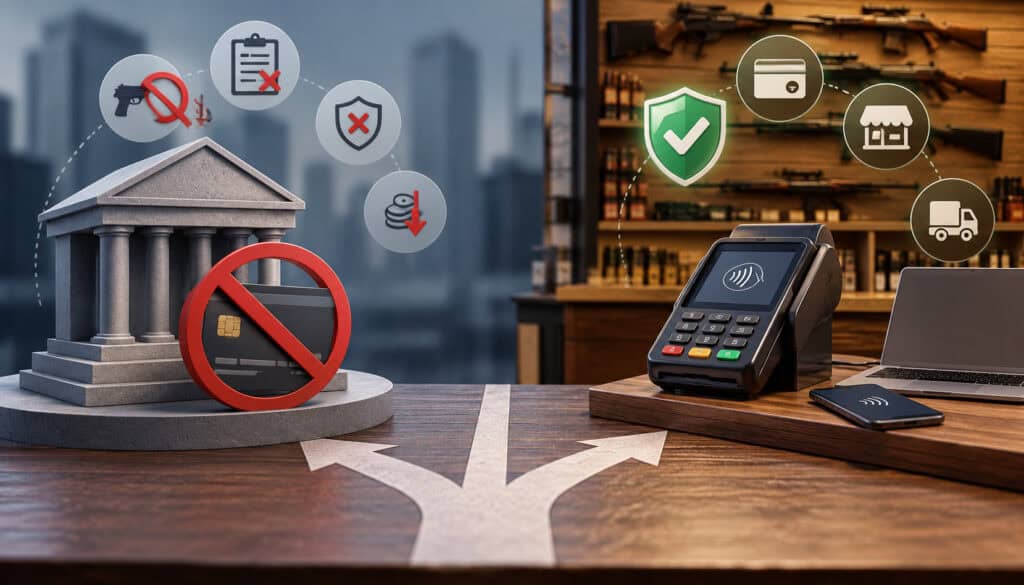
Many standard payment providers are built for general retail, professional services, restaurants, and other broadly accepted categories. Their onboarding systems may prioritize quick automated approval rather than detailed review of regulated or policy-sensitive products.
A merchant may initially appear to receive approval because the provider has not yet reviewed the full product catalog. Problems can arise later when transaction monitoring, a website scan, a customer dispute, or a manual risk review identifies firearm-related products that were not properly disclosed or supported.
The possible outcomes include additional document requests, funding delays, processing limits, rolling reserves, rejected transactions, suspension of online checkout, or account termination.
These actions can be especially disruptive when the business relies on card payments for inventory purchases, customer deposits, range memberships, training reservations, and online orders.
Standard providers may also restrict card-not-present activity even when in-store transactions are allowed. A merchant that adds invoices, keyed transactions, payment links, or e-commerce sales without approval may unintentionally operate outside the account’s accepted risk profile.
The issue is not that every general provider will reject every firearm business. Policies vary. The important question is whether the provider, acquiring bank, card-processing arrangement, and specific merchant account support the business’s products and sales channels.
Risk of Business Misclassification
Business misclassification occurs when the merchant account is established under a description that does not accurately represent what the company sells. For example, a firearm retailer might be described only as a sporting goods store, general retailer, repair service, or outdoor equipment seller.
An inaccurate category can make approval appear easier, but it creates serious operational risk. The processor may later compare the merchant’s website, transaction behavior, customer disputes, or product descriptions with the original application and find a mismatch.
Misclassification can also affect expected transaction patterns. If the account was approved for low-ticket accessories but begins processing higher-value firearm transactions, the change may trigger a risk review. The same may happen when an in-store account suddenly starts receiving a high percentage of keyed or online payments.
Accurate classification allows the underwriter to evaluate the real product mix, sales channels, average ticket size, monthly volume, and customer fulfillment process. Terms such as reserves or processing limits may be less attractive than those offered to a low-risk retailer, but they are easier to evaluate when disclosed before processing begins.
Businesses should never attempt to conceal their category, process transactions for another company, or route unsupported sales through a differently classified account.
Why Policy Fit Matters More Than Basic Approval
A fast approval can be useful, but it does not guarantee long-term reliability. The more important question is whether the provider’s policies support the merchant’s actual products, transaction methods, and growth plans.
A business may be approved only for card-present accessory sales while assuming it can also process online firearm orders, keyed deposits, or recurring range memberships. If those channels were not included in underwriting, the account may face review when activity changes.
Policy fit means the provider understands what is being sold, where customers pay, how orders are fulfilled, and what documentation supports the transactions. It also means the merchant understands its responsibilities, including reporting material changes.
The provider should be able to explain whether new websites, locations, product categories, recurring billing programs, or mobile sales require approval. It should also clearly describe reserve conditions, funding schedules, processing caps, chargeback expectations, and prohibited activities.
Basic approval answers whether processing can begin. Policy fit addresses whether the account can continue operating as the business grows.
Key Benefits of Firearm-Friendly Payment Providers
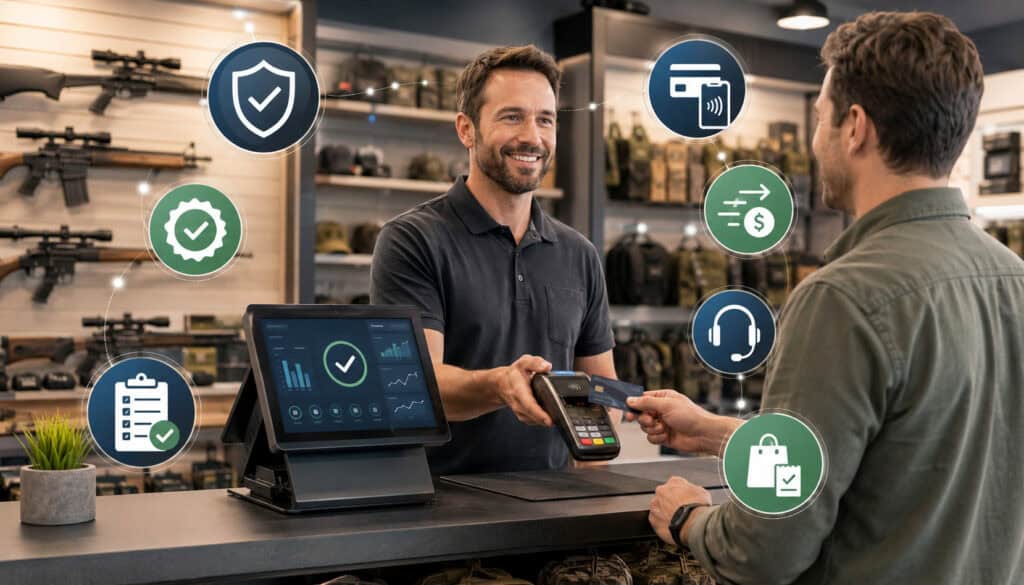
The main benefits of firearm-friendly payment providers are related to alignment. A properly matched provider can review the business accurately, establish appropriate payment tools, explain documentation requirements, and help the merchant understand the limits of the account.
This alignment can support account stability because the business is less likely to be discovered later as an undisclosed firearm merchant. It can also make underwriting more efficient because the provider already understands common documents and operating models.
Another important benefit is sales-channel support. Depending on approval, firearm business payment solutions may include secure in-store terminals, integrated POS equipment, online checkout, virtual terminals, payment links, invoices, ACH payments, recurring billing, and mobile payments.
Relevant risk-management tools are equally valuable. Firearm-friendly payment providers may offer AVS, CVV verification, velocity controls, transaction monitoring, dispute alerts, hosted payment pages, tokenization, and customizable fraud filters. These controls can be particularly useful for online or remote transactions.
The strongest benefit is not a single feature. It is the creation of a payment environment in which underwriting, technology, funding, fraud management, security, and support are designed around the merchant’s disclosed activities.
Better Understanding of Firearm Business Models
Firearm businesses do not all operate in the same way. A retail counter has different payment requirements from an online accessory seller, shooting range, gunsmith, training instructor, manufacturer, or multi-location sporting goods store.
Gun-friendly payment providers may be better prepared to understand these differences. A gun shop may need fast EMV checkout, employee permissions, detailed receipts, returns, and end-of-day batch reporting. A range may need membership billing, class registration, deposits, waivers, and recurring payments.
A gunsmith may use invoices, payment links, or a virtual terminal for approved transactions. An online merchant may require a gateway, hosted checkout, tokenization, AVS, CVV checks, fraud scoring, and order-review procedures.
Understanding the business model helps the provider configure payment methods appropriately. It also allows underwriting to evaluate the source of transactions, fulfillment time, expected refund behavior, and typical ticket size.
This does not eliminate policy restrictions. It does, however, reduce the likelihood that the merchant must repeatedly explain its operations to teams unfamiliar with the industry.
More Accurate Underwriting and Risk Review
Accurate underwriting evaluates the complete business before live processing begins. The provider reviews what the merchant sells, how customers pay, where orders are fulfilled, and what transaction patterns should be expected.
For a firearm-related merchant, the review may include FFL documentation where applicable, business licenses, ownership information, bank records, product catalogs, processing statements, website policies, shipping practices, and expected monthly volume.
The underwriter may also examine average and maximum ticket sizes. A merchant expecting mostly $75 accessory transactions presents a different payment profile from one regularly processing purchases worth several thousand dollars.
A thorough review can identify questions before they become account problems. The provider can clarify whether a rolling reserve applies, whether remote transactions are allowed, whether online sales need additional controls, or whether certain products are excluded.
Businesses can review a general overview of firearms merchant account approval requirements before applying. Preparing accurate records in advance may reduce unnecessary delays and repeated document requests.
Firearm-Friendly Payment Providers vs. Standard Payment Providers
The difference between specialized and general providers is not limited to transaction rates. It may affect underwriting, product support, payment channels, risk monitoring, account communication, and long-term reliability.
The following table provides a practical comparison. Individual providers vary, so merchants should verify every feature and policy before signing an agreement.
| Feature | Firearm-Friendly Payment Providers | Standard Payment Providers |
| Business fit | Structured to review eligible firearm-related businesses | Built mainly for general retail and service businesses |
| Underwriting | May review FFL documents, product categories, volume, and sales channels | May not have policies or banking support for firearm categories |
| Account stability | Better alignment may reduce unexpected mismatch reviews | Greater mismatch risk when firearm products are restricted |
| Payment channels | May support approved in-store, online, invoice, mobile, and range payments | May limit or reject certain products or transaction channels |
| Documentation | Usually communicates firearm-business requirements earlier | May request additional documents after activity is identified |
| Website review | Examines products, policies, checkout, fulfillment, and disclosures | May apply general e-commerce standards without industry context |
| Risk support | May offer more relevant fraud and chargeback guidance | Usually offers general-purpose risk tools |
| Long-term fit | Can be more suitable for continuing firearm operations | May remain suitable only while activity stays within general policies |
No provider can guarantee uninterrupted processing. Account stability also depends on transaction quality, chargebacks, fraud, policy compliance, accurate disclosure, financial condition, and changes in banking or card-network requirements.
How to Use the Table When Comparing Providers
Begin by identifying the payment activities the business actually needs. These may include retail counter sales, e-commerce checkout, phone orders, invoices, memberships, class deposits, mobile transactions, or ACH payments.
Next, ask each provider whether those channels are permitted for the products being sold. A provider that supports in-store gun store payment processing may have different requirements for online firearm payment processing.
Review the underwriting process as carefully as the technology. Ask which documents are required, who reviews the website, whether processing limits will apply, and what happens if monthly volume exceeds the estimate.
Funding conditions should also be compared. Determine the normal settlement timeline, weekend treatment, reserve terms, potential hold triggers, and procedures for unusual sales spikes.
Finally, evaluate support quality. The business should know whom to contact about deposits, chargebacks, gateway problems, risk reviews, or adding a new product category.
The best payment providers for firearm businesses are those that fit the merchant’s operations, not simply those with the most features.
Why the Lowest Rate Is Not Always the Best Choice
A low advertised transaction rate may not represent the merchant’s total payment cost. Additional expenses can include authorization fees, gateway charges, monthly minimums, PCI-related fees, chargeback fees, equipment costs, annual charges, early termination fees, and reserve requirements.
A low rate also has limited value if the account does not support firearm products or the merchant’s primary sales channel. An unexpected shutdown can interrupt revenue, delay customer orders, and create urgent migration costs.
Merchants should request a complete fee schedule and review the contract. They should compare effective cost using realistic volume, ticket size, card mix, and transaction channels.
Price remains important, but it should be considered together with underwriting fit, account stability, funding terms, fraud tools, reporting, security, hardware compatibility, and support responsiveness.
A slightly higher cost may be reasonable when it accompanies accurate classification and reliable infrastructure. Conversely, specialized positioning does not automatically justify unclear or excessive pricing. Every proposal should be evaluated carefully.
Benefit One: Better Merchant Account Stability
Better merchant account stability is one of the most important potential benefits of firearm-friendly payment providers. Stability does not mean that reviews or holds can never occur. It means the merchant account is initially established with the business’s firearm-related activities disclosed and evaluated.
An accurately underwritten account is less likely to trigger a review simply because the processor discovers the merchant’s industry. The provider can establish expected monthly volume, ticket sizes, sales channels, product categories, and fulfillment practices from the beginning.
Communication also plays an important role. The merchant should know when to report a new location, website, product line, recurring billing program, or substantial volume increase.
Stable processing supports more than checkout. It affects cash flow, inventory purchasing, payroll, membership revenue, customer deposits, repairs, training reservations, and online order fulfillment.
Merchants should still maintain backup operational plans. These may include preserving transaction records, keeping settlement reserves, documenting processor contacts, and understanding how to export customer or payment data without storing sensitive card details.
Reducing the Risk of Sudden Account Holds
Funding holds often occur when transaction activity differs from the account profile or creates an unexpected risk signal. Examples include a rapid increase in volume, unusually large tickets, excessive refunds, a rise in card-not-present transactions, or a high number of disputes.
A firearm-friendly provider may reduce avoidable surprises by identifying these risks during underwriting. The account can be configured with realistic processing limits, suitable fraud controls, and documented sales-channel approval.
The merchant must still monitor activity. Before a promotion, expansion, or major sales event, it can be helpful to inform the provider about expected volume changes. Businesses should also keep invoices, receipts, order confirmations, shipping records, refund documentation, and customer communications readily available.
A processor may request records during a risk review. Organized documentation can help explain legitimate activity more quickly, although it does not guarantee immediate release of funds.
No legitimate provider should promise that holds are impossible. Instead, it should explain possible triggers, review procedures, reserve terms, and escalation contacts.
Supporting Long-Term Payment Continuity
Payment continuity allows customers to complete purchases through approved methods without repeated interruptions. It also helps the business forecast deposits and plan operating expenses.
A retail interruption can cause abandoned purchases and longer checkout times. For a range, it can disrupt class reservations or memberships. For a gunsmith, it can delay deposits and final invoices. For an online merchant, it can stop checkout entirely.
Long-term continuity depends on both the provider and the merchant. The provider must maintain a suitable processing arrangement, while the business must operate within the approved account profile.
Merchants should monitor processor notices, update expiring documents, respond promptly to information requests, and review chargeback trends. They should also ask for approval before introducing a materially different payment channel or product category.
A well-managed relationship can make payment operations more predictable, but regular oversight remains necessary.
Benefit Two: Clearer Underwriting Requirements
Firearm-friendly payment providers are more likely to have an established process for reviewing firearm businesses. This can give applicants a clearer understanding of required documents and reduce unnecessary confusion.
Underwriting verifies the identity, ownership, financial condition, operating model, product catalog, and transaction expectations of the applicant. It also helps the acquiring bank decide whether to accept the business and under what terms.
Requirements vary according to the merchant’s structure, history, products, volume, sales channels, and risk profile. An established retail shop with several years of processing statements may receive different requests from a new e-commerce business.
Clear requirements allow the applicant to prepare a complete package before submission. They also make it easier to identify issues involving website policies, license documentation, chargeback history, or inconsistent financial information.
A provider should explain what it needs and why. Merchants should be cautious when instructed to omit firearm products or misstate their business activities to simplify approval.
Documents Firearm Businesses May Need
Common underwriting materials may include:
- Business formation documents and current business licenses
- FFL documentation where applicable
- Tax identification information
- Government-issued identification for owners or responsible parties
- Beneficial ownership information
- Voided business check or bank verification letter
- Recent business bank statements
- Previous merchant processing statements
- Chargeback and refund history
- Product catalog and pricing information
- Website addresses and sales-channel descriptions
- Expected monthly processing volume
- Average and maximum ticket sizes
- Supplier invoices or fulfillment records
- Shipping, refund, privacy, and terms-and-conditions pages
- Customer service contact information
The exact list depends on the provider and acquiring bank. A new merchant may also be asked for financial projections, inventory information, supplier relationships, or evidence that the website is ready for customers.
Where licensing applies, merchants should consult qualified professionals and current official guidance regarding their specific obligations. Merchant account approval should never be treated as confirmation of legal compliance.
Why Complete Applications Move More Smoothly
Incomplete applications create delays because the underwriter must pause the review and request missing information. Inconsistencies can also raise questions about the accuracy of the submission.
For example, the website may show products that were not included in the application. The stated monthly volume may not match previous processing statements. Ownership details may differ from business records.
A complete application allows the underwriter to review the entire risk profile at one time. It can also help the provider recommend suitable terminals, gateways, fraud tools, and funding terms.
Applicants should review every answer before submission. Estimates should be reasonable and supported by available records. New businesses should identify projections as estimates rather than presenting them as established history.
Organized documentation does not guarantee approval, but it can reduce avoidable back-and-forth communication.
Benefit Three: Support for Approved Sales Channels
A firearm business may accept payments through several channels. Each channel creates a different transaction environment and may require separate approval, technology, pricing, and fraud controls.
Card-present payments generally occur through an EMV terminal or POS system with the customer and card present. Card-not-present payments may occur through online checkout, a virtual terminal, invoice, or payment link.
A firearm-friendly provider may help the business establish the channels approved for its operating model. This can include gun store credit card processing, range membership billing, mobile checkout, service invoices, and eligible online transactions.
Businesses should not assume that all payment tools are included automatically. The merchant agreement or approval documentation should identify what is permitted. Additional review may be required when adding e-commerce, recurring billing, ACH payments, or mobile sales.
The right combination should balance customer convenience, security, operational efficiency, and policy compliance.
In-Store and POS Payment Support
Retail firearm operations often need reliable terminals that support EMV chip cards and, where available, contactless payments or digital wallets. EMV technology is designed to strengthen card-present payment security by using transaction-specific data rather than relying only on static magnetic-stripe information.
A firearm POS payment processing setup may also provide itemized receipts, employee permissions, refund controls, batch management, and end-of-day reconciliation. Integration with retail software may help the business compare sales and payment records.
The merchant should confirm whether the POS system supports the desired hardware and payment processor. Proprietary systems can sometimes limit future provider choices, so contract and data-portability terms deserve review.
Managers should control refunds, voids, manual entries, and transaction adjustments. Each employee should use an individual login rather than a shared account.
A secure, properly configured retail counter can reduce errors and improve recordkeeping without replacing the business’s separate inventory, licensing, or transfer responsibilities.
Online, Invoice, and Remote Payment Support
Online and remote payments require stronger fraud controls because the physical card is not presented to the merchant. The business may need an approved gateway, hosted checkout page, virtual terminal, payment links, or invoice tools.
Useful controls include AVS, CVV verification, velocity limits, risk scoring, device information, transaction monitoring, and manual review. The provider should explain which settings are available and how they affect legitimate customers.
Online merchants should display accurate product descriptions, customer service details, refund policies, shipping policies, privacy information, and terms and conditions. Checkout pages should clearly identify the merchant and explain expected fulfillment.
Sensitive card information should not be collected through ordinary email, text messages, chat applications, or handwritten notes. A hosted payment page or secure invoice link is generally safer than asking an employee to handle card numbers manually.
Remote-payment approval should be documented. A merchant approved only for card-present processing should request review before adding online checkout or keyed transactions.
Benefit Four: Better Fraud and Chargeback Management
Fraud and chargebacks can create direct financial losses and threaten merchant account stability. A firearm-friendly provider may understand the transaction patterns and fulfillment risks associated with firearm retail, accessories, training, repairs, memberships, and online orders.
Card-not-present fraud may involve stolen card details, account takeover, false identities, mismatched addresses, unusual order quantities, or attempts to redirect shipments. Card-present fraud can still occur through lost or stolen cards, fallback transactions, or employee misuse.
Not every dispute is criminal fraud. Customers may forget a transaction, misunderstand the billing descriptor, dispute a delayed order, request a refund after missing the stated deadline, or claim that merchandise was not received.
The provider can supply tools, but the merchant must create effective procedures. Clear policies, trained employees, order verification, secure fulfillment, accurate receipts, and prompt customer service are essential.
Chargebacks are part of the card-payment system and provide consumers with a process for challenging unauthorized or incorrect charges. Merchants should respond with truthful, relevant records rather than attempting to obstruct legitimate disputes.
Fraud Tools for Firearm-Related Payments
Common fraud-management features include:
- Address Verification Service for comparing billing information
- CVV checks for card-not-present transactions
- Velocity controls limiting repeated attempts
- Transaction amount thresholds
- Country, region, or address-based filters
- Device and session analysis
- Suspicious-order alerts
- Duplicate-transaction detection
- Manual review queues
- Employee permissions for keyed payments
- Transaction monitoring and risk scoring
These tools should be configured according to the merchant’s real customer base. Overly strict settings can decline legitimate customers, while weak settings can allow avoidable fraud.
Employees should recognize warning signs such as repeated declined cards, rushed high-value purchases, inconsistent billing details, unusual pickup requests, or requests to divide one purchase across many cards.
Fraud controls are most effective when combined with documented procedures. Staff should know when to pause a transaction, escalate it to a manager, contact the provider, or request additional verification permitted by applicable rules.
Chargeback Prevention and Dispute Records
Chargeback prevention begins before the sale. The customer should understand what is being purchased, how the charge will appear, when fulfillment is expected, and how refunds or cancellations work.
Useful records may include:
- Itemized receipts
- Order confirmations
- Signed service or membership agreements
- Accurate product descriptions
- Delivery or shipping records
- Customer communications
- Refund confirmations
- Transaction verification results
- Website policy versions
- Proof that the customer accepted applicable terms
When a dispute notice arrives, the business should respond within the stated deadline. The response should address the reason code and provide relevant evidence without including unnecessary sensitive information.
A firearm-friendly payment provider may offer dispute alerts, online response tools, or guidance on documentation. However, the merchant remains responsible for maintaining accurate records and submitting a truthful response.
Benefit Five: Stronger Payment Security
Payment security is central to secure payment processing for firearm businesses. A payment provider should offer technology and procedures that reduce unnecessary exposure to cardholder data.
The Payment Card Industry Data Security Standard establishes baseline technical and operational requirements for protecting payment account data. Merchants can review official payment card security guidance to understand how card-present and card-not-present environments differ.
Useful security features may include EMV terminals, encryption, tokenization, hosted checkout pages, secure gateway connections, role-based permissions, multifactor authentication, transaction logs, and account alerts.
Tokenization replaces sensitive account information with an alternative value that has limited use. This can reduce the need for business systems to retain raw card details. Merchants should still ask how data is stored, which service providers have access, and what responsibilities remain with the business.
Technology alone is not enough. Staff training, password controls, device inspections, software updates, and incident-response procedures are also necessary.
Protecting Customer Card Data
Customer card numbers should not be written in notebooks, stored in spreadsheets, photographed, sent through ordinary email, or shared in unsecured messages. These practices create avoidable exposure and make access difficult to control.
In-store transactions should be entered through approved terminals. Online customers should enter payment details through a secure checkout page. Invoice customers should receive a protected payment link instead of sending card information to an employee.
Merchants should understand whether their systems store, process, or transmit payment data. They should also confirm which parties are responsible for terminal management, gateway security, software updates, and PCI-related validation.
Payment tokenization can help reduce exposure by replacing the primary account number with a restricted-use token. More information about this security method is available through official payment tokenization guidance.
Any suspected compromise should be escalated promptly according to the provider’s incident procedures and applicable professional guidance.
Secure Staff Access and Internal Controls
Each employee should have a unique login for the POS system, gateway, virtual terminal, and reporting portal. Shared credentials make it difficult to determine who processed a refund, changed a setting, or viewed sensitive information.
Access should follow job responsibilities. A cashier may need to accept payments but not change bank information. A manager may approve refunds but not administer every security setting.
Businesses should consider:
- Manager approval for large refunds or voids
- Multifactor authentication for administrative accounts
- Regular password updates
- Prompt removal of former employees
- Daily review of refunds and keyed transactions
- Restrictions on exporting customer information
- Device inspections for signs of tampering
- Logs showing administrative changes
Internal controls protect both the business and its customers. They may also help the merchant respond more effectively when investigating an error or suspicious transaction.
Benefit Six: Better Reporting and Reconciliation
Reliable reporting helps firearm businesses understand where money is coming from, when deposits should arrive, what fees were charged, and which transactions require attention.
A provider may offer reports for authorizations, batches, settlements, refunds, chargebacks, gateway activity, invoices, recurring payments, and ACH transactions. These reports should be reviewed alongside POS records and bank deposits.
Reconciliation can identify missing deposits, duplicate charges, incorrect refunds, unexpected fees, and transactions assigned to the wrong location or sales channel. It can also reveal changes in chargeback rates or card-not-present activity.
Businesses should establish a regular schedule rather than waiting until a problem occurs. Daily checks may focus on batch totals and deposits, while monthly reviews may examine effective processing costs, dispute trends, reserve balances, and channel performance.
Good reporting also supports discussions with the provider. A merchant can ask more precise questions when it has transaction dates, batch numbers, settlement amounts, and fee details available.
Matching Sales to Deposits
Payment reconciliation usually compares several records:
- The POS or sales-system total
- The terminal or gateway batch total
- The processor’s settlement report
- Refund and chargeback adjustments
- Processing fees
- The final bank deposit
The amounts may not always match on the same day because settlement schedules, weekends, holidays, split deposits, reserves, or net billing can affect timing.
Employees should document unexplained differences and investigate them promptly. A small recurring discrepancy may point to a configuration error, duplicate refund, missed batch closure, or fee that was not understood.
The business should also verify that bank account changes are authorized and secure. Requests to redirect deposits should receive enhanced review because bank-change fraud can cause major losses.
Consistent reconciliation strengthens financial oversight and helps the merchant identify payment issues before they accumulate.
Tracking Payment Activity by Channel
Separating transactions by channel helps the business understand performance and risk. Card-present retail sales may have different costs and dispute patterns from online checkout, invoices, memberships, or keyed transactions.
Channel reporting can answer practical questions:
- Which channel produces the most revenue?
- Where are refunds increasing?
- Which transactions attract the most fraud alerts?
- Are online disputes rising faster than retail disputes?
- How much revenue comes from recurring memberships?
- Are mobile transactions being processed through an approved method?
These insights can guide fraud settings, staff training, customer communication, and cost management.
Sudden channel changes should also be reviewed. If keyed transactions rise sharply, the merchant should determine whether employees are bypassing an EMV terminal or whether the business has introduced an unreported remote-payment process.
Benefit Seven: More Practical Support for Firearm Retail Operations
Generic payment support often focuses on terminal troubleshooting and deposit questions. Firearm-friendly providers may be better prepared to discuss the operational needs of gun shops, ranges, gunsmiths, trainers, accessory sellers, and other firearm-related merchants.
Relevant support can include assistance with merchant account documents, gateway configuration, chargeback reports, volume-limit questions, terminal replacement, reserve explanations, and adding approved payment channels.
A provider should not be expected to serve as the merchant’s legal adviser or licensing authority. Its role is to support the payment relationship and explain its own policies, account requirements, and technology.
Support quality should be evaluated before an emergency. Merchants can ask whether assistance is available outside normal business hours, how risk reviews are escalated, and whether chargeback or gateway teams have separate contact procedures.
The value of practical support becomes most visible when a deposit is missing, an online filter blocks legitimate customers, a terminal fails, or the business needs approval for a new location.
Support for Gun Shops and Retail Counters
Gun shops typically need fast and secure checkout, reliable EMV equipment, itemized receipts, refund controls, employee permissions, and accurate daily reporting.
The payment provider should explain terminal replacement procedures, offline-processing risks, batch settlement, contactless acceptance, and keyed-transaction rules. Merchants should avoid manually entering card details when the chip can be read unless there is a valid and approved reason.
A well-designed gun store merchant account may also support multiple terminals or locations, provided they are properly disclosed. Reporting should allow managers to compare activity by employee, register, or store.
POS integration can reduce duplicate data entry, but merchants should evaluate compatibility carefully. Payment records should complement, not replace, separate inventory and regulated recordkeeping systems.
Support for Ranges, Training, and Service-Based Payments
Ranges and training providers may collect payments for memberships, classes, lane reservations, rentals, events, and merchandise. Their payment requirements can include recurring billing, online registration, deposits, card-present checkout, invoices, and refund management.
Recurring billing should use secure tokenized credentials rather than stored card numbers. Customers should receive clear information about the amount, frequency, renewal terms, cancellation process, and billing descriptor.
Gunsmiths and service businesses may need estimates, deposits, progress invoices, or final payment links. The provider should confirm whether these methods are approved and how long fulfillment may affect dispute risk.
Detailed receipts are particularly important when one transaction includes several components, such as training, range access, rental fees, and retail merchandise.
Practical payment support recognizes that these businesses earn revenue through more than counter sales.
Payment Provider Features Firearm Businesses Should Review
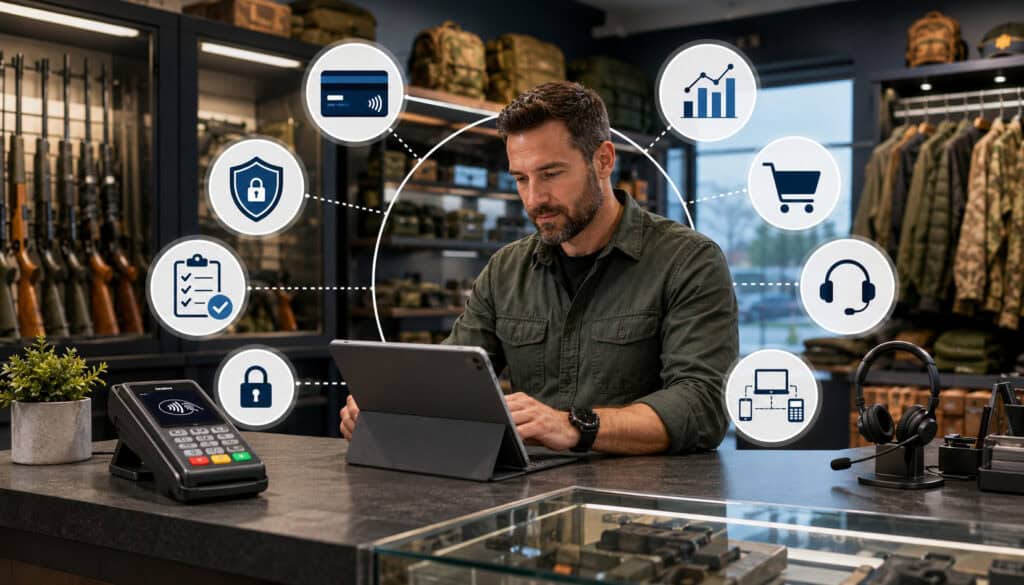
Choosing among firearm-friendly payment providers requires a structured review of account fit, technology, risk controls, funding, pricing, and contractual terms.
Begin with eligibility. Ask whether the provider supports the exact product catalog and whether its acquiring bank accepts the business model. Determine whether approval covers in-store, online, invoice, mobile, recurring, and ACH transactions.
Next, review the technology. Confirm POS compatibility, EMV support, contactless acceptance, gateway integrations, virtual-terminal controls, hosted checkout, tokenization, reporting, and user permissions.
Risk features are equally important. Ask about AVS, CVV checks, velocity limits, transaction monitoring, chargeback alerts, reserve policies, processing caps, and procedures for unusual volume.
Finally, examine the agreement. The merchant should understand all fees, funding timelines, reserve rights, cancellation terms, equipment obligations, data access, and account-review provisions.
A knowledgeable attorney, accountant, compliance professional, or payments adviser can help evaluate obligations that are unclear or material to the business.
POS, Gateway, and Online Payment Features
For in-store transactions, review:
- EMV chip acceptance
- Contactless payments and supported digital wallets
- Terminal connectivity and replacement procedures
- Refund and void controls
- Employee permissions
- Receipt options
- Batch reporting
- POS integration and data export
For remote transactions, review:
- Hosted checkout pages
- Payment gateway compatibility
- Virtual terminals
- Secure invoices and payment links
- Tokenized recurring billing
- AVS and CVV controls
- Risk filters and manual review
- Order and settlement reporting
Businesses should also ask whether adding an integration changes PCI responsibilities or introduces another service provider. The system should minimize exposure to raw card data and provide reliable logs.
Risk, Security, and Account Support Features
Important risk and account-support features include:
- Transaction monitoring
- Custom fraud rules
- Chargeback notifications
- Dispute-response portals
- Reserve and hold transparency
- Processing-limit alerts
- Secure account access
- Multifactor authentication
- Funding-status reporting
- Responsive technical and risk support
The provider should explain how risk reviews are conducted and what documentation may be requested. It should also identify how merchants can report planned volume increases, new websites, additional locations, or product changes.
Responsive support does not guarantee a favorable outcome in every review, but it can improve communication and help the merchant understand required next steps.
Firearm-Friendly Payment Provider Benefits Checklist
The following checklist can help businesses compare the benefits of firearm-friendly payment providers consistently.
| Benefit Area | What to Look For | Why It Matters |
| Underwriting fit | Firearm-business acceptance and clear document requirements | Reduces approval confusion |
| Sales channels | Approved in-store, online, invoice, mobile, and range payments | Supports real operations |
| Payment security | PCI-aware tools, tokenization, encryption, and secure checkout | Reduces exposure of payment data |
| Fraud tools | AVS, CVV, velocity limits, filters, and monitoring | Helps identify suspicious transactions |
| Chargeback support | Dispute alerts, records portal, and response guidance | Supports timely dispute management |
| Reporting | Deposits, refunds, fees, batches, and chargebacks | Improves reconciliation |
| Funding clarity | Settlement timelines, holds, limits, and reserves | Supports cash-flow planning |
| Policy transparency | Written product and sales-channel rules | Reduces mismatch risk |
| Support quality | Responsive technical, funding, and risk contacts | Helps resolve issues efficiently |
| Contract clarity | Complete fees, term, cancellation, reserve, and equipment conditions | Reduces unexpected obligations |
The checklist is a starting point rather than a substitute for reviewing the merchant agreement. Every material statement should be confirmed in the provider’s written terms.
How to Use the Checklist Before Choosing a Provider
Create a list of required and optional capabilities before requesting quotes. Required items may include firearm credit card processing at the retail counter, online accessory checkout, recurring range memberships, or secure invoices.
Score each provider based on whether the feature is confirmed in writing, available only with additional approval, or not supported. This prevents a low price from distracting attention from missing operational capabilities.
Compare the full economic arrangement, including reserve exposure, equipment costs, gateway charges, settlement timing, chargeback fees, and cancellation terms.
Support can also be tested during the evaluation process. Note how clearly representatives answer product-policy, underwriting, security, and funding questions.
A responsible comparison focuses on long-term fit, not promises of guaranteed approval or uninterrupted processing.
Documentation to Keep After Approval
After approval, retain organized copies of:
- The merchant agreement and fee schedule
- Approval emails and written policy confirmations
- Current licenses and FFL documentation where applicable
- Monthly merchant statements
- Bank deposit records
- Receipts and invoices
- Refund and cancellation records
- Chargeback notices and responses
- Shipping or delivery documentation
- Website policies and dated updates
- Processor communications
- Reserve and funding notices
- Reports showing channel and transaction activity
Documents should be stored securely with access limited to authorized personnel. Sensitive card information should not be included unless specifically required and securely handled.
Good records help with reconciliation, disputes, audits, risk reviews, and contract questions.
Best Practices for Working With Firearm-Friendly Payment Providers
A stable relationship requires continuing attention after the account is approved. Merchants should treat payment processing as an operational system rather than a utility that can be ignored until a problem develops.
Recommended practices include:
- Describe the business accurately during underwriting.
- Disclose all products, locations, websites, and sales channels.
- Keep FFL documentation current where applicable.
- Review website policies before applying.
- Use only approved payment channels.
- Monitor chargebacks and refunds regularly.
- Use secure terminals and hosted payment tools.
- Enable appropriate fraud controls for remote transactions.
- Train staff on payment procedures and data security.
- Reconcile deposits consistently.
- Review funding terms, reserves, and processing limits.
- Keep processor communications organized.
- Ask before adding new products or payment methods.
- Never process payments on behalf of another business.
- Compare support quality as carefully as transaction rates.
These practices help preserve alignment between the merchant’s actual activity and its approved account profile.
Building a Transparent Relationship With the Provider
Transparency begins during the application but should continue throughout the relationship. The business should communicate material changes before they appear unexpectedly in transaction data.
Examples include launching a new website, adding online sales, opening another location, introducing recurring memberships, expanding the product catalog, or expecting a large increase in monthly volume.
The provider may require additional review or documentation. Although this can feel inconvenient, advance communication is generally preferable to an unplanned investigation after processing patterns change.
Merchants should document important conversations and request written confirmation when a change affects approved products or channels.
Transparency does not guarantee approval for every expansion. It does, however, help both parties evaluate changes before they create operational disruption.
Reviewing the Account Regularly
A monthly payment review should examine:
- Processing volume and average ticket size
- Largest transactions
- Refund rates
- Chargeback counts and reasons
- Fraud alerts
- Deposit timing
- Processing fees
- Reserve balances
- Declined-transaction patterns
- Processor notices
- User access and permissions
- Website and policy changes
Quarterly or annual reviews can compare actual activity with the original application. If the business has grown substantially, the merchant can discuss updated processing limits or pricing.
Regular reviews also help identify unused services, outdated terminals, former employee accounts, or unexplained charges.
Common Mistakes to Avoid When Choosing a Payment Provider
One common mistake is selecting a provider solely because it offers quick approval or a low advertised rate. A payment account that does not support the business’s real operations may create greater costs later.
Another mistake is failing to disclose online or remote sales. Card-not-present activity has different fraud and chargeback characteristics and may require separate underwriting.
Merchants may also overlook website requirements. Missing refund, shipping, privacy, contact, or terms-and-conditions pages can delay approval or create customer confusion.
Weak fraud controls are another avoidable problem. Accepting every remote order without verification can increase losses and disputes. At the same time, merchants should avoid arbitrary practices that inconvenience legitimate customers without improving security.
Finally, some businesses sign agreements without understanding reserves, equipment leases, processing limits, funding timelines, chargeback fees, cancellation provisions, or personal-guarantee language.
Ignoring Firearm Business Compatibility
A provider’s ability to process general retail transactions does not mean it supports firearm-related activity. Compatibility must cover the merchant’s actual products and sales channels.
A business selling accessories today may plan to add firearms, ammunition, training, repairs, or online orders later. Those plans should be discussed during evaluation because the account may need additional review.
Compatibility also extends to technology. A provider may accept the business category but lack integration with the merchant’s preferred POS or website platform.
Ask direct questions and retain the answers. Avoid relying on vague statements such as “we work with almost everyone.”
The provider should be able to explain what it supports, what it restricts, and what requires additional approval.
Not Reading Reserve, Funding, and Account Review Terms
A rolling reserve allows a portion of processing funds to be retained temporarily according to the agreement. Other accounts may be subject to fixed reserves, delayed funding, transaction-level holds, or processing caps.
Merchants should understand:
- The reserve percentage or amount
- How long funds may be retained
- Conditions for increasing a reserve
- Normal settlement timing
- Reasons funding may be delayed
- Maximum ticket and monthly-volume limits
- Chargeback thresholds
- Account-review procedures
- Termination and cancellation rules
- Equipment return requirements
Terms may allow the processor or acquiring bank to take action when risk changes. A qualified professional can help review provisions that are unclear or financially significant.
How to Choose Firearm-Friendly Payment Providers
The selection process should begin with a complete description of the business. Document the product catalog, customer types, locations, websites, payment channels, monthly volume, average ticket size, maximum ticket, refund practices, and fulfillment timelines.
Use this profile to evaluate each provider. Confirm firearm-business acceptance, required documents, acquiring support, online-sales policies, POS compatibility, gateway options, fraud tools, chargeback services, security features, funding speed, reserve terms, processing limits, and customer support.
Request written pricing based on realistic transaction data. Compare total expected cost rather than focusing on one percentage.
Review the merchant agreement before committing. Pay close attention to restricted activities, reserve authority, funding delays, data access, equipment obligations, cancellation, renewal, and personal guarantees.
No article or checklist can determine whether a particular provider is appropriate for every business. Obtain professional review for legal, regulatory, financial, banking, tax, or contractual questions specific to the operation.
Questions to Ask Before Choosing a Provider
Useful questions include:
- Do you and the acquiring bank accept my exact firearm-related business model?
- Which products are approved, restricted, or prohibited?
- What FFL documentation is required where applicable?
- Are online sales and card-not-present transactions permitted?
- Does approval include invoices, payment links, or virtual-terminal use?
- Which POS systems, gateways, and e-commerce platforms are compatible?
- What fraud tools are included?
- How are chargebacks reported and managed?
- What chargeback thresholds or monitoring programs apply?
- What are the normal settlement timelines?
- Can funding be delayed after a sales spike?
- Is a rolling or fixed reserve required?
- What processing limits apply?
- What are the complete monthly and transaction fees?
- What PCI-related support or validation tools are available?
- What is the contract term and cancellation process?
- How are risk reviews escalated?
- Must new products, locations, or websites be approved?
- Who provides technical, funding, and chargeback support?
The quality and specificity of the answers can reveal whether the provider understands the business.
Comparing Long-Term Value Over Short-Term Savings
Long-term value combines reliable payment acceptance, account alignment, security, support, reporting, funding predictability, and reasonable total cost.
A low quote may save money when all other factors are equal. However, a low rate does not compensate for an unsupported business model, inadequate fraud tools, unclear reserves, or poor assistance during a risk review.
Businesses should estimate the operational impact of downtime, delayed deposits, rejected online transactions, or an emergency gateway migration. These risks may be more significant than a small difference in transaction pricing.
At the same time, merchants should not accept poor terms merely because a provider advertises specialized experience. Transparency, written policies, fair pricing, and contract clarity remain essential.
The strongest choice is usually the provider that offers the most sustainable combination of fit, functionality, security, support, and cost.
FAQs
What are firearm-friendly payment providers?
Firearm-friendly payment providers are payment organizations or merchant service arrangements willing to evaluate and support eligible firearm-related businesses.
They may provide a firearm merchant account, POS equipment, EMV terminals, a gateway, virtual-terminal access, payment links, invoices, reporting, and risk-management tools.
They still conduct underwriting and may impose product restrictions, reserves, processing limits, or sales-channel conditions. Firearm-friendly does not mean automatic approval or permission to process every type of transaction.
What are the main benefits of firearm-friendly payment providers?
The main potential benefits include more accurate underwriting, clearer documentation requirements, improved business-category alignment, support for approved sales channels, stronger fraud tools, chargeback assistance, secure payment technology, useful reporting, and more relevant account support.
These advantages may reduce preventable payment disruptions, but they do not eliminate risk. The business must continue following provider policies, monitoring transactions, maintaining documentation, and reporting important operational changes.
Why do firearm businesses need specialized payment processing?
Some general payment providers restrict firearm-related products or do not have acquiring relationships designed to support them. Firearm businesses can also present distinctive underwriting considerations involving product categories, licenses, ticket sizes, fulfillment practices, online transactions, and dispute exposure.
Specialized processing helps ensure that the business is reviewed according to its actual activity. This can reduce the risk of operating through an account that was established for an inaccurate or unsupported category.
Can firearm-friendly payment providers support online sales?
Some providers may support eligible online firearm-related sales, accessories, training, memberships, or other approved products. Approval depends on the provider, acquiring bank, product catalog, licensing status, website, fulfillment model, transaction values, and fraud controls.
The merchant should obtain specific approval for e-commerce and card-not-present activity. Online checkout should use secure payment tools, and the website should provide clear product, shipping, refund, privacy, and customer-service information.
How can the right payment provider reduce account shutdown risk?
The right provider can reduce mismatch risk by accurately reviewing the firearm-related business before processing begins. Products, sales channels, monthly volume, average ticket size, websites, and supporting documents can be evaluated during underwriting.
This does not guarantee that the account will never be reviewed or terminated. Chargebacks, fraud, policy changes, unsupported activity, financial concerns, or acquiring-bank decisions can still affect the account.
What documents may firearm businesses need during underwriting?
Documents may include business licenses, FFL documentation where applicable, owner identification, beneficial ownership information, tax details, bank statements, previous merchant statements, product catalogs, supplier information, website policies, and processing projections.
Requirements vary. Applicants should ask for a written checklist and provide accurate, current, and consistent information.
How do firearm-friendly providers help with chargebacks?
A provider may offer dispute alerts, transaction records, response portals, reason-code information, and guidance on relevant evidence. Some also provide fraud filters that can reduce transactions likely to become disputes.
The merchant remains responsible for clear receipts, accurate descriptions, customer communication, refund procedures, shipping records, and truthful dispute responses. Chargeback support should never be used to obstruct legitimate consumer claims.
What should firearm businesses compare before choosing a payment provider?
Businesses should compare product eligibility, underwriting transparency, approved payment channels, POS and gateway compatibility, security, fraud tools, chargeback support, reporting, settlement timing, reserves, processing limits, total fees, contract terms, and support quality.
The comparison should be based on the real business model. A provider suitable for a retail range may not be appropriate for a high-volume e-commerce merchant.
Conclusion
The benefits of firearm-friendly payment providers extend well beyond the ability to accept credit and debit cards.
A suitable provider can offer better underwriting alignment, clearer documentation expectations, approved payment-channel support, stronger account stability, fraud controls, chargeback tools, payment security, reporting, and support that reflects firearm-related operations.
For gun shops, FFL dealers, ranges, trainers, gunsmiths, accessory sellers, and online merchants, the central advantage is accurate fit. The business is reviewed according to what it actually sells, how customers pay, and how transactions are fulfilled.
That fit can reduce preventable surprises, but responsible management remains essential. Merchants should disclose all products and channels, use secure payment tools, monitor refunds and chargebacks, reconcile deposits, maintain current documentation, and communicate material changes.
Pricing should be evaluated carefully, but the lowest advertised rate should not be the only deciding factor. Policy alignment, acquiring support, security, funding terms, reserve clarity, contract conditions, reporting, and responsive assistance can be more important to long-term reliability.
Firearm businesses should approach payment-provider selection as a risk-management and operational decision. A transparent, properly underwritten, and securely configured payment relationship provides a stronger foundation for serving customers and maintaining dependable daily operations.