
By Wade Holbrook September 13, 2026
For firearms instructor class deposits payments, the most important decision is not whether to charge 25%, 50%, or the full class price upfront. It is whether the payment provider actually supports the training business being presented to it—and whether the booking system creates a defensible record of what the student agreed to pay.
A firearms or CCW instructor should solve two payment questions before opening registration: Does the processor support this business model, and exactly what happens to the money when a student cancels late, does not appear, or the class cannot take place?
Full prepayment, deposits, stored-card charges, refunds, rescheduling credits, and installment arrangements can all be workable. But they solve different business problems.
The terms need to be visible before the student commits, later card-on-file charges need appropriate authorization, and the payment trail should identify the merchant, class, amount, cancellation cutoff, and disposition of the student’s money.
That structure matters because a prepaid class dispute is rarely decided by one document. A processor, acquirer, issuer, or card network may need to understand an entire chronology: what the student booked, what was disclosed, what was charged, whether the student cancelled, whether the instructor performed, and whether a refund was due.
For firearms trainers, that chronology begins even earlier—with correct merchant underwriting.
Why Processor Eligibility Comes First for Firearms Trainers
A firearms training merchant account should accurately describe the business that will actually generate transactions.
That sounds obvious, but a training business can have a more complicated payment profile than its website headline suggests. An independent instructor might collect payments for group courses, private appointments, deposits, remaining balances, rescheduling fees, recurring range programs, or events hosted at third-party facilities.
A range might process training together with memberships and retail activity. A larger academy may use several instructors while one company collects all student payments.
The payment provider evaluates that complete model, not simply the label “education.”
An underwriter may want to understand the website, class descriptions, ownership, transaction channels, processing history, expected ticket size, refund practices, future fulfillment exposure, and whether the merchant’s public-facing activities match the application.
Firearms-related merchants can benefit from reviewing the documentation commonly involved in merchant account underwriting for firearms businesses before investing heavily in a booking integration.
This does not mean every payment company treats firearms training identically. Provider policies differ, policies change, sponsor-bank requirements matter, and a provider’s treatment of firearms sales does not automatically tell you how it will classify a training-only business.
The safest operational approach is to disclose the business accurately and obtain a clear answer about the intended activity, including online class payments, card-on-file use, deposits, no-show charges, and any other relevant revenue streams.
Aggregator Versus Underwritten Merchant Account
A general-purpose payment aggregator typically offers standardized onboarding across a very broad merchant population. Acceptance may initially be automated or streamlined, while continuing use remains subject to the provider’s acceptable-use rules, risk review, transaction monitoring, and financial-partner requirements.
An underwritten merchant account involves a more direct assessment of the individual merchant before or during approval. That process may examine business activities, transaction volume, websites, policies, financial information, processing history, ownership, and related risk controls.
That distinction can be important for firearms-related activity because an underwritten relationship creates an opportunity to describe the business accurately before substantial volume begins. It does not guarantee approval. A particular processor, acquirer, sponsor bank, or program can still decline the activity.
Current provider policies also illustrate why instructors should not make assumptions based merely on a payment company’s popularity. Categories associated with legal firearms may receive restrictions, additional due diligence, limited availability, or other provider-specific treatment. Training itself may or may not be separately enumerated.
Therefore, a booking application’s statement that it “supports card payments” is not sufficient evidence that the underlying payment provider supports a firearms instructor.
Booking software manages scheduling. The processor and acquiring relationship determine whether the payment activity is supported.
Why Accounts Can Be Restricted or Closed Later
A payment account can encounter problems after activation when the provider discovers that the actual business differs from the activity it expected.
Possible policy or risk triggers include:
- an unsupported business category;
- business activity not disclosed during onboarding;
- a website or service mix that does not match the application;
- substantial changes in transaction volume or fulfillment exposure;
- elevated customer disputes or refunds;
- policy reviews affecting a business category; or
- information requested during a periodic risk review that cannot be adequately verified.
It is better to describe training, classes, private lessons, range-related revenue, recurring payments, and other material activities at underwriting than to attempt to fit the operation into an unrelated lower-risk description.
Firearms businesses can review additional considerations around payment stability and accurate business classification when evaluating how processing activity should be presented.
Full Prepayment vs Deposit-Plus-Balance for Training Classes
Once processor eligibility is established, the next decision is how much of the class price to collect before service occurs.
There is no universal answer.
Full payment works well for some scheduled classes because the student finishes checkout once and the instructor does not need to collect a balance on the morning of the course. But it also increases the amount held before the service occurs and therefore increases the amount potentially involved in a refund or prepaid class chargeback.
A deposit-plus-balance structure lowers the initial prepaid exposure, but it creates another collection event. The instructor must determine when the remaining balance becomes due, what happens if payment fails, whether a stored credential will be used, and whether an unpaid balance causes the seat to be released.
Table 1: Class Payment Models
| Model | Cash-Flow Benefit | Dispute Risk | Operational Burden |
| Full payment at booking | Entire class fee collected and seat financially committed | Entire prepaid amount may become disputed if cancellation or service-delivery disagreement occurs | Low after successful booking |
| Deposit, balance charged automatically later | Lower initial pre-service exposure | Later charge requires appropriate stored-credential authorization and correct transaction handling | Moderate |
| Deposit, student manually pays balance | Initial commitment without automatic later charge | Lower authorization confusion, but unpaid balances can remain | Moderate to high |
| Pay in full shortly before class | Less long-term prepaid exposure | Seat may be reserved before payment is secured | Higher collection risk |
| Payment at class | Little prepaid-service exposure | Higher risk of late cancellation or no-show producing no revenue | Higher day-of collection burden |
Full prepayment can be attractive for a small group class where every seat is valuable. A student who pays the complete price is financially committed, and the instructor avoids managing balances.
Yet full prepayment also creates an obligation to administer cancellations carefully. If a class is cancelled by the instructor or cannot occur because the venue is unavailable, the business may have to unwind a larger prepaid amount.
Deposit-plus-balance billing spreads those risks. The initial deposit can represent a meaningful reservation commitment without collecting the entire course value months before performance.
Its downside is operational complexity. Staff need to know:
- the balance due date;
- whether the student initiates the second transaction;
- whether automatic charging is permitted;
- what happens after a decline;
- when a seat becomes available to someone else; and
- how a cancelled registration is reconciled.
How Large Should the Deposit Be?
Avoid starting with an arbitrary percentage.
Instead, calculate what the reserved seat economically represents.
Suppose a group class has 12 seats. The instructor must commit to the date, reserve a classroom or range space, prepare materials, schedule another instructor, and stop accepting registrations when capacity is reached.
A cancellation 20 days before the event may allow the seat to be refilled easily. A cancellation the evening before may not.
That means the useful question is not, “What percentage do other instructors charge?”
It is:
What reasonably protects the cost and economic impact of reserving this seat without turning the deposit into an arbitrary punishment?
Relevant variables include:
- class capacity;
- likelihood that a cancelled seat can be resold;
- time between booking and class;
- venue reservation cost;
- instructor preparation;
- nonrecoverable third-party expenses;
- administrative work associated with registration;
- cancellation notice provided;
- waitlist availability; and
- applicable state contract and consumer-protection law.
For example, assume a hypothetical class costs $180. An instructor could compare collecting the whole $180 against a $60 reservation deposit with the remaining $120 due later. Those figures are illustrations, not suggested market rates or legally approved amounts.
A defensible deposit structure should have a business rationale connected to the reservation rather than being designed primarily to maximize forfeitures.
Private lessons can justify different economics from group events. Losing a one-on-one appointment may eliminate the entire revenue opportunity for that time slot, whereas one vacancy in a large course affects only one portion of the event’s revenue.
Multi-day courses can require another structure again because more money, facility commitments, and advance preparation may be involved. Milestone billing or a graduated cancellation schedule can sometimes match that exposure better than a single rule used for every class.
How to Write a CCW Class Cancellation and No-Show Policy

A useful CCW class payment policy answers what happens to the customer’s money at every significant point between booking and completion.
It should not force the student to infer the outcome from vague language such as “all deposits subject to cancellation policy.”
At minimum, the policy should address:
- payment required at booking;
- whether that amount is full payment or a deposit;
- remaining balance and due date;
- ordinary cancellation cutoff;
- late-cancellation treatment;
- no-show treatment;
- rescheduling rules;
- instructor cancellation;
- range or venue closure;
- weather decisions;
- refund method;
- treatment of a failed balance payment;
- whether registration may be transferred to another class;
- whether attendee substitution is permitted; and
- any voluntary store-credit option.
The business should also distinguish three events that are frequently collapsed into one:
Timely cancellation: The student gives notice within the agreed cancellation window.
Late cancellation: The student communicates the cancellation, but does so after the stated cutoff.
No-show: The reservation remains active and the student does not appear as expected.
Different events can produce different payment outcomes. The policy should say so before the customer books.
State contract and consumer-protection rules can affect cancellation fees, deposits, liquidated-damages provisions, disclosures, refund rights, and whether a particular fee is enforceable.
Those rules are not uniform across the United States. Businesses should have their policy reviewed for the states in which they operate rather than copying a cancellation clause from another instructor.
Table 2: Cancellation Outcomes
| Scenario | Payment State | Refund/Fee Decision | Documentation |
| Student cancels before cutoff | Deposit or full payment held | Apply stated timely-cancellation treatment | Cancellation timestamp and confirmation |
| Student cancels after cutoff | Payment already collected | Apply disclosed late-cancel provision if lawful | Policy acceptance and cancellation request |
| Student does not appear | Reservation remains active | Apply authorized no-show treatment if permitted | Roster, check-in record, policy and communications |
| Instructor cancels | Student prepaid | Refund or customer-selected reschedule is generally the cleaner approach | Cancellation notice and refund/reschedule record |
| Venue/range unavailable | Class cannot occur | Follow venue-cancellation provision without treating customer as a no-show | Closure notice and customer communication |
| Weather prevents class | Service cannot occur as scheduled | Follow published weather/reschedule process | Decision time and notice |
| Student transfers to later class | Payment carried forward | Record transfer rather than duplicating payment | Original and replacement booking records |
Disclosure and Checkbox Consent
The cancellation policy should be shown while it can still influence the customer’s decision.
Material terms should appear before the card is submitted—not solely after the purchase in a confirmation email.
A practical checkout flow can provide:
- class price and amount due today;
- balance information, if any;
- cancellation cutoff;
- short late-cancel/no-show summary;
- accessible complete policy;
- affirmative acknowledgment; and
- payment submission.
A checkbox can strengthen the evidence that the customer was presented with the terms. The text should identify what is being accepted rather than saying only “I agree.”
For example, the acknowledgment can reference the cancellation, rescheduling, no-show, and stored-card policy associated with that reservation.
The system should retain the policy version and timestamp when possible.
A checkbox is evidence. It is not a magic clause that makes an otherwise unlawful, unreasonable, misleading, or inadequately disclosed fee enforceable.
Table 3: Policy Disclosure
| Term | Where Shown | Evidence to Retain |
| Amount charged today | Class page and checkout | Order record and receipt |
| Remaining balance | Before payment | Booking record |
| Cancellation cutoff | Near booking action and policy | Policy version and timestamp |
| Late-cancel treatment | Checkout summary and policy | Accepted terms |
| No-show treatment | Checkout summary and policy | Accepted terms |
| Card-on-file authorization | Before credential is stored | Stored-credential agreement |
| Refund/reschedule treatment | Policy and confirmation | Confirmation sent to student |
| Merchant identity | Checkout, receipt and email | Transaction and communication records |
Receipt and Confirmation Language
The confirmation should make the reservation recognizable without requiring the customer to locate the original website page.
Include:
- training business name;
- class name;
- date and time;
- location;
- amount paid;
- balance remaining;
- payment status;
- cancellation cutoff;
- reference or link to the applicable policy;
- support contact information; and
- basic arrival information that is administrative rather than instructional.
The card statement identity matters too. Customers are more likely to question a transaction when the descriptor is an unfamiliar holding company, unrelated DBA, or abbreviation that has no obvious connection to the class they purchased.
Align the website brand, receipt header, booking email, customer-support identity, and statement descriptor as closely as the processing setup permits.
Recognizable descriptors and consistent customer communication are also useful parts of broader chargeback-prevention practices for firearms businesses.
Charging a No-Show Fee With a Stored Credential
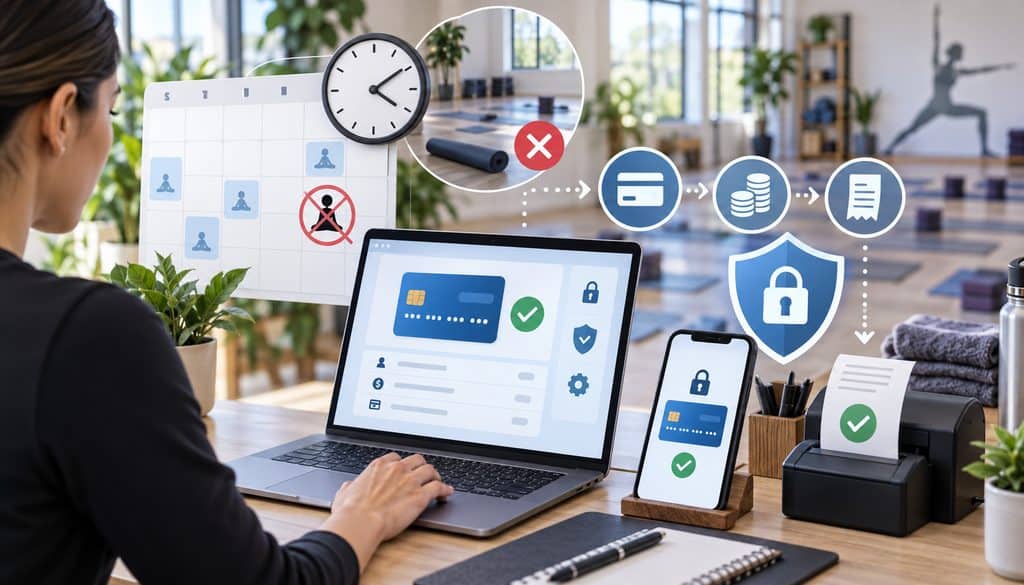
The phrase no-show fee firearms training describes a billing action that requires more care than simply having a card number available.
There are two different permissions involved:
- permission to retain or tokenize a payment credential for future use; and
- authorization to charge that credential later under the circumstances defined by the agreement.
The merchant should not assume that completing the initial deposit transaction automatically grants unlimited authority to use the card again.
Current Visa stored-credential rules require an agreement with the cardholder and specific handling of stored-credential transactions. Mastercard likewise defines credential-on-file transactions around express cardholder authorization to store account data and subsequent authorization to use it.
Merchants should rely on their processor or gateway to submit the appropriate stored-credential and transaction indicators rather than trying to determine network message fields manually.
For the underlying network documentation, see Visa’s current stored-credential requirements and Mastercard’s current transaction-processing rules.
A useful authorization record should make clear:
- who the merchant is;
- that the credential may be stored;
- what future payment it may be used for;
- whether the future amount is fixed or how it will be determined;
- what event triggers the later transaction;
- any balance due date;
- relevant cancellation/no-show conditions; and
- how the customer can contact the merchant.
A No-Show Charge Is Not Automatically a Recurring Charge
Transaction terminology matters.
A monthly membership dues payment, installment schedule, ordinary consumer-initiated stored-card purchase, and merchant-initiated charge are not interchangeable just because the same stored credential is involved.
Visa’s systems, for example, recognize different merchant-initiated transaction categories, including recurring transactions, installment transactions, unscheduled credential-on-file transactions and certain industry-specific practices.
Visa also describes a “no show” transaction in connection with guaranteed reservations for certain merchant segments; that should not be interpreted by a firearms instructor as universal permission to submit every missed class under a network no-show category.
A training business should tell its gateway or processor what it wants to accomplish and have the payment system use the transaction classification appropriate to that merchant, payment agreement, and acceptance environment.
Do not manually label a transaction as recurring merely because it occurs after the initial booking.
Practical No-Show Charge Decision Workflow
Before a later charge is submitted, work through the reservation chronologically:
Reservation exists
→ confirm class, student, payer and payment record.
Cancellation deadline passes
→ confirm the cutoff actually applicable to that booking.
Student does not appear
→ document the absence using the normal attendance process.
Check for business-caused failure
→ make sure the instructor did not cancel and the range or venue did not prevent performance.
Check communications
→ confirm there was no cancellation message that staff overlooked.
Confirm accepted policy
→ identify the policy version and acknowledgment attached to this booking.
Confirm stored-card authorization
→ verify that the later charge is within the customer’s payment authorization.
Check applicable legal requirements
→ do not rely solely on processor capability to determine enforceability.
Process only when permitted
→ use the approved payment workflow and correct processor configuration.
Send a receipt
→ identify why the transaction occurred.
Preserve evidence
→ keep the reservation, authorization, attendance status and communications together.
How Much Should a No-Show Fee Be?
There is no universal no-show amount that is appropriate for every firearms class.
Possible structures include:
- forfeiture of an already-paid reservation deposit;
- a disclosed fixed late-cancellation or no-show charge; or
- retention or charging of a larger portion of the class price when the agreement and applicable law support that outcome.
The business case should relate to the economic impact of the reservation.
If the class had a waitlist and the vacated seat was immediately filled, the instructor may decide to offer more flexible treatment. If a private appointment remained unused and could not reasonably be rebooked, the economics look different.
The objective should be a clear and defensible reservation policy, not a punitive surprise.
Card-on-File Security Is Part of the Payment Policy

A cancellation policy can be carefully drafted and still create unacceptable risk if card information is handled insecurely.
Use a processor, gateway, or booking platform that supports tokenization or a hosted payment environment where practical. The instructor ordinarily should not maintain spreadsheets, notebooks, email messages, or ordinary business databases containing reusable raw card numbers.
PCI DSS requirements apply according to the merchant’s card-data environment and processing setup.
One rule is particularly important for card-on-file arrangements: do not retain the card verification value after authorization.
PCI SSC states that card verification codes such as CVV2, CVC2 and CID are sensitive authentication data and cannot be stored after authorization, even if encrypted. They are also not permitted to be retained for future card-on-file or recurring transactions.
The relevant official guidance is available from the PCI Security Standards Council on card-verification-code storage.
For future transactions, use the token or approved stored-credential functionality supplied by the payment system rather than recording the security code.
Repeatedly requesting card numbers by telephone and manually keying future charges is usually a weaker operational process than giving customers a secure payment link or using an appropriately configured tokenized stored credential. Manual entry can also make transaction recognition and authorization evidence harder to manage.
Handling Concealed Carry Class Refunds
A good policy for concealed carry class refunds separates customer-caused cancellation from circumstances in which the business cannot provide the scheduled service.
Those situations should not automatically receive the same outcome.
When a student cancels within the normal refund window, staff should follow the timely-cancellation rule rather than improvising based on how full the class happens to be that day.
When a student cancels after the cutoff, the business should apply the late-cancellation provision that was disclosed at booking, subject to applicable law.
When the instructor cancels, the analysis changes substantially. The customer was ready to receive a service the merchant is now unable to provide. A full refund or a voluntary rescheduling option is usually the clearest customer-facing structure, subject to the contract and applicable law.
The customer should not automatically be forced to accept store credit merely because a future class exists.
Table 4: Refund Exceptions
| Cause | Customer Responsible? | Typical Policy Treatment | Caution |
| Timely customer cancellation | Yes, but within agreed window | Follow stated refund/reschedule policy | Apply consistently |
| Late customer cancellation | Customer initiated | Apply disclosed late-cancel provision where lawful | Avoid undisclosed forfeiture |
| Customer no-show | Customer did not attend | Apply authorized no-show rule where permitted | Verify no overlooked cancellation |
| Instructor cancellation | No | Refund or voluntary reschedule | Do not treat as customer default |
| Range/venue closure | Usually no | Refund or reschedule under closure policy | Explain who made closure decision |
| Weather makes class impossible | Usually no | Follow published weather process | Define notification and reschedule procedure |
| Student voluntarily requests credit | Depends | Credit may be acceptable if policy/law allow | Record voluntary acceptance |
Weather, Range Closure, and Instructor Cancellation
Weather clauses work best when they define process rather than attempting to predict every event.
State:
- who decides whether the class proceeds;
- when the decision will normally be communicated;
- which communication channel will be used;
- whether the class will move to another date;
- whether the student can choose a refund where applicable; and
- how an already-paid balance moves to a rescheduled class.
The same logic applies to a range closure.
If the venue makes performance impossible, the payment record should not falsely characterize the student as having cancelled or failed to attend. Record the event as a business or venue cancellation and process it under the corresponding policy.
If the instructor reschedules a class and the customer agrees, move the existing payment to the new booking rather than creating unnecessary duplicate charges. Send a new confirmation showing the revised date while preserving the original transaction history.
Refund Timing and the Original Payment Method
Distinguish the date the merchant initiates a refund from the date the customer’s issuer posts the credit.
The merchant controls the first step. The card issuer and payment system influence the second.
Therefore, avoid promising that every customer’s statement will show the money back within a particular number of hours or days unless your provider specifically supports that commitment.
For card transactions, returning funds through the appropriate original payment path generally produces the clearest transaction history and makes it easier to connect the refund with the original sale, subject to processor and network rules.
Record:
- original transaction;
- refund amount;
- initiation date;
- refund reference or transaction ID;
- staff member who processed it; and
- reason for refund.
Store credit can still be useful when the customer willingly selects it and the policy and applicable law permit it. It should not be used as a substitute for a refund the merchant actually owes.
Building a Chargeback Evidence File
A prepaid class chargeback can arise even when the instructor believes the policy was completely clear.
Common dispute narratives include:
- “I did not authorize this charge.”
- “The service was not provided.”
- “I cancelled.”
- “I was promised a refund.”
- “The class was not what I purchased.”
- “I don’t recognize this merchant.”
The strongest response is usually an organized record that addresses the specific allegation rather than a large folder of unrelated documents.
Evidence can include:
- booking confirmation;
- original payment receipt;
- class description shown at purchase;
- accepted cancellation terms;
- stored-credential authorization where applicable;
- cancellation request;
- email or SMS correspondence;
- attendance/check-in record;
- contemporaneous class roster;
- signed documents relevant to participation;
- completion documentation where applicable;
- refund record;
- rescheduling history; and
- merchant identity/descriptor information.
A waiver does not automatically prove that a billing charge was valid. Likewise, an attendance roster does not prove that a separate post-booking charge was authorized.
Each document proves something different.
Table 5: No-Show and Class-Dispute Evidence
| Evidence | What It Supports | Limitation |
| Booking record | Student/payer made a reservation | Does not alone prove later fee authorization |
| Payment receipt | Amount and original transaction | Does not prove service completion |
| Accepted policy | Terms presented and acknowledged | Enforceability still depends on circumstances and law |
| Stored-card authorization | Permission relating to later credential use | Must cover the transaction actually charged |
| Cancellation timestamp | When customer requested cancellation | Must be compared with applicable cutoff |
| Attendance roster | Whether attendee was recorded present | Must be contemporaneous and accurate |
| Check-in record | Physical/administrative arrival | Does not establish every aspect of service |
| Waiver | Enrollment or participation evidence in some cases | Not automatically proof of valid billing |
| Completion certificate | Supports completed service | Relevant only if course was completed |
| Refund record | Shows credit was initiated | Posting may occur later |
| Communications | Shows chronology and customer statements | Use relevant exchanges rather than unrelated messages |
Rosters, Waivers, and Completion Certificates
Attendance records should be created because the business actually operates that way—not reconstructed after a chargeback arrives.
For each scheduled class, maintain a consistent process for marking:
- registered;
- cancelled;
- transferred;
- checked in;
- no-show; and
- completed, where appropriate.
A contemporaneous roster can help demonstrate whether a student attended. It becomes especially useful when paired with the booking record and payment transaction.
A waiver may show that the customer enrolled or participated, depending on when and how it was completed. It should not be presented to an issuer as though signing a waiver automatically establishes consent to every billing action.
A completion certificate can be particularly relevant to a claim that a completed class was never provided. Again, it is evidence, not a guaranteed outcome.
Issuer and network dispute processes still determine whether the submitted evidence satisfies the applicable dispute rules.
Use a Chronology for “I Cancelled” Disputes
When the disagreement concerns cancellation timing, a short chronological presentation is often more useful than several paragraphs of argument.
For example:
May 2 — customer booked class.
May 2 — cancellation policy accepted and payment made.
May 16 at 6:00 p.m. — stated cancellation cutoff.
May 17 at 9:12 a.m. — customer sent cancellation request.
May 18 — scheduled class date.
May 18 — reservation recorded as late cancellation/no-show according to actual circumstances.
May 18 — charge or retained deposit handled according to the policy.
The supporting evidence should connect directly to each event.
This method also helps staff discover mistakes. If the customer actually cancelled before the cutoff but the booking platform failed to update the roster, the chronology may show that a refund is the correct outcome.
Multi-Instructor Schools and the Merchant-of-Record Problem
A training school with several instructors introduces another payment risk: the customer can become unsure who actually sold the class.
One clear merchant-of-record relationship is usually easier to administer.
If “ABC Training LLC” markets the course, collects the student’s $200, sends the receipt, and appears on the card statement, then the customer should generally know that ABC Training handles the payment relationship—even if another instructor teaches the scheduled class.
The customer’s transaction should not unexpectedly fragment into separate charges from the school, an instructor, a range, and another business unless the commercial arrangement clearly requires and discloses those separate merchant relationships.
Table 6: Multi-Instructor Payment Flow
| Party | Role | Payment Responsibility | Refund Responsibility |
| Student | Purchaser/attendee | Pays identified merchant | Requests payment resolution from identified merchant |
| Training school | Merchant of record where structured that way | Collects class payment | Handles customer refund obligations |
| Instructor | Delivers scheduled service | Normally receives internal payout from school | Does not independently reverse school card charge |
| Range/venue | Provides location under separate arrangement | Receives payment according to school/venue agreement | Customer treatment depends on who sold the service |
| Processor/acquirer | Processes payment | Routes authorization/settlement | Processes merchant refund through payment system |
| Booking platform | Scheduling and recordkeeping tool | May transmit payment data to processor | Does not by itself determine merchant responsibility |
The customer-facing payment relationship should remain separate from downstream instructor compensation.
A clean accounting flow might be:
Customer payment → school merchant account → class revenue/accounting record → instructor payout under the school’s compensation arrangement.
That description is about payment operations, not whether an instructor should legally be treated as an employee or independent contractor. Worker classification involves separate tax and employment-law questions.
For each class, track:
- class ID;
- instructor ID;
- seats sold;
- gross bookings;
- deposits;
- balances;
- cancellations;
- refunds;
- permitted forfeitures/no-show amounts;
- disputes;
- instructor payout basis; and
- final payout.
If the school charged the customer’s card, the customer generally should not have to chase the individual instructor for a refund while the school tells them it merely “passed the payment through.”
The merchant of record should be clear enough that the customer knows who took the money and who handles payment questions.
Reconciliation, Prepayments, and Refund Exposure
Class deposits should not disappear into a general sales total without enough detail to determine what happened later.
A basic reconciliation process should connect the booking system with the payment processor and bank deposits.
Track at minimum:
- deposits received;
- full prepayments;
- balance transactions;
- refunds;
- transfers to future classes;
- permitted retained amounts;
- chargebacks;
- processor adjustments; and
- instructor payouts.
From an accounting standpoint, cash received for a future class is not necessarily the same thing as revenue already earned.
The appropriate revenue-recognition treatment depends on the entity’s accounting framework and policies, so the business should coordinate with its accountant or bookkeeper rather than assuming every prepaid dollar becomes current revenue immediately.
For larger schools, it is also useful to monitor future refund exposure.
A business may have $60,000 sitting in its operating bank account while $30,000 relates to classes not yet delivered. If several large courses are cancelled, some portion may need to be returned.
A simple future-class report can list upcoming dates, seats sold, prepaid balances, instructor/venue commitments, and potential refund obligations. That gives management a better picture of how much of current cash relates to future performance.
Common Firearms Training Payment Mistakes
Many payment problems begin well before a chargeback notification.
The biggest mistakes tend to involve mismatches: the merchant account does not match the business, the booking terms do not match what staff actually do, the stored-card agreement does not match the later charge, or the name on the statement does not match the brand the student remembers.
Table 7: Common Payment Mistakes
| Mistake | Payment/Dispute Risk | Better Approach |
| Assuming a booking platform means the processor permits the business | Account review or loss of processing | Confirm underlying processor/acquirer eligibility |
| Describing business incompletely during underwriting | Activity may appear undisclosed | Accurately describe training and payment channels |
| Vague cancellation language | Customer and staff interpret rules differently | Define timely cancellation, late cancellation and no-show |
| Hiding no-show terms in lengthy general terms | Weak disclosure evidence | Surface material terms during checkout |
| Keeping no consent record | Difficult to establish what customer accepted | Retain versioned policy and acknowledgment |
| Charging stored card without appropriate authorization | Unauthorized-charge dispute exposure | Obtain defined stored-credential authorization |
| Treating instructor cancellation like customer no-show | Refund complaints and service-not-provided disputes | Use separate business-caused cancellation rules |
| Forcing store credit when refund is actually due | Escalated customer complaint | Offer credit voluntarily where appropriate |
| Unrecognizable descriptor | “I don’t recognize this” disputes | Align descriptor and customer-facing identity |
| Weak attendance records | Harder to establish whether service occurred | Maintain contemporaneous roster/check-in records |
| Multiple instructors separately charging one student | Descriptor confusion and reconciliation problems | Keep merchant-of-record relationship clear |
| Unclear refund ownership | Student gets passed among parties | Merchant that sold the class manages payment resolution |
Businesses building their overall payments process can also use a broader merchant services setup checklist for firearms businesses to evaluate descriptors, refund permissions, remote payment methods and dispute controls.
Practical Firearms Training Payment Workflow
The following sequence turns the policy into an operating process.
- Confirm processor/acquirer support: Accurately describe the training business, sales channels and expected transaction types.
- Define class payment models: Decide which classes use full payment, deposits, manual balances or another supported structure.
- Choose full prepay versus deposit-plus-balance by class type: Use seat economics and fulfillment exposure rather than one arbitrary rule.
- Draft cancellation and no-show terms: Separate timely cancellation, late cancellation and no-show treatment.
- Review enforceability under applicable state law: Pay particular attention to deposits, cancellation fees, consumer disclosures and liquidated-damages concepts.
- Display material terms before booking: Do not rely solely on post-purchase email terms.
- Capture affirmative acknowledgment: Save the timestamp and policy version where the platform supports it.
- Use tokenized payment storage: Avoid maintaining reusable raw card data yourself.
- Send the booking receipt and confirmation: State the merchant, class, payment status and cancellation information.
- Send reminders: A class reminder and, where appropriate, a reminder before a meaningful cancellation cutoff can prevent accidental no-shows.
- Record attendance accurately: Use the same attendance states across instructors.
- Apply late-cancel or no-show charges only where authorized and lawful: Do not turn the existence of a stored token into unrestricted billing permission.
- Handle instructor, range and weather cancellations separately: Identify the actual cause.
- Process appropriate refunds through the approved payment workflow: Use the original payment route where required or appropriate under provider rules.
- Preserve evidence: Keep booking, consent, communication, attendance and refund records connected.
- Maintain one clear merchant of record: Customers should know who charged them.
- Track instructor compensation separately: Do not confuse instructor payouts with customer payment records.
- Reconcile monthly: Match processor transactions, booking records, refunds, disputes and bank deposits.
- Review dispute reasons: Repeated “cancelled,” “not recognized,” or “service not provided” claims point to specific process problems.
- Recheck provider and card-network requirements periodically: Payment rules and provider policies can change.
Firearms Training Class Payment Checklist
- Confirm the processor supports the actual business model.
- Define full-prepayment versus deposit structures.
- Define the balance due date.
- Define the cancellation cutoff.
- Define no-show treatment.
- Define late-cancellation treatment.
- Review applicable state-law enforceability.
- Display material terms before booking.
- Capture affirmative acknowledgment.
- Preserve the applicable policy version.
- Use tokenized card storage.
- Do not retain CVV after authorization.
- Send a payment receipt.
- Send a booking confirmation.
- Make the merchant identity recognizable.
- Keep the card descriptor aligned with the business where possible.
- Send class reminders.
- Record attendance contemporaneously.
- Record cancellation time and date.
- Apply a later stored-card fee only when authorized and permitted.
- Separate customer cancellation from instructor cancellation.
- Handle range or weather cancellation according to the written policy.
- Return card refunds using the appropriate payment workflow.
- Preserve the refund reference.
- Keep dispute evidence tied to the booking.
- Maintain one clear merchant of record.
- Track instructor payouts separately.
- Reconcile deposits, balances, refunds and disputes.
- Monitor future prepaid balances.
- Review dispute and refund patterns periodically.
Frequently Asked Questions
Can a firearms instructor accept credit cards for training classes?
Potentially, yes, provided the payment provider and acquiring arrangement support the merchant’s actual business activity.
Do not assume that a booking application’s card feature means the underlying provider has approved firearms-related training. Accurately disclose the services, website, sales channels, payment timing, and card-on-file use during underwriting.
Why do some payment providers reject firearms instructors?
Provider risk policies differ. A provider may consider its sponsor-bank requirements, acceptable-use policy, business category, transaction profile, legal and regulatory exposure, fulfillment timing, chargebacks, or other underwriting factors.
The fact that an instructor does not sell firearms does not guarantee that every payment company will classify the business identically.
Is full prepayment or a deposit better for a CCW class?
Neither is universally better. Full prepayment simplifies day-of collection and financially commits the seat but creates greater prepaid exposure. A deposit lowers the initial amount at risk but requires a reliable balance-collection process. Match the structure to class capacity, cancellation lead time, seat recoverability and operating costs.
How large should a firearms training deposit be?
There is no universal percentage. Evaluate the cost of reserving an otherwise sellable seat, instructor preparation, facility commitments, class capacity, cancellation timing and ability to fill a vacancy. The amount should have a defensible business rationale rather than being selected primarily as a penalty.
Can I keep a deposit if a student cancels late?
Possibly, depending on the agreed terms and applicable law. The outcome should be disclosed before booking and distinguish timely cancellation from late cancellation. State law can affect deposits, cancellation provisions, consumer contracts and liquidated damages, so a copied policy from another state should not be treated as universally enforceable.
Can I charge a no-show fee to a stored card?
Only when the later card use is properly authorized, supported by the merchant’s payment setup and permitted under applicable law and network/processor requirements. Merely possessing a tokenized credential does not create unlimited authorization to charge it. Define the fee or calculation method and trigger event in advance.
What should the booking checkbox say?
It should clearly reference the actual policies the student is accepting—for example, class payment, cancellation, late-cancellation, no-show, rescheduling and any applicable stored-credential authorization. The exact wording should fit the business and applicable law. Save the acceptance timestamp and policy version where practical.
What should happen if the instructor cancels the class?
A full refund or a voluntary move to another class is generally the cleanest customer-facing approach, subject to the contract and applicable law. An instructor cancellation should not be recorded as a student no-show. If a student chooses rescheduling, document that choice and move the existing payment without creating an unnecessary duplicate transaction.
What if the range closes because of weather or another issue?
Use the venue-closure or weather provision rather than the student-cancellation rule. Record why the class could not occur, notify students through the stated communication channel, and provide the refund or rescheduling treatment established by the applicable policy.
Should refunds go back to the original card?
Card refunds should generally follow the processor and network’s approved refund procedure, often returning the credit through the original transaction relationship. That also creates a cleaner audit trail. Record the refund transaction or reference number and distinguish merchant initiation from eventual issuer posting.
What evidence helps with a prepaid class chargeback?
Useful evidence can include the booking confirmation, payment receipt, class description, accepted policy, relevant card-on-file authorization, cancellation chronology, communications, check-in records, attendance roster, completion documentation and refund records.
The appropriate evidence depends on the actual dispute allegation, and no evidence package guarantees a favorable decision.
Does an attendance roster help with a dispute?
Yes, particularly when the dispute concerns whether the student attended or whether the service occurred. The roster should be created contemporaneously through normal business operations. It does not independently prove authorization for a separate no-show, cancellation or card-on-file charge.
Should a multi-instructor school use one merchant account?
A school that acts as the seller can often create a clearer customer experience by maintaining one identifiable merchant-of-record relationship and handling instructor payouts separately. The exact structure depends on the business model and payment-provider arrangement, but customers should not unexpectedly see multiple unrelated descriptors for one class.
Who should refund the customer at a multi-instructor school?
When the school was the merchant of record and collected the student’s payment, the school should keep customer-facing refund responsibility clear. Internal compensation disputes with instructors should not force the student to determine which downstream party currently holds the funds.
How do I know whether a processor accepts firearms training businesses?
Ask the provider about the exact business model rather than relying on a broad label such as “education” or “firearms friendly.”
Describe class payments, private lessons, online booking, deposits, future balances, stored credentials, no-show charges, recurring payments if any, and other material activities. Retain documentation of the approved setup and notify the provider when the business model materially changes.
Conclusion
A reliable firearms training payment system begins before the first student enters a card number.
First, confirm that the processor and acquiring arrangement actually support the training business and the payment methods it intends to use. Booking software alone does not answer that question.
Next, design deposits around the economics of reserving a limited class seat rather than an arbitrary penalty. Make timely cancellation, late cancellation and no-show outcomes visible before booking, and keep the student’s acknowledgment with the transaction record.
If a card will be stored, the merchant needs an appropriate stored-credential process and authorization for any later merchant-initiated charge. Instructor cancellations, range closures and weather-related failures also deserve separate treatment from customer no-shows.
When a dispute occurs, the most useful record connects the entire transaction: booking, policy acceptance, payment, communications, attendance status, any later authorized charge, and any refund.
Finally, multi-instructor schools should keep the merchant of record unmistakable. The customer should know which business charged the card, which business handles the refund, and whom to contact when a payment question arises.